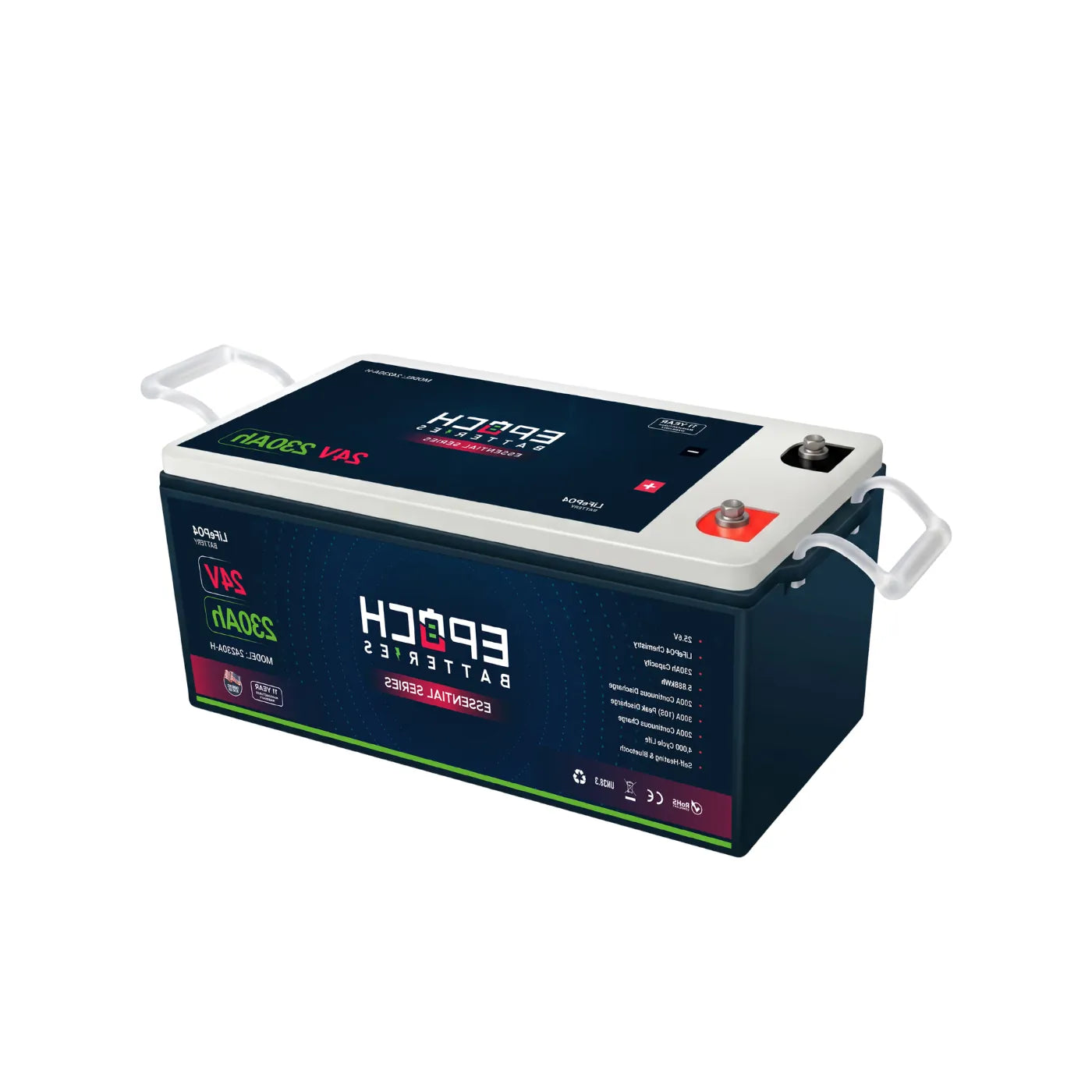
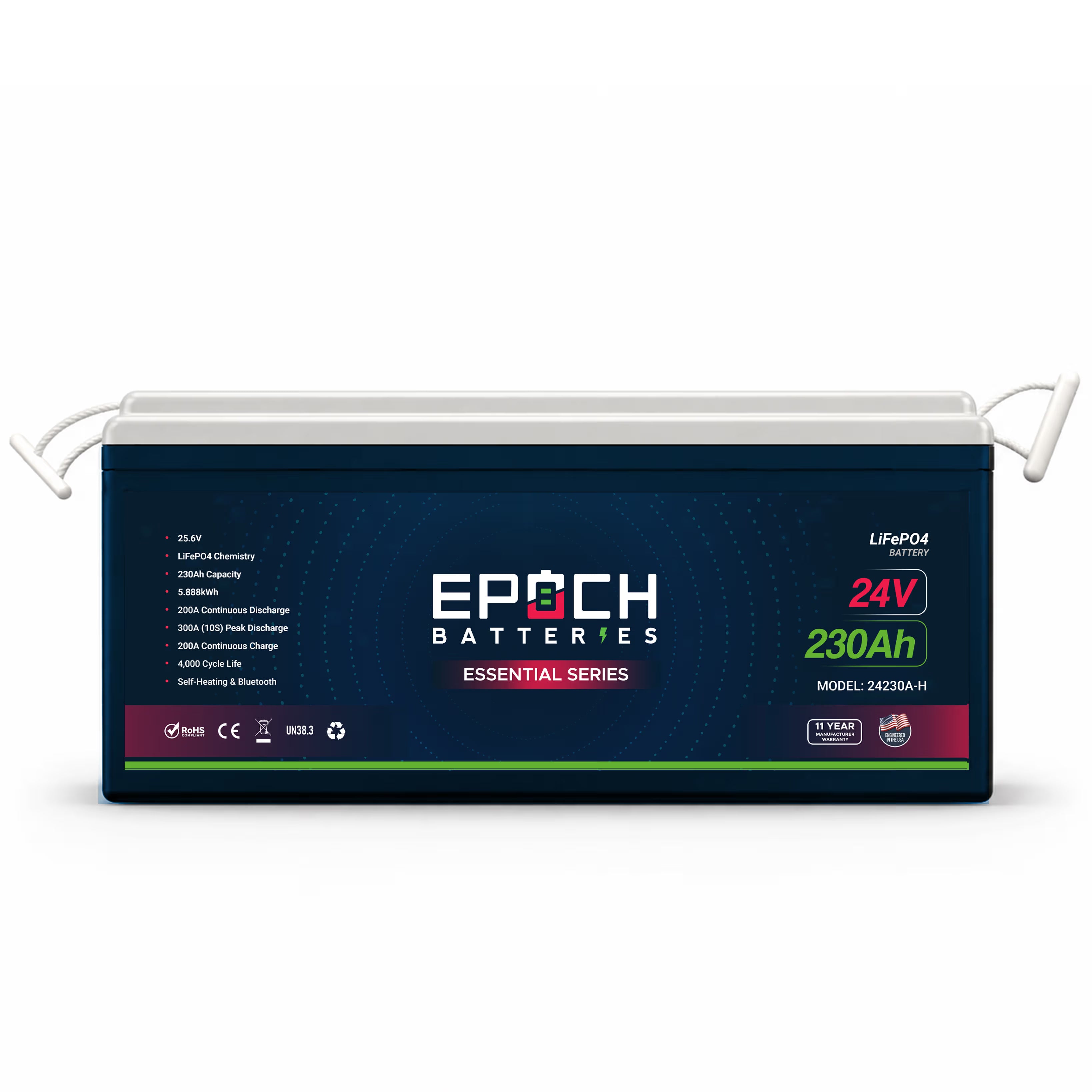
Running a 24V trolling motor or building a 24V house system usually means stacking two 12V batteries in series, twice the weight, twice the terminals, and a series link that can fail. The Epoch 24V 230Ah Essential Series (model 24230A-H) replaces that pair with one native 24V lithium battery, so you get cleaner wiring, less weight, and a deep 5.89kWh reserve in a single Group 8D case.
For anglers, that means long runtime for 24V trolling motors and spot-lock fishing, plus enough capacity to run electronics, livewells, and marine house loads from the same bank. For RV, van, and off-grid builders, it delivers dependable 24V power for inverters, solar charging, and extended boondocking, with a simple path to add capacity later by wiring batteries in parallel.
This is a heated, Bluetooth-monitored LiFePO4 deep-cycle battery. Internal self-heating supports charging in cold conditions, the Epoch Li-Ion app shows state of charge and battery health from your phone, and an advanced BMS protects against overcharge, over-discharge, over-current, short circuit, and temperature extremes. With a 200A continuous discharge rating, 4,000+ cycle life, an IP54 weather-resistant enclosure, and an 11-year manufacturer warranty, it is built for marine, RV, solar, off-grid, backup, and mobile 24V energy systems.
Note: this is a deep-cycle battery for house power and auxiliary storage, not for engine cranking unless Epoch confirms compatibility.
Key Features
Here is what each feature actually does for your day on the water or off the grid:
-
Fewer batteries to lift, charge, and worry about. One native 24V battery replaces two 12V batteries wired in series, so you free up compartment space, drop weight in the bow, and have a single battery to top off at the dock or campsite instead of two. (Group 8D footprint, 84 lb.)
-
Run your trolling motor and your electronics from the same bank. 5.89kWh (230Ah) of fully usable lithium energy is a deep reserve for longer days trolling, spot-locking, or boondocking with capacity to spare for graphs, livewells, lights, and inverters. (230Ah, 100% usable LiFePO4.)
-
Steady power that holds up late in the trip. LiFePO4 keeps its voltage more consistent under load than lead-acid, so your motor keeps its punch and onboard electronics stay stable deep into the day, not just off a fresh charge. (Flat LiFePO4 discharge curve.)
-
Charge with confidence when it is cold. Internal self-heating warms the cells before charging in freezing conditions, so winter RVers and early-season boaters are not stuck with a bank that will not take a charge on a cold morning. (Charge to -20°C with self-heating; heating within specified range and compatible chargers.)
-
Power big loads without stacking batteries. A 200A continuous rating roughly 4,800W, about 5,120W at 25.6V nominal, lets a single battery anchor many 3,000–4,000W 24V inverter systems when the wiring and fusing are properly designed. (200A continuous / 300A 10-sec peak.)
-
Know exactly where you stand before you leave. Built-in Bluetooth and the Epoch Li-Ion app show charge level, voltage, current, and temperature on your phone, so you can check the bank before the dock or the trailhead, no extra shunt or monitor to install. (Bluetooth, iOS & Android.)
-
Set it and forget the maintenance. The advanced BMS guards against overcharge, over-discharge, over-current, short circuit, and temperature extremes, and 4,000+ cycles of LiFePO4 service replace the routine upkeep and short life of lead-acid. (Smart BMS, 4,000+ cycles.)
-
Start with one, grow when your loads grow. Wire identical batteries in parallel later for 460Ah or 690Ah without rebuilding your system, so your bank scales with your needs instead of forcing you to overbuy up front. (Parallel-expandable, per Epoch guidance.)
-
Built for real marine and RV bays, and covered for the long haul. An IP54 dust- and splash-resistant enclosure handles protected marine compartments and RV battery bays (not submersion), backed by an 11-year manufacturer warranty. (IP54, 11-year warranty.)
Applications & Compatibility
This battery is designed for 24V deep-cycle and house-power service. Use the lists below to check whether it fits your setup.
Recommended applications
- 24V trolling motor systems where the motor's current requirements match the battery ratings
- Marine house-power banks for electronics, navigation, pumps, lighting, refrigeration, and accessories
- RV house-battery replacement projects moving from lead-acid to a 24V LiFePO4 platform
- Camper vans, overland rigs, and mobile power systems designed around 24V DC power
- Solar, off-grid, backup, and standby systems using compatible 24V lithium charging equipment
Common uses
- All-day 24V trolling and spot-lock fishing where draw stays high in wind and current
- High-demand 24V inverter systems within the 200A continuous discharge rating and system protection limits
- Group 8D battery tray builds where dimensions, cable clearance, and terminal access are compatible
- Parallel battery banks for additional 24V capacity, following the Epoch manual and support guidance
Suitable for
- Boats running compatible 24V trolling motors (Minn Kota, Garmin, MotorGuide and similar)
- Marine house banks on boats and cruisers with 24V systems
- RVs, fifth wheels, travel trailers, camper vans, and overland builds on 24V
- Off-grid cabins, solar storage, and backup power systems built around 24V
Deep-cycle battery notice: this model is designed for deep-cycle 24V energy storage and house power. For engine starting or cranking, use a cranking-rated battery or confirm compatibility with Epoch first. The 300A rating is a short-duration 10-second peak only, do not design continuous loads above the 200A per-battery limit.
Charging & Installation
Use a 24V LiFePO4-compatible charger, inverter/charger, RV converter, solar charge controller, or DC-to-DC charger. Disable equalization and temperature compensation. Recommended charge settings:
Recommended 24V Charging Settings
| Bulk / absorption voltage |
28.4V – 28.8V |
| Absorption end |
Current ≤ C/20, or 15 minutes max |
| Float |
Disabled preferred, or 26.6V – 27.2V |
| Re-bulk |
26.4V |
| Equalization |
Disabled |
| Temperature compensation |
None / 0 mV per °C |
| Recommended max charge current |
100A (200A battery rating) |
| BMS high-voltage cutoff |
29.2V |
Before installing, confirm tray dimensions, cable clearance, terminal torque, fuse ratings, charger compatibility, inverter settings, alternator charging strategy, and system current requirements. Install fuses or breakers close to the battery positive terminal and secure the battery upright in a dry, ventilated, accessible location.
Do not mix different battery models, capacities, ages, chemistries, or states of charge in the same bank. Charge only with compatible LiFePO4 equipment, and stop use if you notice abnormal heat, odor, swelling, damage, or repeated BMS disconnects.
Specifications
Core Specifications
| Model / SKU |
24230A-H |
| Series |
Essential Series |
| Battery type |
Heated Bluetooth deep-cycle LiFePO4 |
| System voltage |
24V platform / 25.6V nominal |
| Nominal capacity |
230Ah @ 0.2C |
| Nominal energy |
5.89kWh |
| Operating voltage range |
20.0V – 29.2V |
| Max charge voltage |
29.2V |
| Max continuous discharge |
200A |
| Peak discharge |
300A @ 10 seconds |
| Max charge current rating |
200A |
| Recommended max charge |
100A |
| Cell configuration |
8S1P prismatic LiFePO4 |
| Bluetooth / heating |
Yes / Yes |
| Cycle life |
4,000+ cycles |
Mechanical & Environmental
| Dimensions |
20.55 in L × 9.45 in W × 8.60 in H |
| Metric approx. |
52.20 cm L × 24.00 cm W × 21.84 cm H |
| Weight |
84 lb / 38.10 kg |
| Group size |
Group 8D footprint |
| Terminal |
M8 female (verify supplied torque) |
| Case material |
Battery-grade ABS/PC housing |
| IP rating |
IP54 (dust-protected, splash-resistant; not submersible) |
| Charge temperature |
-20°C to 55°C with self-heating |
| Discharge temperature |
-20°C to 60°C |
| Storage temperature |
0°C to 35°C recommended |
| Communication |
Bluetooth (Epoch Li-Ion app, iOS & Android) |
| Certifications |
CE, RoHS, UN 38.3 |
| Warranty |
11-year manufacturer warranty |
Frequently Asked Questions