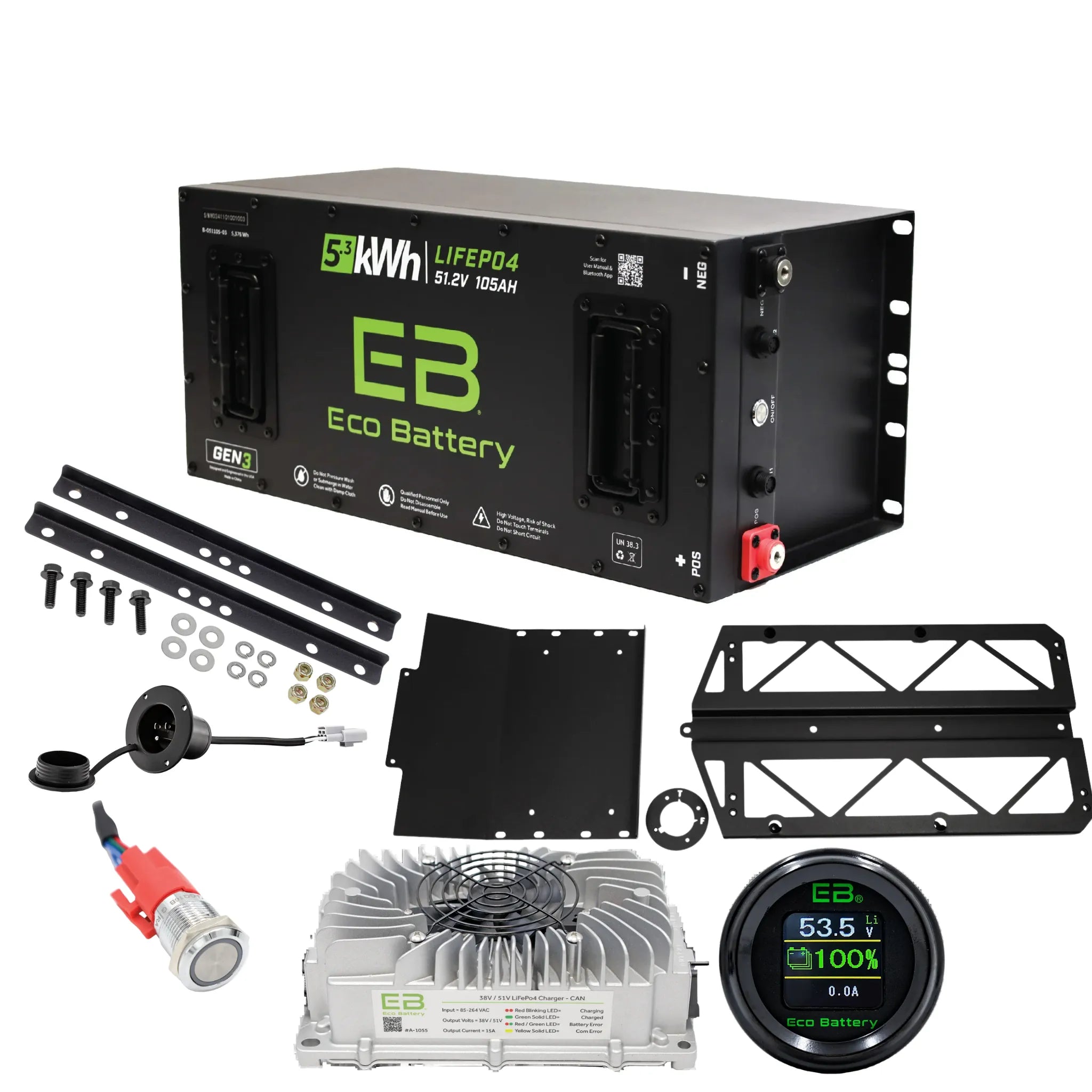
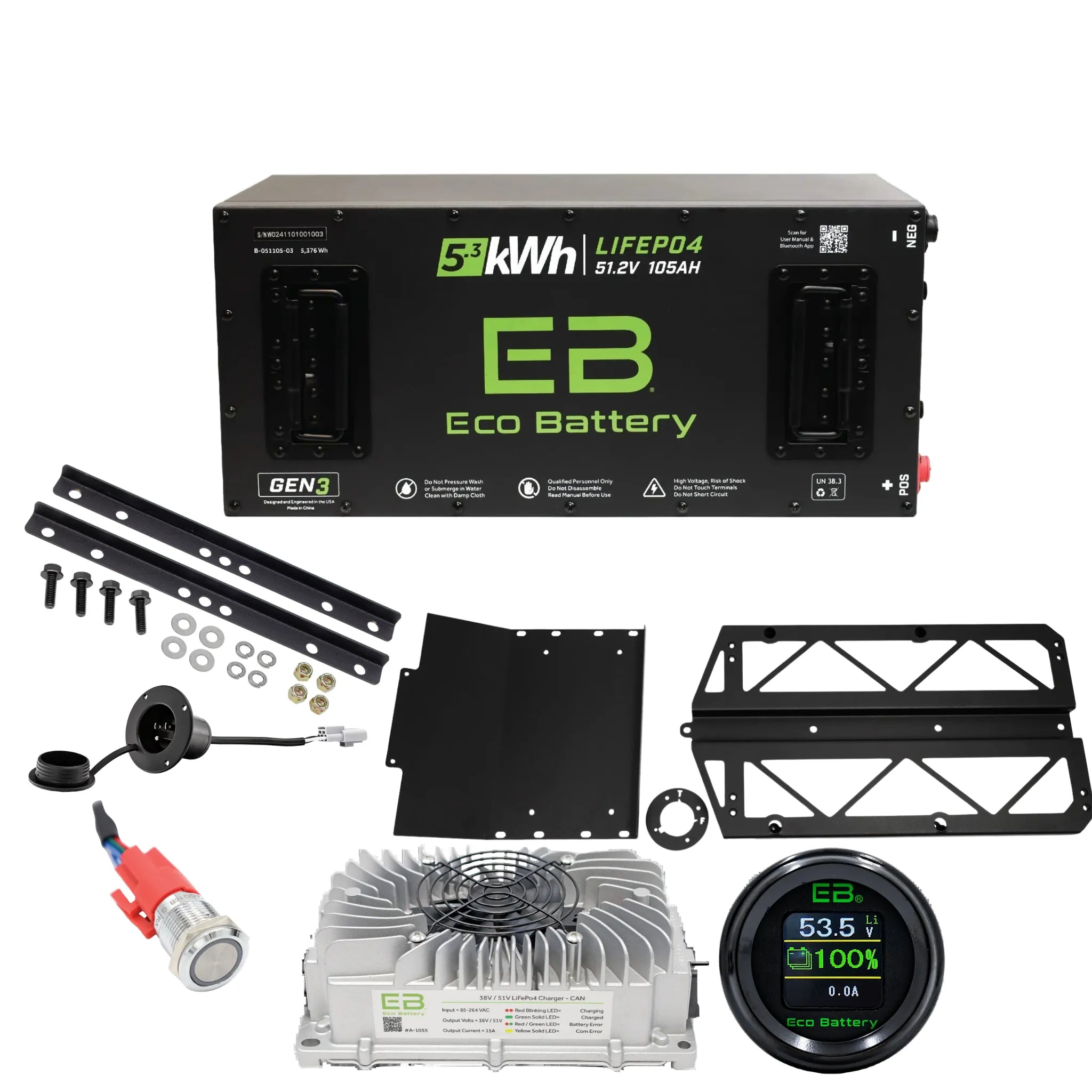
The Eco Battery GEN3 48V (51.2V) Lithium Conversion Kit is a complete drop-in replacement for the factory lead-acid battery pack in a Polaris Ranger EV. It is manufactured by ECO Capital of Saint George, Utah, and sold here by Lithium Battery Supply, an authorized Eco Battery Dealer. One lithium battery replaces all eight factory batteries, and the kit includes everything needed for the conversion: a matched 15A CAN charger, an LCD state-of-charge meter, a quick-connect charge port, Polaris Ranger EV-specific mounting hardware, and a remote wake-up button.
This page covers all three GEN3 capacities available for the Polaris Ranger EV: 105Ah Skinny , 150Ah , and 160Ah . All three are 51.2V nominal, fully compatible with the Ranger EV's 48V system, and all three share the same GEN3 Battery Management System rated at 250A continuous and 600A peak discharge, which is what the Ranger EV's 30HP AC motor requires. Select your capacity above, or see the "Choose Your Capacity" tab for guidance.
Here is what actually changes the day after you install it:
Your Ranger loses 485 to 585 lbs of dead weight. You feel it immediately in acceleration, braking, and handling.
Hills you used to crawl up, you climb without slowing down.
The Ranger runs at full power on mile 40 the same as mile 1. No fade, no slowdown as the charge drops.
You pull into the barn, plug in one cable, and walk away. No watering, no terminal cleaning, no equalization charges.
You stop buying a new set of eight batteries every 3 to 5 years.
Your phone shows exactly how much charge is left, instead of a factory gauge that was calibrated for lead acid and reads wrong on lithium.
Who this is for: owners who run a Polaris Ranger EV on a farm, ranch, hunting property, vineyard, orchard, or large acreage, and who are tired of maintaining, replacing, and hauling around 700 lbs of lead-acid batteries. The 250A continuous and 600A peak discharge ratings handle hill climbs, mud, 4WD, and trailer towing within Polaris payload limits without BMS shutdowns.
Every component is Polaris Ranger EV-specific. No charger reprogramming, no Sevcon controller modification, no fabrication, and no additional 48V-to-12V converter required. The battery is backed by Eco Battery's Limited Lifetime warranty when registered within 60 days of purchase.
Quick Facts
A summary of the Eco Battery GEN3 48V (51.2V) Lithium Conversion Kits for Polaris Ranger EV:
Product: Eco Battery GEN3 48V (51.2V) Lithium Conversion Kit for Polaris Ranger EV
Capacities Available: 105Ah Skinny, 150Ah, 160Ah
Bundle SKUs: B-3171 (105Ah Skinny), B-3180 (150Ah), B-3175 (160Ah)
Battery SKUs: A-051105-03 (105Ah Skinny), A-051150-06 (150Ah), A-051160-06 (160Ah)
Vehicle Compatibility: Polaris Ranger EV 2010 through 2022, Mid-Size and 2-Seat, lead-acid and factory Li-Ion variants
Battery Type: Lithium Iron Phosphate (LiFePO4), 51.2V nominal, Grade A prismatic cells
Energy: 5,376Wh (105Ah), 7,680Wh (150Ah), 8,192Wh (160Ah)
Continuous Discharge: 250A on all three capacities
Peak Discharge: 600A for 5 seconds, 550A for 10 seconds
Charger Included: Eco Battery 38V-51V 15A CAN Charger (A-1055)
Battery Weight: 113 lbs (105Ah), 165 lbs (150Ah and 160Ah)
Weight Savings vs Lead Acid: Approximately 485 to 585 lbs depending on capacity
Dimensions: 22" x 9.75" x 10.43" (105Ah Skinny), 22" x 12.125" x 10.625" (150Ah and 160Ah)
IP Rating: IP67, powder-coated steel case
Communication: CAN bus and Bluetooth via the Eco Battery mobile app
Charging Temperature Range: 32°F to 130°F, with automatic freeze protection below 32°F
Discharge Temperature Range: -20°F to 140°F (105Ah), -4°F to 140°F (150Ah and 160Ah)
Certifications: UN38.3 transport, UL1642 cell level
Warranty: Limited Lifetime, requires registration at ecobattery.com within 60 days of purchase
Manufacturer: Eco Battery by ECO Capital, Saint George, Utah
Shipping: Freight delivery to the contiguous United States only
Choose Your Capacity
All three GEN3 capacities use the same Battery Management System, the same 250A continuous and 600A peak discharge ratings, and the same Polaris Ranger EV mounting kit. The differences are energy capacity, range, weight, physical width, and cold-weather discharge range.
Kit
Energy
Range
Weight
Best For
B-3171
5,376Wh
Up to 45 miles*
113 lbs
Weekend hunting, light farm work, properties under 15 miles daily
B-3180
7,680Wh
Up to 60 miles*
165 lbs
Daily farm and ranch use, regular towing and hauling
B-3175
8,192Wh
Up to 65 miles*
165 lbs
Maximum range, heavy daily duty cycles, hilly terrain, high-mileage routes
*Range estimates are under ideal conditions: flat terrain, single occupant, 12 to 15 mph, fully charged, 70°F. Actual range varies based on terrain, payload, speed, temperature, and driving habits. See the "Range and Performance" tab for real-world figures by use case.
Points to consider before selecting:
Battery bay width. The 105Ah Skinny is 9.75 inches wide. The 150Ah and 160Ah are both 12.125 inches wide. All three are 22 inches long. Verify your bay clearance before ordering.
Cold weather discharge. The 105Ah Skinny operates down to -20°F. The 150Ah and 160Ah operate down to -4°F. If you regularly drive in sub-zero conditions, the 105Ah has the wider operating window.
150Ah versus 160Ah. These two batteries share the same physical footprint, the same 165 lb weight, and the same BMS. The 160Ah carries approximately 512Wh more usable energy, which works out to roughly 5 to 8 percent more range. The 150Ah is the value choice at the same physical size.
Flange supports. The 105Ah kit ships with narrow flange supports (A-8013). The 150Ah and 160Ah kits ship with wide flange supports (A-8016). These are matched to the battery and included in the correct kit automatically.
Adding capacity later. All three capacities are parallel-connectable, up to two units maximum. Series connection is not supported.
Not sure which capacity fits your duty cycle? Contact Lithium Battery Supply at sales@lithiumbatterysupply.com or (786) 321-3526 with your typical daily mileage, terrain, and load and we will recommend the right kit.
Features and Benefits
Every Eco Battery GEN3 Polaris Ranger EV kit includes the following features, each selected for the specific demands of the Ranger EV platform:
250A Continuous Discharge, 600A Peak. The Polaris Ranger EV's 30HP three-phase AC motor draws approximately 150 to 230 amps continuously under normal driving conditions and can peak at 300 to 400 amps during acceleration, hill climbs, and towing. The 250A continuous rating handles these loads without protective shutdowns.
Roughly Double the Usable Energy. Lead-acid batteries are discharged to approximately 50 percent depth to preserve cell life. LiFePO4 cells can be discharged to roughly 90 percent depth or more, delivering substantially more usable energy from the same rated capacity.
CAN Bus Communication. The included Eco Battery CAN charger communicates directly with the battery's Battery Management System during every charge cycle. The BMS controls current, balancing, and shutoff based on real cell data rather than a fixed voltage curve.
Bluetooth Monitoring. The free Eco Battery mobile app on iOS and Android displays real-time voltage, current, individual cell voltages, internal temperatures, and state of charge.
Over-the-Air Firmware Updates. BMS firmware is delivered through the mobile app over Bluetooth. No dealer visit and no hardware return required.
Grade A LiFePO4 Prismatic Cells. Lithium iron phosphate is a thermally stable lithium chemistry. It does not enter thermal runaway the way NMC or LiPo packs can.
Smart BMS Protection. Protection against pack and cell-level overvoltage, undervoltage, overcurrent, short circuit, over-temperature, and cell imbalance. Multiple internal temperature sensors monitor cell health continuously.
Charging Freeze Protection. Charging is automatically disabled when battery temperature drops below 32°F, protecting the cells from lithium plating damage. Standard on all three capacities.
Active Cell Balancing. Cells are balanced during every charge cycle to keep the pack matched over its service life.
IP67 Sealed Steel Case. The powder-coated steel enclosure is dust-tight and protected against temporary water immersion. Built for off-road, mud, rain, and trail use.
Polaris Ranger EV-Specific Mounting Kit. The A-8172 mounting bracket and matched flange supports fit the factory battery tray without modification or fabrication.
15A CAN Charger Included. No need to send the factory Delta-Q QuiQ charger out for lithium reprogramming. The included A-1055 charger is ready to use out of the box.
Remote Wake-Up Button. Wakes the battery from protective sleep mode without opening the seat or hood. The battery also wakes automatically when the charger is connected.
Significant Weight Reduction. One lithium battery replaces the entire eight-battery factory pack, removing approximately 485 to 585 lbs from the vehicle. Acceleration, handling, and chassis wear all improve.
No Maintenance. No water refilling, no acid fumes, no terminal corrosion, and no equalization cycles. The factory lead-acid pack requires monthly water level checks.
No Memory Effect. LiFePO4 chemistry can be charged to any level at any time without affecting long-term capacity. Partial charges are fine.
Cycle Life. LiFePO4 cells are rated for 2,000 to 3,000 charge cycles at 80 percent depth of discharge, compared to approximately 300 to 500 cycles for flooded lead-acid batteries.
Silent Operation. No lead-acid equalization cycle noise. Relevant for hunting, livestock environments, and noise-sensitive properties.
Limited Lifetime Warranty. Backed by ECO Capital's US-based support team when registered within 60 days of purchase. See the Warranty tab for full details.
Fits Your Polaris Ranger EV
Every Eco Battery GEN3 kit on this page is engineered specifically for the Polaris Ranger EV platform. The A-8172 mounting kit, charge port, CAN charger, and BMS are all matched to the Ranger EV's electrical system and battery bay. The Sevcon motor controller does not require reprogramming on either the lead-acid or factory Li-Ion variant.
Compatible Polaris Ranger EV Models:
2010 Polaris Mid-Size Ranger EV
2011 Polaris Mid-Size Ranger EV
2012 Polaris Mid-Size Ranger EV
2013 Polaris Mid-Size Ranger EV
2014 Polaris Mid-Size Ranger EV
2015 Polaris Mid-Size Ranger EV
2016 Polaris 2-Seat Ranger EV (lead acid and factory Li-Ion variants)
2017 Polaris 2-Seat Ranger EV
2018 Polaris 2-Seat Ranger EV (lead acid and factory Li-Ion variants)
2019 Polaris 2-Seat Ranger EV
2020 Polaris 2-Seat Ranger EV
2021 Polaris 2-Seat Ranger EV
2022 Polaris 2-Seat Ranger EV
The included A-8172 mounting kit fits all compatible model years without modification.
Commonly Used For:
Farms and ranches with daily Ranger EV use across large acreage
Hunting clubs, food plot maintenance, and game retrieval
Vineyards, orchards, and tree farms with row-spacing constraints
Equestrian properties and barn use where quiet electric operation matters
Hilly terrain and off-road trail riding
Heavy hauling and trailer towing within Polaris payload limits
Off-grid and remote properties where lead-acid maintenance is impractical
Snow plowing and four-season utility work
Commercial and resort fleet use
Not sure which model year you have, or whether your Ranger EV is the lead-acid or factory Li-Ion variant? Send us your year and VIN and we will confirm fitment before you order. Lithium Battery Supply is an authorized Eco Battery reseller.
What's Included
Every component needed to convert a Polaris Ranger EV from lead-acid to lithium is in the box. There are no additional parts to source, no charger to reprogram, and no controller to ship out for modification.
Kit Contents | B-3171 (105Ah Skinny)
Part Number
Item
A-051105-03
51.2V 105Ah Skinny LiFePO4 Battery GEN3
A-1055
38V-51V 15A CAN Charger
A-3102
LCD State of Charge Meter
A-4012
Eco Battery Charge Port, 110V Quick Connect Plug
A-8013
Battery Flange Supports, Narrow
A-8172
Eco Battery Mounting Kit, Polaris Ranger EV Specific
A-4220
Remote Button Battery Wake Up Kit
Kit Contents | B-3180 (150Ah) and B-3175 (160Ah)
Part Number
Item
A-051150-06 or A-051160-06
51.2V 150Ah or 160Ah LiFePO4 Battery GEN3
A-1055
38V-51V 15A CAN Charger
A-3102
LCD State of Charge Meter
A-4012
Eco Battery Charge Port, 110V Quick Connect Plug
A-8016
Battery Flange Supports, Wide
A-8172
Eco Battery Mounting Kit, Polaris Ranger EV Specific
A-4220
Remote Button Battery Wake Up Kit
Also included: a step-by-step Polaris Ranger EV installation guide from Eco Battery covering wiring, mounting, and the 2015 and newer ground-jump procedure.
Note: A 48V-to-12V DC converter is not included in any of these kits. The Polaris Ranger EV has a factory Sevcon DC-DC converter that already powers 12V accessories. If your configuration requires an external DC converter, it is available separately.
Specifications
All specifications are sourced from official Eco Battery GEN3 data sheets, part numbers 051105-03 (105Ah Skinny), 051150-06 (150Ah), and 051160-06 (160Ah).
General
Specification
105Ah Skinny
150Ah
160Ah
Manufacturer
Eco Battery
Eco Battery
Eco Battery
Battery Part Number
A-051105-03
A-051150-06
A-051160-06
Bundle Part Number
B-3171
B-3180
B-3175
Nominal Voltage
51.2V
51.2V
51.2V
Compatible System Voltage
48V
48V
48V
Working Voltage
43.2V - 58.4V
43.2V - 58.4V
43.2V - 58.4V
Recommended Voltage
48.0V - 57.0V
48.0V - 57.0V
48.0V - 57.0V
Nominal Capacity
105Ah
150Ah
160Ah
Energy
5,376Wh
7,680Wh
8,192Wh
Cell Chemistry
LiFePO4, Grade A
LiFePO4, Grade A
LiFePO4, Grade A
Cell Type
Prismatic
Prismatic
Prismatic
Cell Configuration
1P16S
2P16S
2P16S
Self Discharge
Approximately 1% per month
Approximately 1% per month
Approximately 1% per month
BMS
Proprietary Eco Battery GEN3
Proprietary Eco Battery GEN3
Proprietary Eco Battery GEN3
IP Rating
IP67
IP67
IP67
Discharging
Specification
105Ah Skinny
150Ah
160Ah
Max Continuous Discharge
250A
250A
250A
Max Discharge, 5 Seconds
600A
600A
600A
Max Discharge, 10 Seconds
550A
550A
550A
Recommended Voltage Cutoff
48.0V
48.0V
48.0V
BMS Voltage Recovery
46.4V
46.4V
46.4V
Discharge Temperature Range
-20°F to 140°F
-4°F to 140°F
-4°F to 140°F
Charging
Specification
All Capacities
Auto Charger Wake-Up
Yes
Max Continuous Charge
Below 52A
Max Charge, 30 Seconds
200A
Bulk / Absorb Voltage
57.0V
Float Voltage
54.0V or Off
BMS High Voltage Cutoff
59.2V
Charging Temperature Range
32°F to 130°F
Charging Freeze Protection
Yes, automatic cutoff below 32°F
Included Charger
Eco Battery 38V-51V 15A CAN Charger (A-1055)
Physical
Specification
105Ah Skinny
150Ah
160Ah
Dimensions (L x W x H)
22" x 9.75" x 10.43"
22" x 12.125" x 10.625"
22" x 12.125" x 10.625"
Weight
113 lbs (51.25 kg)
165 lbs (74.84 kg)
165 lbs (74.84 kg)
Enclosure
Powder Coated Steel
Powder Coated Steel
Powder Coated Steel
Terminal Type
M8 Female
M8 Female
M8 Female
Terminal Torque Spec
6 ft/lbs (72 in/lbs)
6 ft/lbs (72 in/lbs)
6 ft/lbs (72 in/lbs)
Series Connectable
No
No
No
Parallel Connectable
Yes, up to 2 units
Yes, up to 2 units
Yes, up to 2 units
UN Shipping Class
UN 3480
UN 3480
UN 3480
Communication and Certifications
Specification
All Capacities
Bluetooth
Yes
CAN Communication
Yes
Mobile App
Eco Battery app for iOS and Android
Software Updates
Over-the-air via Bluetooth
UN38.3
Certified, transport safety testing
UL1642
Certified, cell level
Warranty
Limited Lifetime, registration required within 60 days
Manufacturer
ECO Capital, Saint George, Utah
Installation
The Eco Battery GEN3 conversion is designed as a drop-in upgrade for the Polaris Ranger EV. Most owners with basic mechanical skills complete the install in 3 to 5 hours. The majority of that time is spent removing the eight factory lead-acid batteries. Basic hand tools are sufficient. No rewiring and no controller reprogramming are required.
Installation Steps:
Disconnect the main positive and negative cables and remove all eight factory lead-acid batteries from the Polaris Ranger EV
Clean the battery tray and inspect cables for corrosion, replacing any compromised cables
Install the A-8172 Polaris-specific mounting bracket in the factory tray
Set the lithium battery into the bracket and secure it with the included flange supports (A-8013 narrow for 105Ah, A-8016 wide for 150Ah and 160Ah)
Connect main positive and negative cables directly to the lithium battery terminals, torqued to 6 ft/lbs
Mount the A-4012 quick-connect charge port and connect the included harness
Install the A-3102 LCD state-of-charge meter in place of the factory gauge
Wire and mount the A-4220 remote wake-up button in a convenient location
Power on the system, pair the Eco Battery app via Bluetooth, and run the recommended firmware update
Test the vehicle at low speed before full use
Polaris Ranger EV-Specific Install Notes:
Sevcon 12V Converter. The Polaris Ranger EV has its own factory Sevcon 48V-to-12V converter under the hood that powers headlights, switches, and the rear solenoid. Continue using it. No additional 12V converter is needed.
Pink Wires. The two small pink wires with 2A fuses that previously tapped 12V off the lead-acid pack should be capped and zip-tied out of the way. They powered the lead-acid charge indicator only and are not needed with the new LCD gauge.
2015 and Newer Rangers. Once the factory Delta-Q charger is removed, 2015 and newer Polaris Ranger EVs will not run unless the two ground wires inside the factory charger's molex connector are jumped. The installation guide covers this step.
Pilot Car Upgrades. If your Ranger has a Pilot Car aftermarket upgrade, contact Pilot Car for cart-side programming to match the Eco Battery profile.
Factory Lithium Variants. These kits are also compatible as a direct replacement for the factory Polaris Li-Ion pack on 2016 and 2018 through 2021 model years, without controller reprogramming.
Firmware. Eco Battery recommends downloading the mobile app and installing the latest firmware update during initial installation.
A full Polaris Ranger EV installation PDF is available from Eco Battery. Contact Lithium Battery Supply at sales@lithiumbatterysupply.com or (786) 321-3526 and we will email it before you order.
Charger and BMS
Every kit includes the A-1055 38V to 51V 15A CAN charger, matched to the GEN3 battery. The charger and the battery's Battery Management System communicate over CAN bus during the entire charge cycle. The BMS tells the charger when each cell is balanced and when to taper or shut off current. If your charger is CAN-enabled, connect the CAN cable from the charger to one of the two CAN ports on the meter cable. The battery must be powered on, indicated by the illuminated power button, to accept a charge.
What You Do Not Need to Do:
Reprogram or modify the factory Polaris Delta-Q QuiQ charger
Ship the Delta-Q to Flight Systems, FSIP, or any third party for a lithium algorithm
Rent or purchase a Delta-Q programming tool
Reprogram the Sevcon motor controller
Send the controller out for any modification
BMS Protections Included:
Pack-level and cell-level overvoltage cutoff
Pack-level and cell-level undervoltage cutoff to prevent deep discharge damage
Overcurrent protection
Short-circuit protection
Cell-level over-temperature protection and BMS over-temperature cutoff
Active cell balancing during every charge cycle
Low-temperature charge lockout, preventing charging below 32°F
Sleep mode for long-term storage
Remote wake-up via button or automatic wake on charger connection
Over-the-air firmware updates through the Eco Battery Bluetooth app
LiFePO4 does not need to be topped off between uses, has no memory effect, and is not damaged by partial charges. Storing the battery at 40 to 60 percent state of charge is optimal for long-term storage.
Range and Performance
Real-world range on a Polaris Ranger EV depends on terrain, load, tire size, speed, and temperature. The figures below reflect typical results reported by Ranger EV owners running a single battery.
Expected Range by Use Case:
Conditions
105Ah
150Ah
160Ah
Stock Ranger, flat terrain, light to moderate use
30 to 45 miles
45 to 60 miles
50 to 65 miles
Mixed work use, moderate hills
25 to 35 miles
35 to 48 miles
40 to 50 miles
Hilly terrain, full bed, towing, or sustained 4WD
15 to 25 miles
23 to 38 miles
25 to 40 miles
Lifted Rangers with oversized tires typically see 15 to 25 percent less range than the figures above.
Performance Improvements vs Factory Lead-Acid:
Voltage Stability. Lithium holds steady voltage from 90 percent down to 10 percent state of charge. Hill climbs and acceleration feel the same at half charge as they do fully charged. Lead acid sags noticeably as it discharges.
Acceleration. Removing 485 to 585 lbs from the vehicle results in quicker throttle response.
Torque Under Load. The 250A continuous discharge rating delivers steady torque on hills and during towing without BMS cutbacks.
Reduced Chassis Wear. Lower total vehicle weight reduces strain on the motor, controller, suspension, and frame.
Towing and Heavy-Use Notes:
The Polaris Ranger EV is rated to tow up to 1,500 lbs. All three GEN3 capacities handle this within the published continuous and peak discharge specs.
For sustained towing on long grades, monitor cell temperatures in the Eco Battery app.
If a single battery is not enough for your duty cycle, a second identical battery can be added in parallel for roughly double the runtime. Two 105Ah units provide 210Ah (10,752Wh). Two 150Ah units provide 300Ah (15,360Wh). Two 160Ah units provide 320Ah (16,384Wh). Contact Lithium Battery Supply to spec a dual-battery configuration.
Cold Weather Performance
LiFePO4 batteries discharge reliably in cold weather but should not be charged below freezing. All three GEN3 capacities charge between 32°F and 130°F. The 105Ah Skinny discharges down to -20°F. The 150Ah and 160Ah discharge down to -4°F.
Cold Weather Best Practices for Polaris Ranger EV Owners:
Charge the battery as soon as you finish using it, while the cells are still warm internally from operation
For overnight charging below freezing, store the Ranger in a garage that stays above 32°F
The BMS automatically prevents charging when the battery is below freezing, protecting the cells from lithium plating damage. Charging resumes automatically once the battery warms above 32°F
Discharge performance gradually softens below 50°F but the battery remains fully functional to its rated minimum
For regular sub-zero driving, the 105Ah Skinny has the wider discharge window at -20°F
For sub-freezing storage and outdoor charging, a heated GEN3 configuration is recommended
About Heated GEN3 Batteries: Heated versions of these batteries have integrated self-heating hardware. When the charger is plugged in and the battery temperature is below approximately 32°F, the BMS automatically activates internal heaters. Once the cells warm above freezing, normal charging begins. Heating runs only while the charger is connected. Contact Lithium Battery Supply if you need a heated configuration for your Polaris Ranger EV and we will confirm availability and lead time.
How It Compares
Eco Battery GEN3 vs Standard Golf Cart Lithium Batteries
The Eco Battery GEN3 uses the same LiFePO4 cell chemistry found in golf cart batteries, but the BMS specifications are different. A standard golf cart motor draws approximately 30 to 100A continuously. The Polaris Ranger EV motor draws 150 to 230A continuously and up to 400A at peak. Golf cart batteries with a BMS rated at 175A continuous or lower will trigger protective shutdowns under Ranger EV loads. The GEN3 BMS is rated at 250A continuous and 600A peak, and the kit includes a Polaris Ranger EV-specific mounting bracket rather than a generic golf cart tray.
Eco Battery GEN3 vs Four 12V Drop-In Lithium Batteries
BMS Coordination. Four 12V drop-ins each have their own BMS, and those BMS units do not communicate with each other. Under heavy Polaris Ranger EV load, the weakest BMS shuts down first and stops the vehicle. The GEN3 uses a single BMS sized for the application.
Continuous Current Rating. Most consumer-grade 12V drop-ins are rated 100A to 200A continuous, which is below what the Ranger EV draws under load. The GEN3 is rated 250A continuous.
Fitment. Drop-ins require fabricated brackets to fit the Polaris tray. The GEN3 bundle includes the A-8172 Polaris-specific mount.
Warranty. Eco Battery provides a Limited Lifetime warranty backed by US support. Most drop-ins carry shorter warranties or none at all.
Eco Battery GEN3 vs Factory Polaris Lead-Acid Pack
Usable Capacity. Lithium delivers roughly twice the usable energy because depth of discharge is approximately 90 percent or more, versus roughly 50 percent for lead acid.
Weight. 113 to 165 lbs versus approximately 650 to 700 lbs for the eight-battery factory pack.
Maintenance. Zero, versus monthly watering, terminal cleaning, and equalizing.
Cycle Life. 2,000 to 3,000 cycles at 80 percent depth of discharge, versus approximately 300 to 500 cycles for flooded lead acid.
Voltage Sag. Lithium holds steady voltage from 90 percent to 10 percent state of charge. Lead acid sags noticeably as it discharges, reducing performance late in a charge cycle.
Storage. Lithium can sit for months with roughly 1 percent self-discharge per month. Lead acid sulfates when stored discharged.
Eco Battery GEN3 vs Factory Polaris Li-Ion Replacement
The factory lithium-ion pack in the 2016 through 2021 Polaris Ranger EV Li-Ion degrades over time. Replacement through Polaris dealers is typically more expensive than a third-party lithium conversion kit. The Eco Battery GEN3 kit is compatible with the factory Li-Ion controller variant without reprogramming and includes a Limited Lifetime Warranty with US-based support from ECO Capital.
FAQs
Which capacity should I choose: 105Ah, 150Ah, or 160Ah?
All three share the same BMS and the same 250A continuous, 600A peak discharge ratings. The 105Ah Skinny holds 5,376Wh, weighs 113 lbs, is 9.75 inches wide, and suits weekend hunting, light farm work, and properties under 15 miles of daily driving. The 150Ah holds 7,680Wh and the 160Ah holds 8,192Wh. Both weigh 165 lbs, are 12.125 inches wide, and suit daily farm and ranch use, regular towing, and high-mileage routes.
Between the 150Ah and 160Ah, the physical size, weight, and BMS are identical. The 160Ah carries approximately 512Wh more energy, or roughly 5 to 8 percent more range. The 150Ah is the value option at the same footprint.
How much range can I expect in a Polaris Ranger EV?
On a stock Ranger with light to moderate use on flat terrain: approximately 30 to 45 miles on the 105Ah, 45 to 60 miles on the 150Ah, and 50 to 65 miles on the 160Ah. In mixed work conditions with moderate hills, expect roughly 25 to 35 miles (105Ah), 35 to 48 miles (150Ah), and 40 to 50 miles (160Ah). In hilly terrain, mud, or with a fully loaded bed, expect 15 to 25 miles (105Ah), 23 to 38 miles (150Ah), and 25 to 40 miles (160Ah). Lifted Rangers with oversized tires typically see 15 to 25 percent less than these figures.