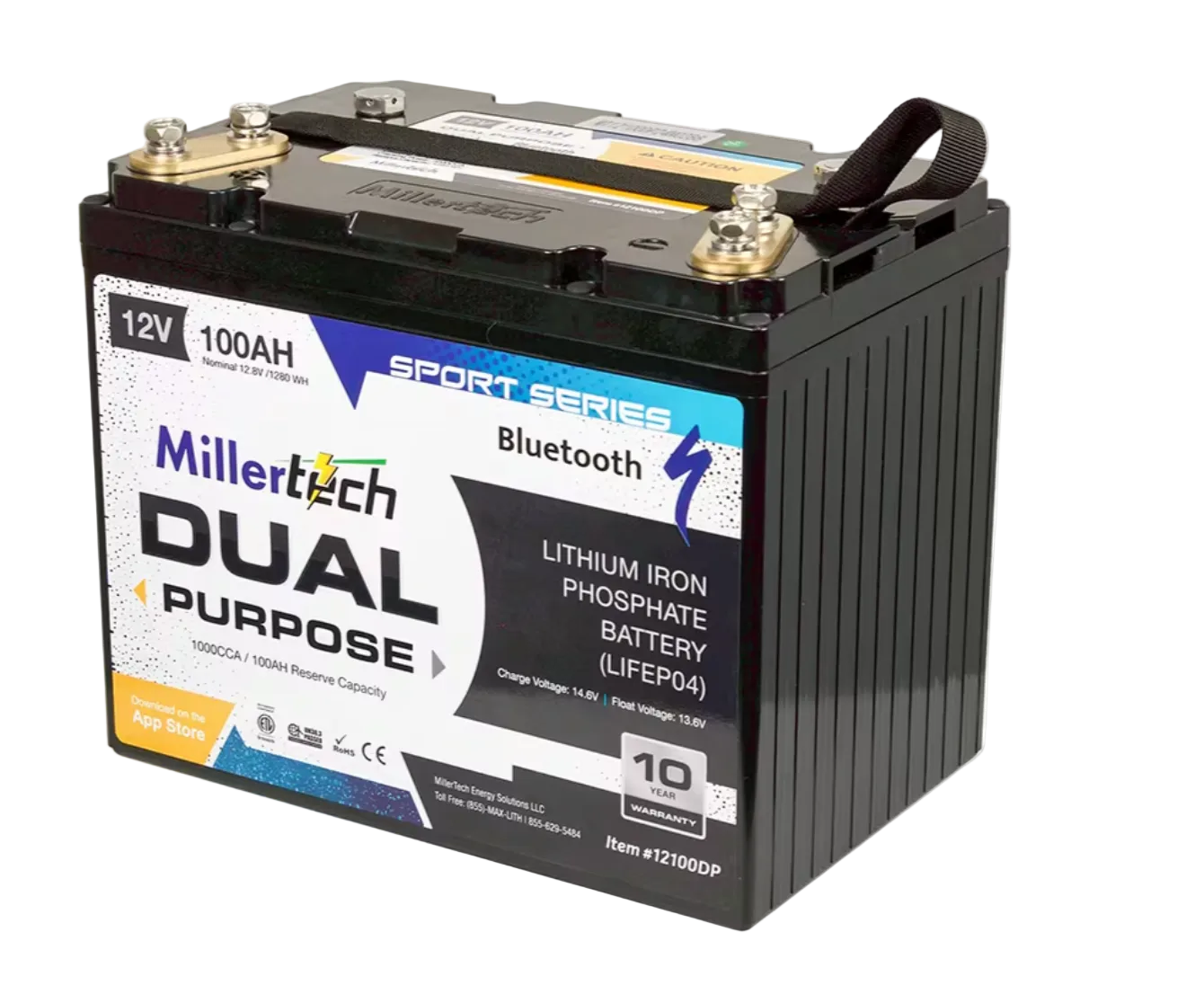
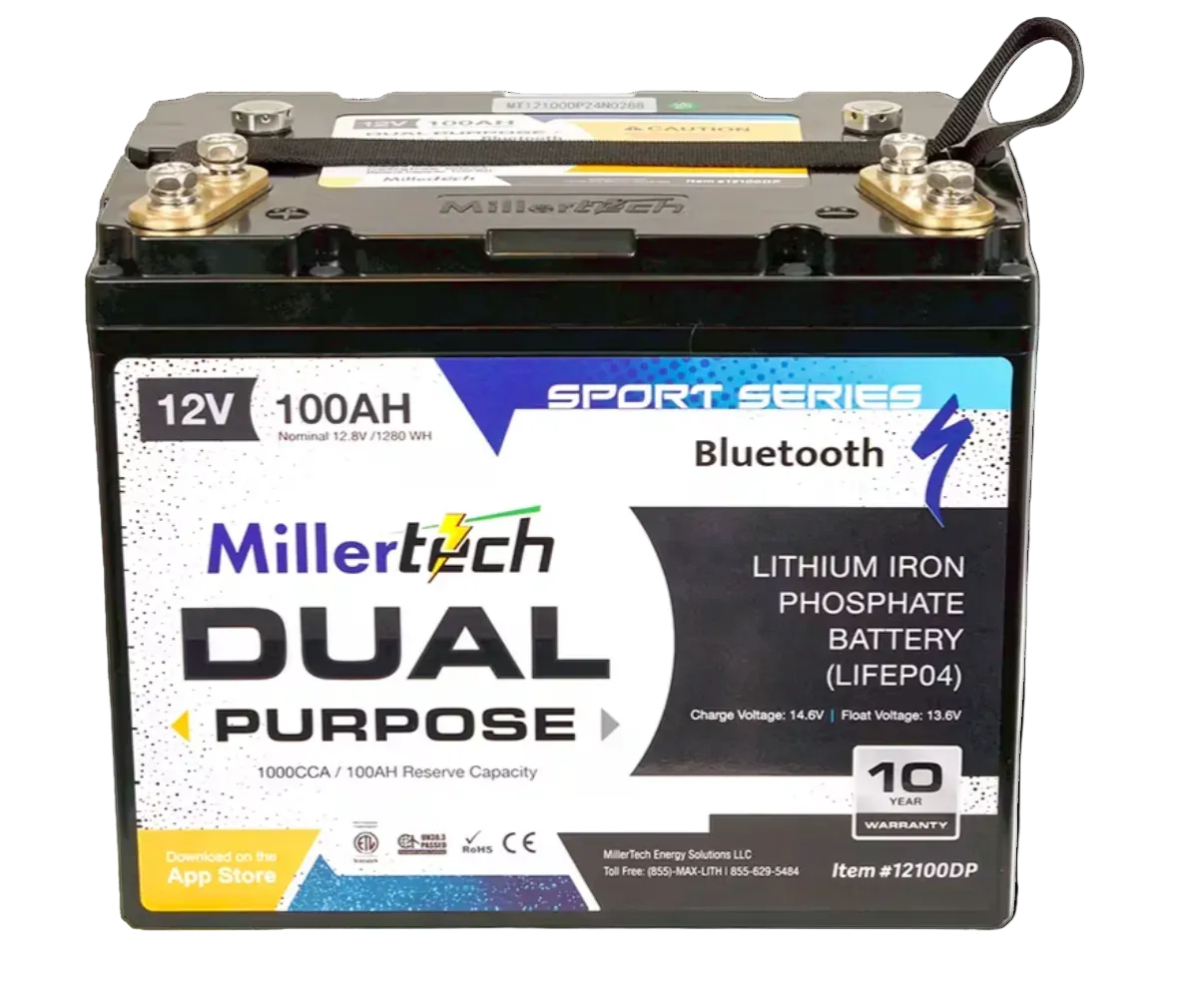
The Millertech 12V 100Ah Dual Purpose is a LiFePO4 (lithium iron phosphate) battery built to do two jobs from a single Group 24 box: deliver the high burst of current needed to start your outboard , and provide the steady, stable deep-cycle energy that today's electronics-heavy boats demand. It carries a 1000 CCA cranking rating and 100Ah of storage, with a Battery Management System (BMS) that handles over-charge, over-discharge, over-current, and temperature protection automatically.
For most bass, bay, and multi-species anglers, this is the "one battery" answer, it cranks the motor and runs the console and bow electronics off the same source, which is why owners routinely report replacing a pair of lead-acid batteries with a single Millertech and shedding weight in the process.
The 100Ah is the compact, right-sized option: a smaller Group 24 case, 1000 CCA, and a lower price than the 135Ah. If you run four or more large graphs with multiple forward-facing sonar units, the largest high-horsepower outboards, or want the longest possible day, step up to the Millertech 12V 135Ah Dual Purpose (Group 31, 1500 CCA) .
Who this battery is for
Anglers who want a single starting + electronics battery instead of separate cranking and house batteries.
Boaters running forward-facing sonar (LiveScope, Mega Live, ActiveTarget) plus multiple graphs who keep dipping their AGM too low.
Anyone cutting weight or fitting a Group 24 tray, a 31 lb lithium in a compact case.
RV, off-grid, solar, tiny-home, and golf-cart users who need a rugged 12V dual-purpose battery.
Who should look elsewhere
If your engine maker specifically prohibits lithium starting batteries and you don't want to add a DC-DC charger, a dedicated deep-cycle lithium plus an AGM cranking battery may suit you better. See the Charging & Engine Compatibility tab.
If you need a dedicated 24V or 36V trolling motor bank, use Millertech's dedicated 24V/36V trolling batteries for that job (see Trolling Motors below).
Standard vs. Heated, which variant?
This page offers two versions. The Standard (12100G24-DP) is the right choice for most boaters, especially in warm climates. The Heated (12100DPH-G24) adds smart self-heating for cold-weather charging : when it is connected to a charger and the internal temperature drops to 32°F, the heater automatically warms the battery to 34°F before charging resumes, so freezing temperatures don't stop you from topping off. Note the heater runs only while connected to a charger, it is a cold-charging feature, not a discharge warmer. If you launch, store, or charge in sub-freezing conditions, choose Heated.
Is this the right battery for you?
Choose this battery if you:
Have a Group 24 tray or tight battery space and want a compact dual-purpose lithium.
Run a lighter electronics load, one or two graphs and a forward-facing sonar unit, rather than a full four-graph tournament spread.
Want one battery to crank the motor and run your electronics on a bass, bay, or multi-species boat.
Want a lower entry price into lithium cranking, or need a dependable secondary/kicker battery.
Value Bluetooth monitoring and want to know your charge before you leave the ramp.
Step up to the 135Ah (Group 31, 1500 CCA) if you:
Run four or more large graphs and multiple forward-facing sonar units.
Crank the largest high-horsepower outboards and want maximum cranking headroom.
Fish the longest days and want the most reserve capacity possible.
Consider a different setup if you:
Need a dedicated 24V or 36V trolling motor bank use a Millertech 24V/36V trolling battery for that job.
Run an engine whose maker prohibits lithium cranking batteries and you don't want to add a DC-DC charger pair an AGM cranking battery with a lithium house battery instead.
Popular with:
Tournament bass anglers and weekend fishermen
Bay boats, multi-species, walleye, crappie, and musky rigs
Electronics-heavy boats running forward-facing sonar
RV, off-grid, solar, and tiny-home 12V systems
Why upgrade from AGM
Serious anglers move off AGM and flooded lead-acid for a handful of concrete reasons:
Voltage stays flat. Lead-acid sags as it drains, which is exactly when forward-facing sonar starts dropping out. LiFePO4 holds a stable voltage deep into the discharge, so your graphs stay lit and connected.
More usable capacity. You can safely use nearly all of a lithium battery's rated capacity, versus roughly half of a lead-acid battery, so 100Ah of lithium does the work of a much larger AGM.
Weight. At 31 lb, it is a fraction of a comparable lead-acid starting battery, and consolidating two batteries into one compounds the savings.
Faster charging and no memory effect. Charge it at any state of charge without harming capacity.
Long, maintenance-free service life. Millertech rates the Sport Series for many times the cycle life of lead-acid, backed by a 10-year warranty.
Applications & Compatibility
Common applications
Bass boats single cranking + electronics battery.
Bay boats, multi-species, and center-console rigs as a starting battery, house/electronics battery, or both.
Forward-facing sonar setups a dedicated electronics battery for FFS and networked graphs.
RV and campers dual-purpose starting and house power.
Off-grid, solar, and tiny homes, 12V storage with a rugged, sealed case.
Emergency and backup power.
Boat, engine & electronics compatibility
Boats it's commonly installed on
As a Group 24 dual-purpose battery, it drops into the standard trays used across most fishing platforms, Skeeter, Ranger, Phoenix, Bass Cat, Nitro, Triton, Caymas, Vexus, Blazer, Falcon, Xpress, SeaArk, Lund, Alumacraft, Crestliner, and Tracker among them. If you're searching for a battery for a specific hull (for example, a Ranger Z520 or a Phoenix 921), the fit comes down to your Group 24 tray and your engine's charging requirements, confirm both before ordering.
Engines
Millertech states this battery meets the cranking and charging requirements for Mercury 4-stroke outboards up to 250 hp (Pro XS, FourStroke, and Verado families), consistent with Mercury's service bulletin permitting lithium starting batteries on qualifying engines. Owners have run them since 2016.
For other brands, Yamaha (SHO, VMAX), Suzuki, Honda, Tohatsu verify with the engine manufacturer first. Several have not approved lithium cranking batteries, or require specific conditions. When in doubt, run a dedicated AGM cranking battery alongside a lithium house battery with a DC-DC charger. Always confirm against your engine's current manual before converting.
Electronics it powers
This battery supplies stable 12V power to essentially any marine electronics you can wire to it. Because LiFePO4 holds a flat voltage deep into the discharge, voltage-sensitive gear stays lit and connected far longer than on a sagging lead-acid battery. Commonly powered gear includes:
Forward-facing sonar (FFS): Garmin LiveScope (LVS34, LVS62), Humminbird MEGA Live and MEGA Live 2, Lowrance ActiveTarget and ActiveTarget 2.
Chartplotters and graphs: Garmin, Humminbird, and Lowrance multifunction displays, including networked NMEA 2000 setups.
Trolling motors (as a house/electronics source, not the trolling bank): Minn Kota Ultrex, Quest, and Ghost; Garmin Force and Force Pro; MotorGuide Tour Pro; Rhodan.
Accessories: Power-Pole shallow-water anchors, livewell and bilge pumps, aerators, lighting, stereo, and USB charging.
Electronics are electrical loads, not compatibility restrictions any 12V device can be powered. Naming a brand here does not imply endorsement by that manufacturer.
Real-World Performance
The 100Ah is sized for a full day of typical fishing electronics. Runtime depends on your exact gear, screen brightness, and pump duty cycle, but the estimates below give a realistic picture of what one battery handles. If your loads land in the "heavy" row, size up to the 135Ah.
Estimated runtime by setup
Typical setup
Approx. draw
Estimated runtime
Light: one or two 12″ graphs + one forward-facing sonar
~7-8A
~11-13 hours
Moderate: three graphs + FFS + intermittent livewell
~12-14A
~7-8 hours
Heavy: four graphs + two FFS modules + steady aerators (size up to 135Ah)
~16-18A
~5-6 hours
Estimates only, based on typical 2-3A draw per graph or forward-facing sonar module and 100Ah of capacity; engine cranking draw is negligible over a day. Real results vary with your exact electronics, backlight level, and pump duty cycle. Putting units in standby during runs extends runtime.
Good fit for the 100Ah
Single cranking + electronics battery on bass, bay, and multi-species boats running a couple of graphs and a forward-facing sonar unit.
Dedicated electronics battery that keeps voltage flat so graphs and FFS stay lit deep into the day.
Secondary or kicker starting battery , or a compact replacement where a Group 24 tray limits your options.
RV, off-grid, and solar 12V setups needing a rugged dual-purpose battery in a smaller case.
Running four or more large graphs with multiple FFS units, heavy livewell aeration all day, or the largest outboards? That is the job for the 135Ah (Group 31, 1500 CCA) it carries more reserve and more cranking headroom.
Charging & Installation
What charger should I use?
Use a lithium (LiFePO4) charger. This battery is built around a 14.6V max charge voltage, and a lead-acid or AGM charger set to higher absorption or equalization voltages can trip the BMS or stress the cells. Equalization is not recommended turn it off if your charger has it. Millertech's recommended charge current is about 25A, and the battery accepts up to 100A maximum. Matching chargers below.
Charger
Best for
Notes
12V 10A (1210C)
Overnight / light use
110V AC plug-in, most economical
12V 20A (1220C)
Same-day recharge
110V AC plug-in, roughly twice as fast
12V 20A On-Board (1220M)
Permanent boat install
IP65 waterproof, plug into shore power
12V-24V Dark Speed On-The-Run
12V + 24V systems
Charges while you run; IP65
12V-36V Dark Speed On-The-Run
12V + 36V systems
Charges while you run; IP65
2-Bank / 3-Bank On-Board (1215-2, 1215-3, 121624-3, 121636-3)
Multiple batteries at once
Isolated banks; charge start + electronics + trolling together
Can I use a NOCO or my existing onboard marine charger?
Yes, provided it has a true lithium/LiFePO4 mode. Many marine chargers (including NOCO Genius models) offer a selectable lithium profile. Avoid charging on a lead-acid-only profile with high equalization voltage.
Can I charge it from my outboard's alternator while running?
This is the most important compatibility question for a lithium starting battery, so here is the straight answer. Because lithium has low internal resistance, it can pull a high charge current, and a marine alternator running at full output for long stretches generates heat. With 1000 CCA and a 300A peak, this battery starts a wide range of outboards. Mercury has issued a service bulletin permitting lithium starting batteries on qualifying engines when the battery meets their specifications. For the largest high-horsepower outboards, or if you want maximum cranking headroom, the 135Ah (1500 CCA) is the stronger choice.
Always confirm against your own engine's manual or service bulletin before installing. Yamaha, Suzuki, and Honda have generally not approved lithium starting batteries at the time of writing; if you run one of these engines, verify with the engine manufacturer first, or run a dedicated AGM cranking battery with a lithium house battery and a DC-DC charger.
Storage and winterizing
LiFePO4 stores well. Charge it, disconnect it, and keep it in a cool, dry place; it does not need a constant trickle charge. Self-discharge is under 4% per month.
Cold weather & low-temp protection
Every version of this battery includes built-in low-temperature charging protection. The recommended charge temperature range is 25°F-131°F, and the BMS blocks charging when the battery is too cold to prevent the permanent damage (lithium plating) that occurs if a LiFePO4 cell is charged below freezing. The battery still delivers power in cold conditions, but its rated discharge range runs from -4°F to 140°F, and usable capacity drops as temperatures fall well below freezing; the low-temp protection specifically prevents charging below freezing.
The Heated (12100DPH-G24) version adds a smart heater for cold-weather charging: connected to a charger, if internal temperature drops to 32°F the heater warms the battery to 34°F, then charging resumes automatically. The heater runs only while a charger is connected. If you fish, store, or charge in freezing conditions, the Heated variant removes the guesswork.
Trolling motors (24V / 36V)
This battery is designed as a 12V cranking and house battery. For a 24V or 36V trolling motor , the cleanest setup is a dedicated Millertech 24V or 36V trolling battery sized to your motor, kept separate from the starting battery. That is how most owners run it: one Dual Purpose for the boat, a separate higher-voltage battery for the trolling motor.
Some anglers do wire two 12V 100Ah Dual Purpose batteries in series to build a 24V bank. If that is your plan, confirm the exact series/parallel configuration and limits with Millertech before wiring , and always use identical batteries (same model, capacity, and age) with proper fusing. Contact us and we'll confirm the right configuration for your motor.
Installation
Fitment. This is a true BCI Group 24 (10.23″ x 6.61″ x 8.35″) and drops into standard Group 24 trays. A matching tray is available if you need one.
Terminals. Heavy-duty M8 bolts and washers in 18-8 stainless. Torque terminal connections to 10 ft-lbs. If you are stacking multiple lugs, you may need to remove a washer or use a slightly longer bolt to fully seat into the copper pillar.
Orientation and mounting. Seat the battery in the tray and secure with hold-down straps; the case has molded strap grooves to keep straps in place.
Wiring. Use correctly sized cables and fuse/breaker protection appropriate to your loads. Connect electronics and accessories to the battery through a fused distribution point.
App. Download the Millertech Bluetooth app to monitor charge percentage, voltage, current, and temperature.
Specifications
Specification
Standard (12100G24-DP)
Heated (12100DPH-G24)
Capacity
100Ah
100Ah
Energy storage
1.28 kWh
1.28 kWh
Nominal voltage
12.8V
12.8V
Chemistry / cell type
LiFePO4 / prismatic
LiFePO4 / prismatic
Cold Cranking Amps (CCA)
1000A
1000A
Peak discharge (up to 5 sec)
300A
300A
Max continuous charge / discharge
100A
100A
Recommended charge current
25A
25A
Max charge voltage
14.6V
14.6V
Float voltage
13.4V
13.4V
Low-voltage cutoff
10V (any cell 2.5V)
10V (any cell 2.5V)
Recommended low-voltage disconnect
12.0V
12.0V
Charge temp range (low-temp protection)
25°F to 131°F
25°F to 131°F
Self-heating
No
Yes (32°F trigger on charger, warms to 34°F)
Discharge / operating temp range
-4°F to 140°F
-4°F to 140°F
Efficiency
98%
98%
Self-discharge
< 4% / month
< 4% / month
Memory effect
None
None
BMS
Yes
Yes
Bluetooth
Yes
Yes
Terminals
M8 18-8 stainless, 10 ft-lbs
M8 18-8 stainless, 10 ft-lbs
Case
Sealed IP65, rubber gasket, stainless breather vent
Sealed IP65, rubber gasket, stainless breather vent
Group size
BCI Group 24
BCI Group 24
Dimensions
10.23″ x 6.61″ x 8.35″
10.23″ x 6.61″ x 8.35″
Weight
31 lbs
31 lbs
Warranty
10 years
10 years
Specifications per Millertech published data sheets. Confirm against the current manufacturer manual for your exact SKU.
AGM vs. Millertech lithium
Typical AGM Group 24
Millertech 100Ah Dual Purpose
Usable capacity
~50% of rated
Nearly all of rated
Voltage under load
Sags as it drains
Stays flat deep into discharge
Weight
~40-45 lb
31 lb
Charge speed
Slower
Fast, no memory effect
Maintenance
Periodic
None
Monitoring
External meter
Built-in Bluetooth app
Warranty
Typically 1-4 years
10 years
Frequently Asked Questions
Choosing the right size: 100Ah vs 135Ah
What is the difference between the Millertech 100Ah and 135Ah Dual Purpose?
Both are dual-purpose LiFePO4 batteries with Bluetooth, a BMS, and a 10-year warranty. The 100Ah is a compact Group 24 case, 1000 CCA , 31 lb, at a lower price. The 135Ah is a larger Group 31 case, 1500 CCA , 33 lb, with more capacity and cranking headroom. Choose by your tray size, electronics load, and engine.
Cold weather & the Heated version
Why Buy From Us
Choosing a $900+ lithium marine battery is about more than picking specs, it's about matching the right battery to your boat, engine, electronics, and charging system, and knowing someone has your back if a question comes up. That's where we come in.
We help you choose the right battery
No two boats are set up the same way. Before you order, we can walk through your boat make and model, engine and horsepower, tray dimensions, number of displays, forward-facing sonar, trolling motor voltage, existing charger, and climate. Our goal isn't to sell you the biggest battery, it's to match the battery to your application, and to tell you plainly if a different configuration fits better.
Support before and after the sale
Reach out before ordering and we'll review your setup. We can help with choosing the right model, Standard vs. Heated, charger compatibility, Group 24 tray fitment, charging questions, basic installation guidance, product registration, and warranty support. Most questions come after installation, when you add another graph, upgrade a charger, or plan future electronics and we're here for those too.
Genuine, warranty-backed products
Every Millertech battery we sell is a genuine, current-version product with full manufacturer-backed warranty coverage and original documentation. Millertech's 10-year warranty requires no proof of purchase and covers shipping both ways.
Fast, secure shipping
Your battery ships securely packaged with tracking provided once your order is processed. Shipping is free.
Still not sure it's the right fit?
Contact us before you order and we'll review your boat, engine, charger, electronics, sonar, trolling motor, climate, and any planned upgrades, then recommend the configuration that fits your setup. We'd rather help you get the right battery than sell you the wrong one.
What's included
Millertech 12V 100Ah Dual Purpose battery (Standard or Heated variant selected)
Terminal hardware (M8 18-8 stainless bolts and washers)
Bluetooth app access (iOS and Android)
Product manual and warranty documentation