If your Polaris Ranger EV is bogging down on hills, dying before the workday is over, or eating your time with battery watering and corrosion, this Lithium Rhino 48V conversion kit replaces all eight factory lead-acid batteries with one lithium pack. It is built for Ranger EV owners who use their machine for property work, trail riding, hunting, hauling, and chores and want dependable power without the weight and upkeep of lead.
Removing the factory battery bank takes roughly 700 pounds of lead out of your Ranger. Because lithium holds steady voltage as it drains, the Ranger keeps consistent power and speed from a full charge down to nearly empty, instead of the gradual fade you get from tired lead-acid batteries.
This kit comes in two capacities so you can match it to how hard you run your Ranger:
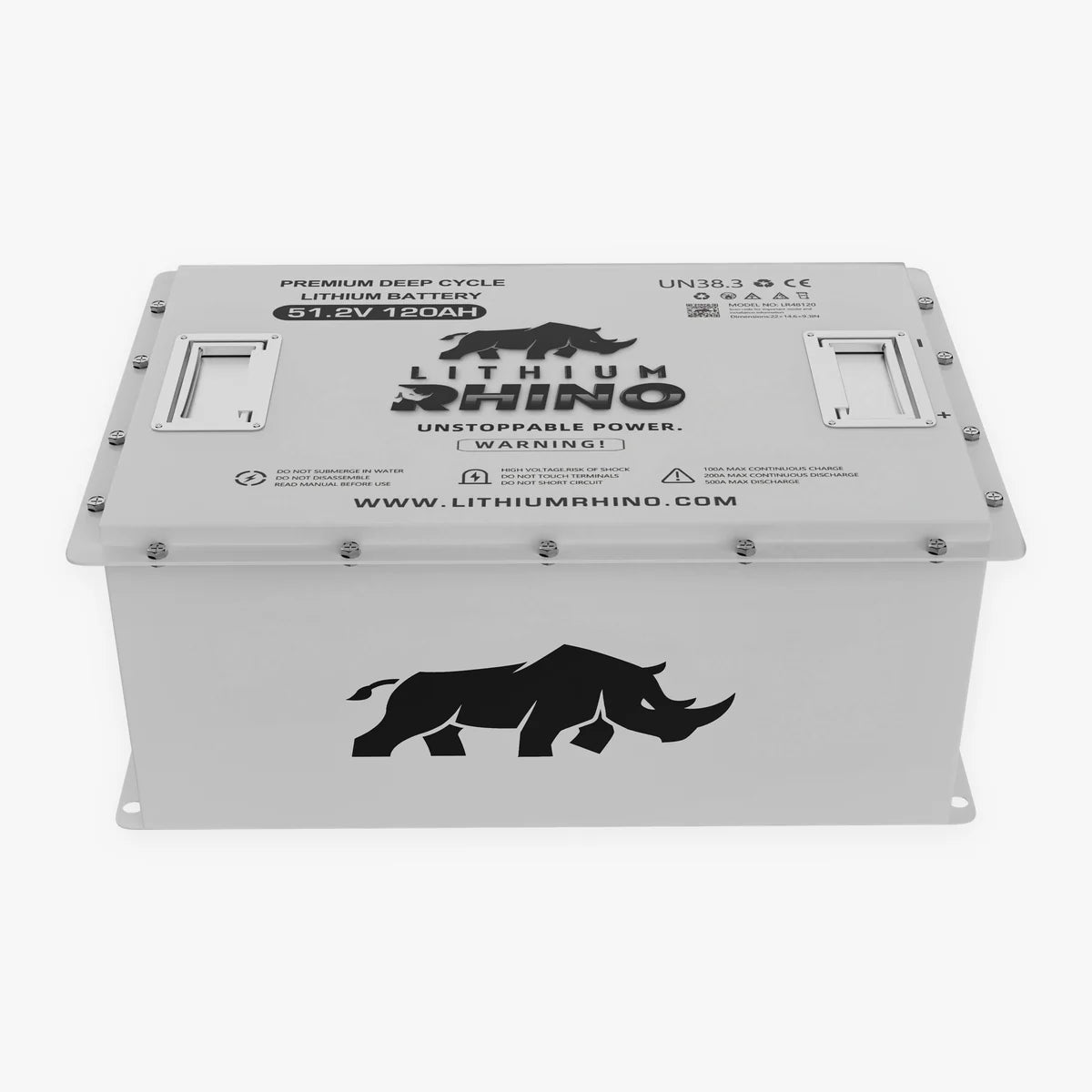
120Ah (250A / 500A BMS): the value choice for light-to-moderate duty and single-rider daily use, with roughly 40 to 50 miles of range. A Self-Heated upgrade is available for below-freezing charging.
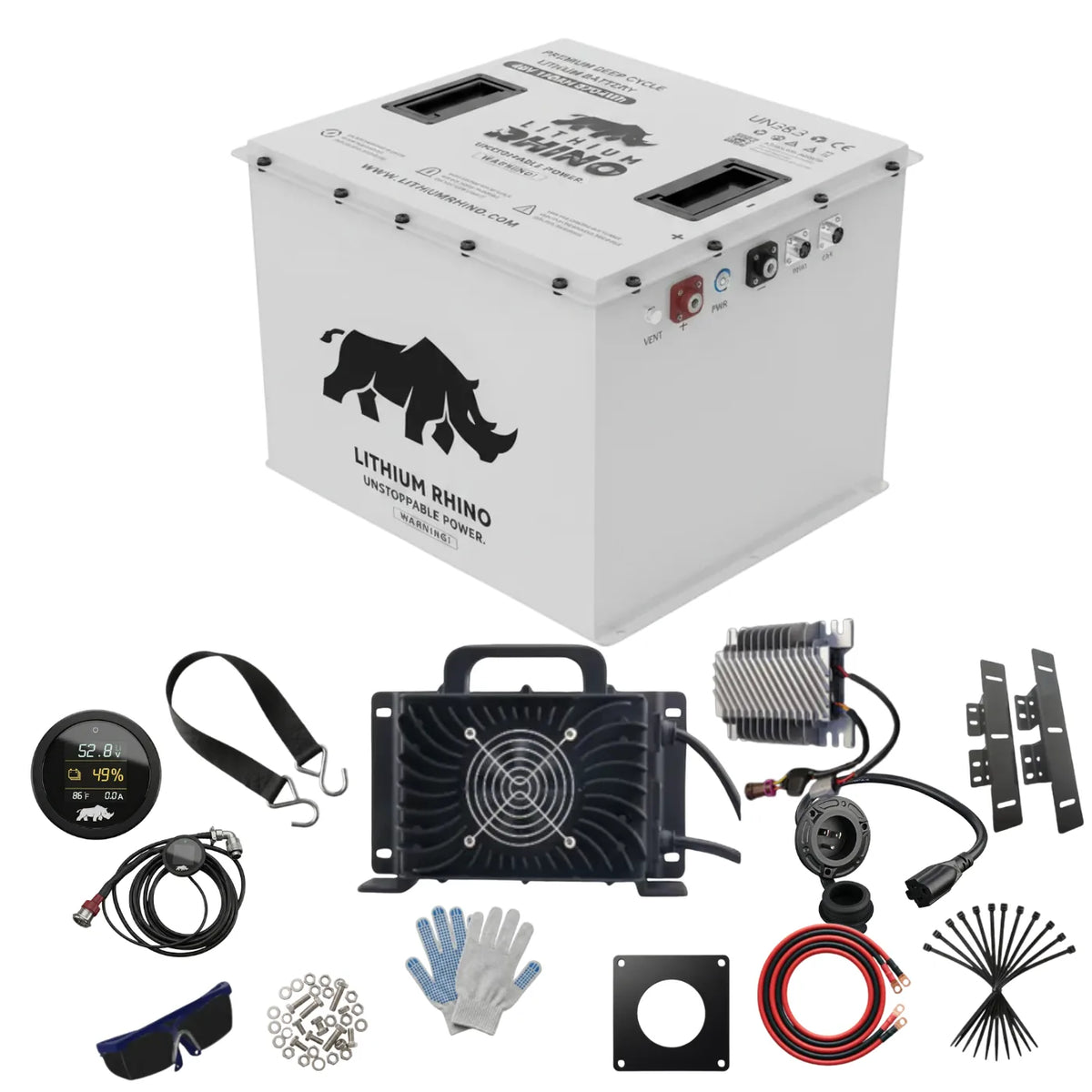
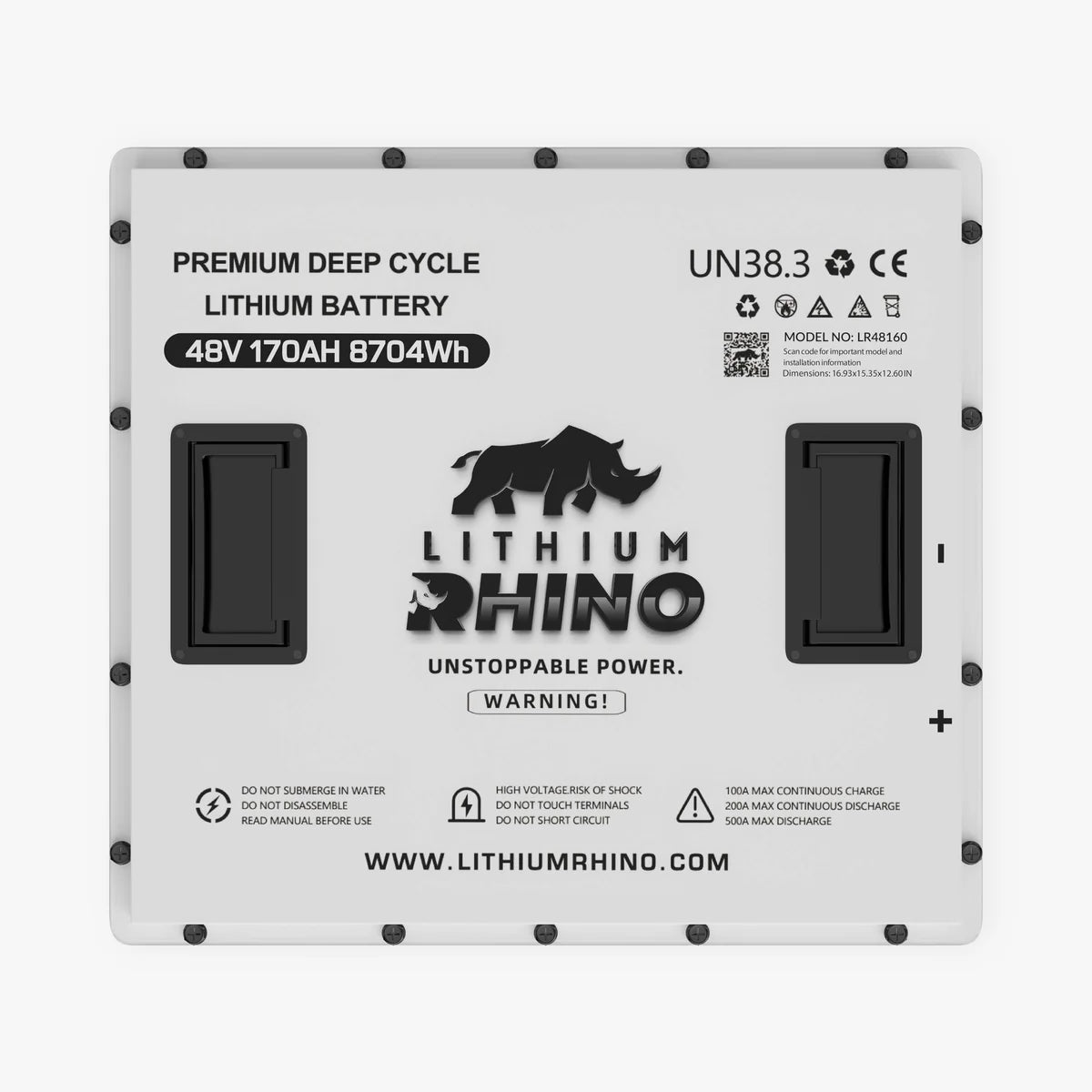
170Ah (300A / 800A BMS): the heavy-duty choice for towing, plowing, upgraded controllers, and maximum range, with an advertised range up to 74 miles. Self-heating is built in, and it adds CAN and RS485 communication ports and a round gauge that integrates with the Polaris EV factory dash.
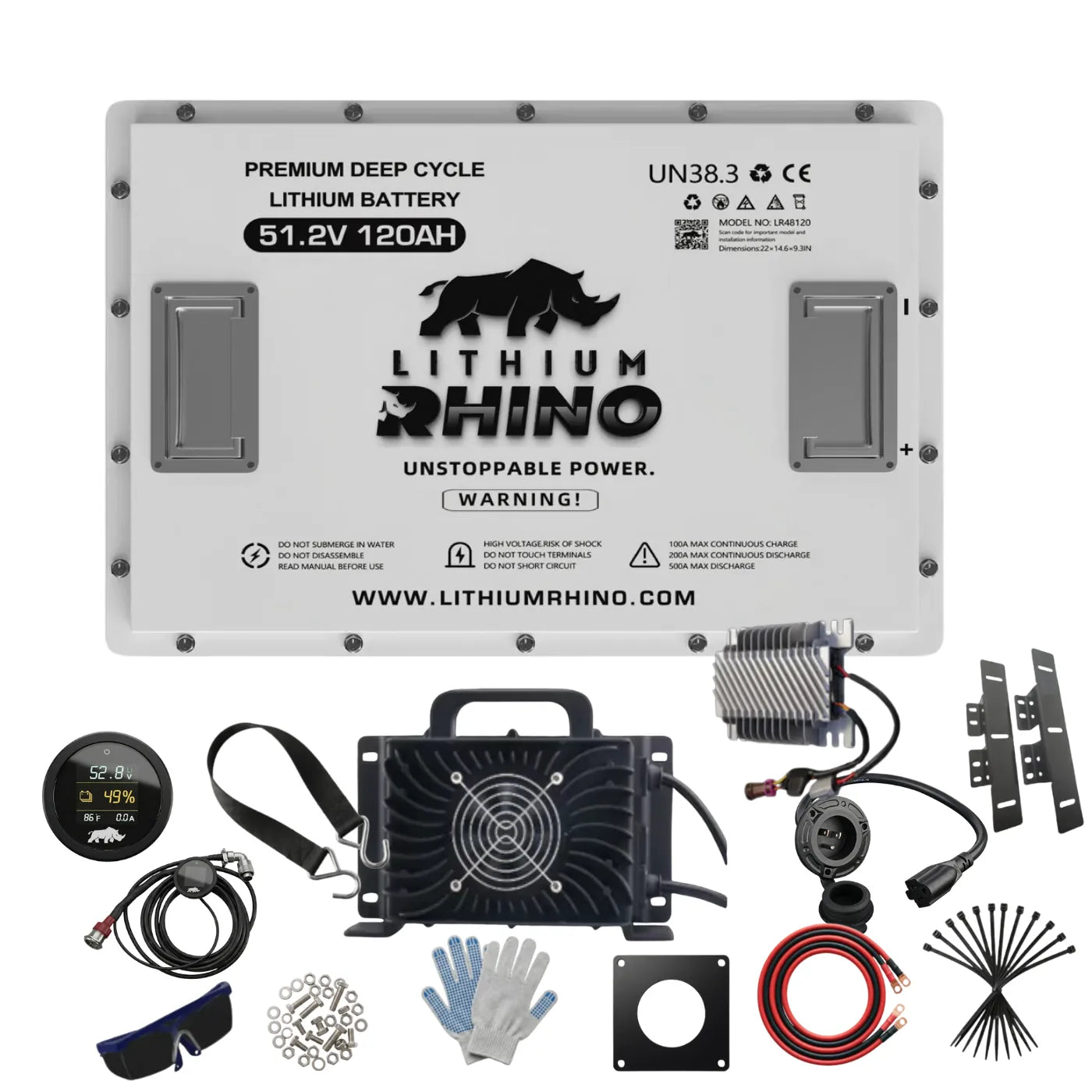
Both are complete drop-in kits that include the battery, a 25-amp lithium smart charger, a 12V converter for standard accessories, mounting brackets and hardware, a color gauge, and Bluetooth monitoring through the free Lithium Rhino app. Both carry an 8-year warranty and a 6,000+ cycle rating.
Choosing Your Capacity
Both packs are 48V (51.2V) and install the same way. The difference is how much range and current they deliver, and a few features on the 170Ah. Here is how to choose.
Choose the 120Ah if you
Use the Ranger mostly solo for property, trail, hunting, and light chores
Want roughly 40 to 50 miles of range at the best value
Do not tow heavy or plow for long stretches
Can add the Self-Heated option if you charge below freezing
Choose the 170Ah if you
Tow, plow, haul, or run steep terrain and want current headroom (300A continuous / 800A max)
Want maximum range, advertised up to 74 miles
Run an upgraded controller or motor
Want self-heating built in for winter charging, plus CAN and RS485 comm ports and Polaris EV factory-dash gauge integration
If you are between the two, size up. Extra capacity gives more range, cooler operation under load, and longer cell life, and it is the more forgiving choice for a working Ranger. Contact us and we will help you match the pack to your use.
Features
Replaces all eight factory batteries. One compact pack takes the place of the Ranger EV's eight lead-acid batteries, removing roughly 700 pounds of lead and freeing up payload for gear, tools, and passengers.
Grade-A LiFePO4 prismatic cells. Rated for 6,000+ charge cycles, so for most owners this is a one-time upgrade rather than a battery you replace every few seasons.
Flat lithium discharge curve. Voltage stays steady as the pack drains, so the Ranger does not lose power or speed late in the day the way lead-acid does.
Smart Rhino BMS. The 120Ah runs a 250A continuous / 500A peak BMS; the 170Ah steps up to 300A continuous / 800A max for heavy loads and upgraded drivetrains. Both protect against over-charge, over-discharge, over-temperature, and short circuits.
Self-heating options. The 170Ah includes inner self-heating for sub-freezing charging. The 120Ah offers a Self-Heated version as an upgrade.
Communication and cabling (170Ah). The 170Ah adds dual CAN and RS485 communication ports and 2 AWG pure-copper cables for higher-current, integrated builds.
25-amp lithium smart charger included. Charges the pack with a matched smart charger and shuts off automatically when full.
12V converter included. Powers standard 12V accessories such as lights and dash. High-draw winches and snow plows need a heavier-duty 12V solution.
Bluetooth app and color gauge. The free Lithium Rhino app (iOS and Android) and a dash gauge show live state of charge, per-cell voltage and temperature, fault alerts, and cycle history. The 170Ah round gauge integrates with the Polaris EV factory dash.
8-year warranty and US-based support. Full replacement for the first six years, then a $500 deductible for years seven and eight, plus lifetime customer support and install videos.
Polaris Ranger EV Fitment
This kit is a 48V (51.2V) lithium conversion for the electric Polaris Ranger EV, which leaves the factory with eight lead-acid batteries wired to a 48V system. A single Lithium Rhino pack replaces all eight. Always confirm your exact year and model before ordering.
Designed for
Polaris Ranger EV that runs on eight 48V lead-acid batteries, roughly model years 2010 through 2021
Polaris Ranger EV LSV (48V) variants
Any later Ranger EV still built on the same eight-battery 48V lead-acid platform, including 2022 units. Fitment follows the platform, not the badge year.
Not for
Polaris Ranger XP Kinetic (2022 and newer). The Kinetic is a factory high-voltage lithium machine with its own sealed battery, charger, and controls, and cannot be converted with a 48V drop-in pack.
Gas Ranger models, which do not run on a 48V traction battery.
The pack mounts in the factory battery area using the included universal brackets and hardware. Because Ranger EV battery bays vary by year, we recommend contacting us with your year and model so we can confirm fit and mounting before you order. If you are unsure whether you have the 48V EV or the Kinetic, count your batteries: this kit is for machines with eight 48V lead-acid batteries.
Suitable for
Property and acreage maintenance
Trail riding and hunting
Hauling, towing, and plowing (170Ah recommended for heavy or sustained loads)
Daily use on moderate to demanding terrain
Note on range
Range figures assume a stock Ranger EV with a single rider on moderate terrain. Loads, passengers, towing, hills, tire size, and driving style all reduce real-world range.
Specifications
Specifications by capacity. Choose your capacity in the product options above.
Specification
120Ah
170Ah
Nominal voltage
51.2V (48V class)
51.2V (48V class)
Capacity
120Ah
170Ah
Total energy
6,144Wh (6.1 kWh)
8,704Wh (8.7 kWh)
Advertised range (single rider)
Approx. 40 to 50 miles
Up to 74 miles
Cell chemistry
Grade-A LiFePO4 prismatic
Rated cycle life
6,000+ cycles
6,000+ cycles
Max continuous discharge
250A
300A
Peak / max discharge
500A
800A
Self-heating
Optional (Self-Heated version)
Built in
Communication ports
—
CAN and RS485
Recommended charge current
25A
25A
Max charge current
120A
100A
Included charger
25A smart charger, dual mount
Cell balancing
Active
Active, ±20 mV
Dimensions (L x W x H)
18.9 x 13.4 x 9.3 in
20.7''×17.9''×12.6''
Weight
Approx. 120 lb
Approx. 209lbs
Operating / discharge temp
-4°F to 131°F
-4°F to 131°F
Ingress rating
IP65
IP65
Dash gauge
Color round touchscreen with power button
Color round touchscreen; integrates with Polaris EV factory dash
App
Free Lithium Rhino app (iOS, Android)
Warranty
8 years (6 full + 2 at $500 deductible)
Certifications: UN38.3, MDSD (UN3480 shipping class). Values above are manufacturer figures.
What's Included
Every kit ships complete. There is nothing extra to buy to finish a standard install.
51.2V LiFePO4 battery pack (120Ah or 170Ah)
25-amp lithium smart charger with dual-mount bracket
12V DC converter (reducer) for accessory power
Color round touchscreen gauge with secondary power button
Charge port adapter plug, charging cable, and charge port plate
Universal mounting brackets and hardware
Heavy-gauge main cable set (170Ah uses 2 AWG pure-copper cables)
Bracket drill bit
Lead-acid battery removal strap
Heavy-duty zip tie
Safety glasses and gloves
Built-in Bluetooth app module and install guide
The 170Ah also includes dual CAN and RS485 communication ports for integrated and upgraded-controller builds.
Installation & Charging
Installation
This is a do-it-yourself drop-in kit. Most owners complete the install in about 2 to 4 hours with basic hand tools. You remove all eight factory lead-acid batteries and mount the single lithium pack in the battery area with the included brackets and hardware.
Disconnect and remove the eight factory lead-acid batteries using the included removal strap.
Mount the lithium pack with the universal brackets and hardware.
Connect the main cables and the 12V converter for standard 12V accessories.
Install the charge port adapter and plate, and mount the gauge.
Power on and confirm state of charge on the gauge or the Lithium Rhino app.
Because the motor and controller do not change, the stock contactor sees the same load and does not need upgrading for a single drop-in pack.
Charging your Ranger EV
Both kits charge with the included 25-amp lithium smart charger, which is matched to the pack and its BMS and shuts off automatically when full. A lead-acid charger is not designed for lithium and should not be used.
Many Ranger EVs have an onboard Delta Q (QuiQ) charger set up for lead-acid batteries. If you want to keep using the onboard charger, it typically needs to be set to a lithium profile first. Contact us with your charger model before ordering and we will confirm your best charging setup.
Warranty & Shipping
Warranty
Both kits carry an 8-year warranty on the cells, BMS, and built-in electronics: full replacement for the first six years, then a $500 deductible for years seven and eight, plus lifetime US-based customer support. Register your kit on install day to activate coverage.
Shipping
Each kit ships in a single hazmat-certified wooden crate for safe transit. Please keep the crate and packaging in case a warranty claim ever requires return shipping.
Returns
Returns are accepted per our store return policy. Contact our support team to start a return and we will walk you through the process.
Frequently Asked Questions
Which capacity should I choose, 120Ah or 170Ah?
Choose the 120Ah for mostly solo property, trail, and hunting use with roughly 40 to 50 miles of range at the best value. Choose the 170Ah if you tow, plow, haul, run an upgraded controller, or want maximum range up to 74 miles, plus built-in self-heating, CAN and RS485 ports, and Polaris factory-dash gauge integration. If you are between the two, size up.