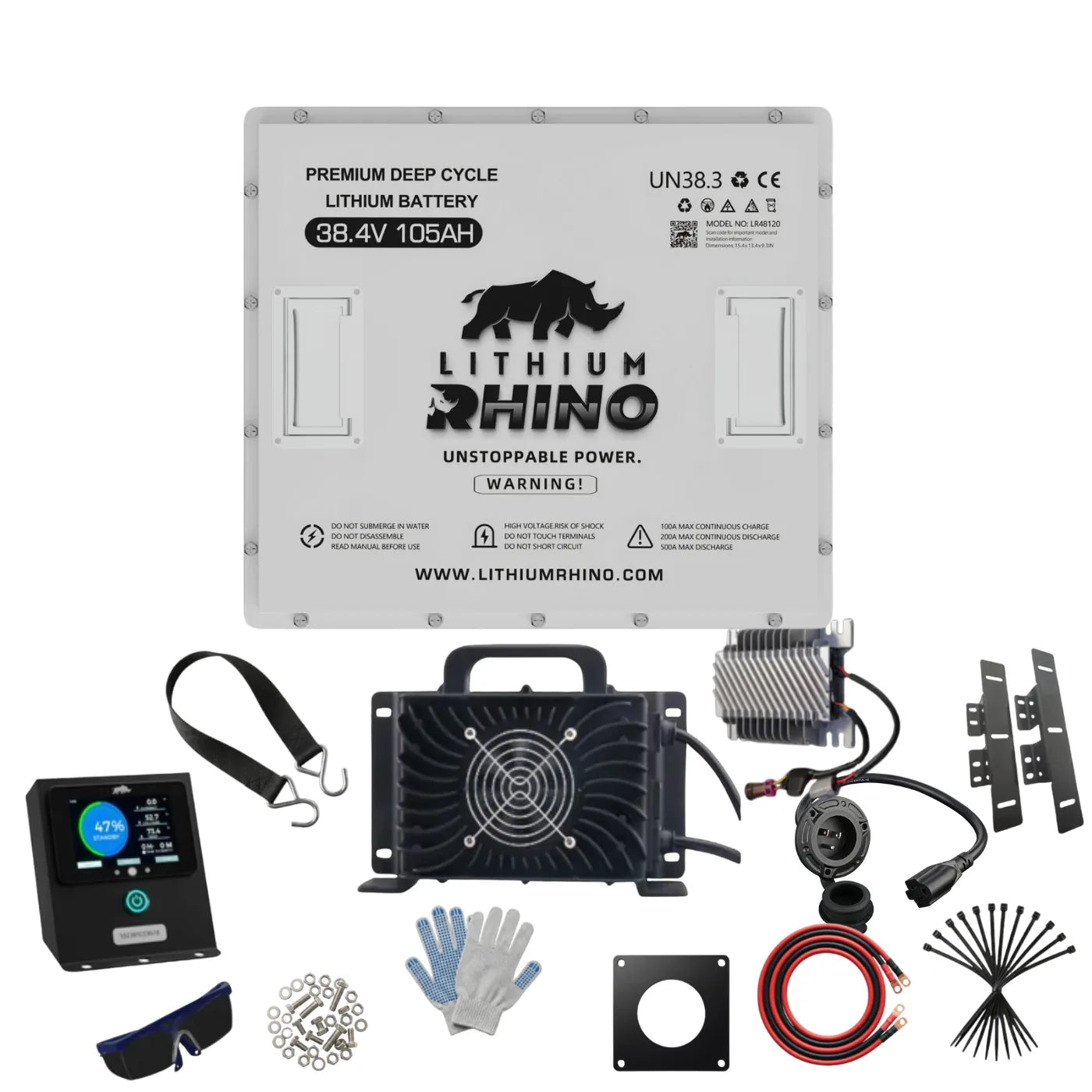
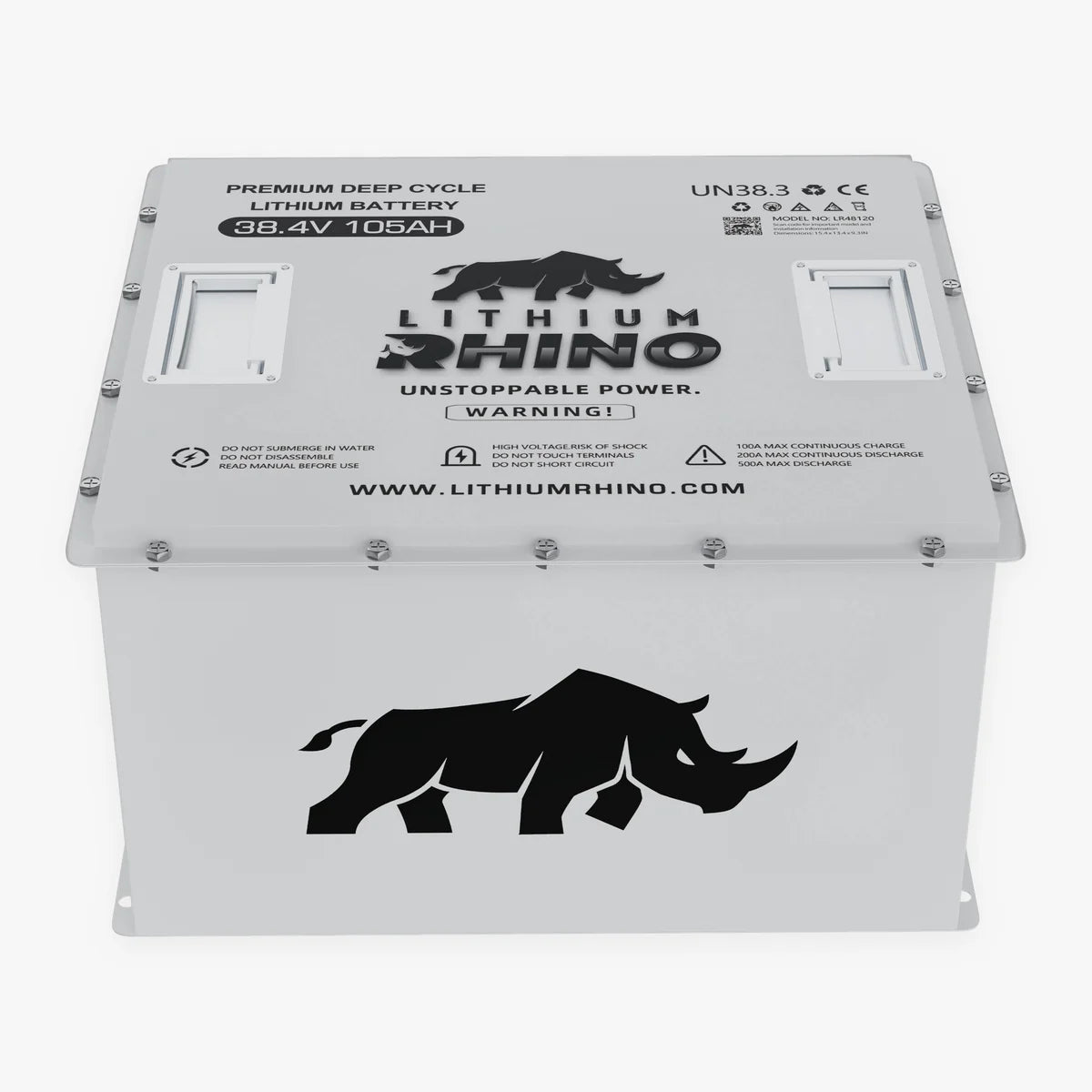
The Lithium Rhino 36V 105Ah Lithium Golf Cart Battery Conversion Kit (model LR36105) is a complete lead-acid replacement system for compatible 36V golf carts including the Club Car DS, E-Z-GO TXT, E-Z-GO Medalist, E-Z-GO Marathon, and Yamaha G Series G1 through G16. The kit replaces six 6-volt flooded lead-acid batteries with one 38.4V nominal, 105Ah lithium iron phosphate battery delivering 4,032 watt-hours.
The Lithium Rhino LR36105 battery measures 15.4 inches long by 13.4 inches wide by 9.3 inches tall and weighs approximately 80 pounds, replacing a lead-acid bank that typically weighs 370 to 400 pounds.
The Lithium Rhino 36V 105Ah kit includes a 25-amp lithium charger, a 40-amp DC-to-DC converter, a 4-inch LCD touchscreen, a Bluetooth module, mounting brackets, cables, and installation hardware.
A full charge of the Lithium Rhino LR36105 takes approximately 252 minutes at the recommended 25-amp charge rate.
The battery management system supports 200 amps continuous discharge, 500 amps peak for 30 seconds, and 700 amps for 1 second.
The Lithium Rhino warranty runs 8 years, with full coverage at no cost for the first 72 months and a flat $500 cost in months 72 through 96. Registration within 120 days of purchase is required for the full term.
This kit fits 36V golf carts only. It does not fit 48V or 72V carts and will not convert a 36V cart to a higher voltage.
If your 36V golf cart still runs on six flooded lead-acid batteries, you already know the routine: checking water levels, cleaning corroded terminals, and watching the cart slow down as the pack drains. The Lithium Rhino 36V 105Ah conversion kit replaces that entire bank with a single sealed LiFePO₄ battery and the supporting components required to run it properly.
This is a system, not just a battery. A lithium battery alone will not finish a conversion. Your cart needs a lithium-specific charger, a DC-to-DC converter to power 12V accessories that used to tap off the lead-acid bank, a state-of-charge display that reads lithium correctly, and mounting hardware to secure one battery in a tray built for six. All of that ships in the crate.
The result is a cart that weighs roughly 300 pounds less, delivers steady power from full charge down to empty, charges in about four hours, and requires no watering, no terminal cleaning, and no equalization.
Why upgrade from lead acid to lithium
Weight. A six-battery flooded bank typically weighs 370 to 400 pounds. This battery weighs approximately 80 pounds. That difference shows up in acceleration, hill climbing, tire wear, and suspension life.
Consistent power. Lead-acid voltage sags under load and drops steadily as the pack discharges, which is why an older cart feels strong in the morning and sluggish by afternoon. LiFePO₄ holds a much flatter voltage curve, so the cart pulls similarly at 30 percent charge as it does at 100 percent.
No maintenance. No distilled water. No acid spills on the garage floor. No corroded terminals or jumper cables to service. The battery is sealed and IP65 rated.
Charge time. The included 25A charger brings the pack to full in approximately 252 minutes. Many lead-acid setups take eight hours or more.
Service life. Lithium Rhino rates this battery at 6,000+ charge cycles.
Why choose the 105Ah capacity over a smaller 36V pack
105Ah is the larger of the two 36V capacities Lithium Rhino builds, and it is the right choice for most owners who actually use their cart rather than driving it a few blocks a week.
Choose 105Ah if your cart has rear seats or carries passengers regularly, if you live on hills or drive unpaved property, if you run lights, a sound system, or a windshield wiper, or if you would rather charge every few days than every night. A smaller pack works for flat, short, single-passenger use, but capacity is the one thing you cannot add later without buying another battery.
Capacity also matters for warranty compliance in commercial settings. Lithium Rhino's warranty excludes batteries used in commercial applications that are repeatedly cycled beyond 80 percent depth of discharge within 24-hour periods. If your cart runs hard every single day, size up rather than running a smaller pack to empty.
Lead acid vs. Lithium Rhino 36V 105Ah
Comparison point
Typical 36V flooded lead-acid bank
Lithium Rhino 36V 105Ah
Number of batteries
Six 6V batteries plus jumper cables
One sealed battery
Approximate weight
370–400 lbs
80 lbs
Watering
Required, typically monthly
None
Terminal corrosion
Common; requires cleaning
Sealed terminals, no acid
Voltage under load
Sags; performance falls as pack drains
Flat discharge curve
Usable depth of discharge
Commonly limited to about 50%
80% DOD recommended
Full charge time
Often 8+ hours
Approx. 252 minutes at 25A
Monitoring
Voltmeter or fuel gauge
LCD display and Bluetooth app
Warranty
Varies by brand, commonly 1–2 years
8 years limited, 6 years full
Lead-acid figures are typical industry values for a six-battery GC2 bank and vary by brand, age, and maintenance history.
Who uses a 36V lithium conversion kit
This kit suits both private owners and light commercial operators running compatible 36V carts:
Neighborhood and community carts, including gated and 55+ communities
Golf course play and personal course carts
Campground and RV park transportation
Farms, ranches, and acreage property work
Hunting properties and food plot access
Resorts, marinas, and event venues
Warehouse, facility, and grounds crew carts
Commercial and fleet operators: see the warranty tab for depth-of-discharge requirements that apply to daily heavy-cycle use.
Compatibility
This kit fits compatible 36V golf carts. It does not fit 48V or 72V carts, and it will not convert a 36V cart to a higher voltage. Confirm your cart is a 36V system before ordering.
How to confirm your cart is 36V
The fastest check is under the seat. Lift it and count the batteries, then count the round fill caps on top of one battery.
Six batteries with three caps each: six 6V batteries in series, which is a 36V system. This kit applies.
Six batteries with four caps each: six 8V batteries, which is a 48V system. This kit does not apply.
Four batteries with six caps each: four 12V batteries, which is a 48V system. This kit does not apply.
Commonly compatible 36V models
Brand
36V models
Notes
Club Car
DS 36V
Primarily older DS carts. Some carry an onboard computer that requires bypass; many 36V DS carts have none. Verify yours.
E-Z-GO
TXT 36V, Medalist, Marathon, DCS and PDS 36V models
The charge port trigger wire must be rerouted or the cart will not drive. See the installation tab.
Yamaha
G1, G2, G3, G5, G8, G9, G11, G14, G16
G19, G22, and G29 are 48V and are not compatible. Confirm tray space on G1 and G2.
Other
Columbia, Par Car, Fairplay, Harley-Davidson, Cushman, Melex, Western 36V carts
Fitment confirmed case by case. Contact us with your model.
Telling a Yamaha G16 from a G19
These two look nearly identical and are the most common mix-up on 36V orders. Look at the forward and reverse control. If it is a black switch on the dash, the cart is a G19 and it is 48V. If it is a large black lever in the center of the rear body, the cart is a G16 and it is 36V. There is no meaningful difference between a G14 and a G16, so either identification points to 36V.
Will the battery fit in a 36V golf cart battery tray
The Lithium Rhino LR36105 battery measures 15.4" long by 13.4" wide by 9.3" tall. That is shorter than the six batteries it replaces, so seat clearance is not a concern on common platforms. Measure your tray before ordering, particularly on early Yamaha G1 and G2 carts, which have the tightest compartments in the 36V category.
Before you order, confirm
Cart year, make, and model
36V system verified by battery and cap count
Battery tray interior dimensions
Controller type solid-state or resistor coil
Whether your cart has an onboard computer
Charge port style on the cart
Any existing 12V accessories, lights, or aftermarket motor and controller upgrades
What's Included
Every kit ships in one crate with the components required to complete a conversion. Nothing on this list is sold separately as an add-on.
Component
Detail
36V 105Ah LiFePO₄ battery
Model LR36105, 38.4V nominal, 4,032Wh
Lithium smart charger
25A output.
DC-to-DC voltage converter
40A output for 12V accessories, with trigger wire to the solenoid
LCD touchscreen display and mount
4" screen with built-in secondary battery power button
Bluetooth module
Included; pairs with the Rhino app for iOS and Android
Charge port adapter
Adapter style and cart coverage: Universal
Charge port plate
For mounting the charge receptacle
Heavy gauge cables
Main positive and negative connections
Universal mounting brackets
Secures one battery in a tray built for six
Drill bit and mounting hardware
Metal drill bit plus fasteners
Heavy-duty zip ties
Cable management
Lead-acid removal strap
For lifting out the old batteries
Safety gloves and glasses
Included for the removal step
Rhino decal license plate
Installation documentation
Written instructions plus model-specific video guides
Specifications
Lithium Rhino LR36105 general specifications
Specification
Value
Model number
LR36105
Nominal voltage
38.4V (36V system)
Working voltage range
32.4V – 43.8V
Nominal capacity
105Ah
Energy
4,032Wh
Cell chemistry
Lithium iron phosphate (LiFePO₄)
Cell type
Prismatic
Cell configuration
1P 12S, 12 cells
Recommended depth of discharge
80% DOD
Reserve capacity at 25A
252 minutes
Cycle life
6,000+ cycles
Lithium Rhino LR36105 dimensions and weight
Specification
Value
Dimensions (L × W × H)
15.4" × 13.4" × 9.3"
Weight
Approx. 80 lbs
Terminal type
M8 female
Shell
Metal shell, iron plate baking varnish
IP rating
IP65
Series connectable
No. Series connection voids the warranty.
Parallel connectable
Maximum 3 units. See note below.
Parallel limit note. The Lithium Rhino datasheet lists this battery as parallel connectable up to 4 units, while the published Lithium Rhino warranty excludes damage to batteries with more than 3 connected in parallel. We list 3 as the maximum so you stay inside warranty coverage.
Lithium Rhino LR36105 charge and discharge specifications
Specification
Value
Recommended charging current
25A
Maximum charging current
105A
Charging time at 25A
Approx. 252 minutes
Maximum charge voltage
working voltage tops at 43.8V
Maximum continuous discharge
200A
Peak discharge
500A for 30 seconds; 700A for 1 second
Discharge temperature range
-4°F to 131°F
Lithium Rhino LR36105 BMS protections and connectivity
Specification
Value
Pack over-voltage protection
Yes
Pack under-voltage protection
Yes
Cell over-temperature protection
Yes
BMS over-temperature protection
Yes
Short circuit and over-current protection
Yes
Cell balancing
Yes, ±20mV accuracy
Yes
Bluetooth
Yes
Additional communication ports
RS-485 and CAN
Certifications
UN38.3, CE
Shipping classification
UN 3480
Smart BMS protections in plain terms
The battery management system is built into the pack and works automatically. There is nothing to configure.
Overcharge protection stops the charge before cell voltage climbs too high. The included smart charger also stops on its own once the pack is full.
Over-discharge protection shuts output down before the cells are damaged. If the cart stops with charge apparently remaining, the BMS is protecting the battery.
Overcurrent and short circuit protection cut power instantly if a cable is pinched, a terminal shorts, or a controller fails.
Thermal protection monitors both the cells and the BMS itself. If internal or ambient temperatures pass the limit, the battery shuts down.
Cell balancing keeps all 12 cells within ±20mV of each other. This is the maintenance a lead-acid bank required manually, done automatically.
Bluetooth monitoring and anti-theft
The included Bluetooth module pairs with the Rhino app on iOS and Android at no cost and with no subscription. The app provides live state of charge, pack voltage, temperature, individual cell voltages, fault alerts, cycle history, and diagnostic data that Rhino support can review remotely.
The app also includes an anti-theft function that shuts off battery discharge and puts the pack into LOCK status. In LOCK mode the cart will not drive and the battery will not charge. It can be released from the app, or overridden using the DSG switch in the top left corner of page 2 on the LCD screen.
Range & Charging
How far a 36V 105Ah lithium golf cart battery will go on a charge
We do not guarantee a driving range. Any range figure is an estimate, and the honest answer is that two identical carts with this same battery can deliver very different results.
Lithium Rhino estimates 40 to 50 miles per charge, and states that figure assumes a stock cart with factory-size tires of about 18 inches overall height, a factory controller, and a factory motor.
The table below is our own estimate based on the battery's 4,032Wh capacity and typical golf cart energy consumption. Every figure is an estimate, not a promise.
Use case
Estimated consumption
Estimated range at 80% DOD
Estimated range at full discharge
Flat pavement, 1–2 passengers, stock tires, no accessories
~80 Wh per mile
~40 miles
~50 miles
Mixed neighborhood driving, some grade, occasional passengers
~110 Wh per mile
~29 miles
~36 miles
Hills, 4 passengers, lift kit and larger tires, accessories running
~160 Wh per mile
~20 miles
~25 miles
Estimates only. Calculated from 4,032Wh nominal energy and typical consumption ranges. Actual results vary.
What actually changes your range
Terrain sustained climbing consumes far more energy than flat ground
Passenger and cargo weight four adults versus one driver is a substantial difference
Tire size and lift kits taller tires change gearing and increase motor load
Motor and controller aftermarket high-speed setups draw more current
Speed and driving style wide-open throttle and hard stop-and-go cost range
Accessory loads lights, sound systems, and fans draw through the converter
Temperature cold weather reduces available capacity
Tire pressure and brake drag underinflated tires and dragging brakes waste energy before it reaches the wheels
How to charge a 36V lithium golf cart battery
Use the included 25A lithium charger. A lead-acid charger cannot charge this battery correctly and should never be used. Never run a lead-acid equalization cycle on a lithium pack. Charging outside the parameters in the owner's manual is a warranty exclusion.
A full charge takes approximately 252 minutes, or just over four hours, at the recommended 25A. The battery accepts up to 105A maximum charge current, but the included charger is matched at 25A, which is the recommended rate for cell longevity.
Unlike lead acid, there is no benefit to charging after every short trip and no penalty for partial charges. Charge when it is convenient. Do not leave the battery uncharged for extended periods the warranty excludes batteries left uncharged for over one year, as periodic charging maintains cell health.
Installation
Most owners complete this conversion in two to four hours. It is a manageable job for someone comfortable with basic hand tools and high-current DC wiring. If you are not, have a golf cart technician install it. Lithium Rhino provides model-specific video guides and a free 30-minute video support call.
How to install a 36V lithium conversion kit, step by step
Identify your main positive and negative leads and the 12V accessory wires before disconnecting anything
Disconnect the negative terminal first and remove the six lead-acid batteries using the included strap
Clean and neutralize the battery tray, and inspect for corrosion damage
Position the lithium battery and secure it with the supplied brackets and hardware
Connect the main positive and negative cables to the M8 terminals using the supplied hardware
Install the DC-to-DC converter, run the trigger wire to the solenoid, and connect your 12V accessory circuits
Install the charge port components and adapter
Mount the LCD display and secondary power button
Verify controller and motor operation before driving
Test at low speed in an open area before normal use
Register the battery within 120 days to secure full warranty coverage
Three model-specific items worth knowing before you start
E-Z-GO charge port trigger wire. This is the single most common reason a converted E-Z-GO will not move after installation. The blue wire with the black clip coming from the old charge port must be clipped and run to the Rhino positive terminal. This tells the cart it is not charging so it will engage forward and reverse. Without this step the cart will not drive, even though the lights work and the battery appears healthy. Most general conversion videos do not cover it.
Club Car onboard computer. Club Car began fitting onboard computers to 48V models in the mid-1990s. On carts that have one, it manages lead-acid charging and can trigger a drive lockout when it does not recognize a lithium pack, requiring a bypass. Many 36V DS carts have no onboard computer at all. Check your specific cart rather than assuming either way.
Resistor coil and V-Glide carts. Some older Club Car DS and E-Z-GO Marathon carts use a resistor coil speed control rather than a solid-state controller, managing speed by burning excess energy as heat. These carts will run on lithium, but they are inefficient by design and the battery will not correct that. If you are already considering a solid-state controller upgrade, this is a sensible time to do both.
Why the mounting brackets do not sit flush
The supplied brackets are not designed to sit flush against the battery case. They seat into the slots on the battery and the bolts pull the pack down tightly. This is normal and is not a defect. Secure mounting matters: damage caused by inadequate securing is a warranty exclusion.
FAQs
Will this kit fit my golf cart?
The Lithium Rhino 36V 105Ah conversion kit fits many 36V golf carts but not all of them, and we do not claim universal compatibility. Confirm your cart is a 36V system, measure your battery tray against the 15.4" by 13.4" by 9.3" battery, and identify your controller type and charge port. Contact us with your year, make, and model and we will confirm fitment before you order.
How do I know whether my cart is 36V or 48V?
Lift the seat and count the batteries, then count the fill caps on one of them. Six batteries with three caps each is a 36V system and this kit applies. Six batteries with four caps each, or four batteries with six caps each, is a 48V system and this kit does not apply.
Does one battery really replace all six lead-acid batteries?
Yes. One 105Ah LiFePO₄ battery replaces the entire six-battery bank along with the jumper cables between them. This is also the recommended approach over installing multiple smaller lithium batteries in series, which requires an external balancer and adds failure points.
The specs say 38.4V. Is that safe in a 36V cart?
Yes. 38.4V is the nominal voltage of a 12-cell LiFePO₄ pack, and it is the correct battery for a 36V system. For context, a fully charged and rested 36V lead-acid bank reads approximately 38.2V, so your cart already operates at that voltage today. "36V" describes the system, not the exact resting voltage of the pack.
Will it fit my battery tray?
The Lithium Rhino LR36105 battery measures 15.4" long, 13.4" wide, and 9.3" tall a smaller footprint and lower height than the six batteries it replaces, so seat clearance is not a concern on common platforms. Measure your tray before ordering. Early Yamaha G1 and G2 carts have the tightest compartments in the 36V category and deserve a careful measurement.
Can I keep my stock motor?
Yes. A 36V lithium conversion does not change your system voltage, so your existing motor operates exactly as designed. No motor modification is required.
Can I keep my stock controller?
In most cases, yes. System voltage stays at 36V and the motor is unchanged, so a healthy factory controller continues to work normally. What changes is that the controller now receives steady voltage throughout the drive instead of being starved by a sagging lead-acid pack. If your controller is already failing or shows heat damage, address that before or during the conversion. Note that battery failure caused by a faulty electrical system is a warranty exclusion, so it is worth repairing known problems first.
My Club Car has resistor coils and a V-Glide. Will this work?
Yes, these carts will run on lithium. Be aware that a resistor coil system controls speed by dissipating excess energy as heat, so it is inefficient regardless of battery type and a lithium pack will not change that. Many owners of these carts pair a lithium conversion with a solid-state controller upgrade. Contact us to discuss your specific setup.
Do I need to bypass the onboard computer on my Club Car?
It depends on your cart. Club Car began fitting onboard computers to 48V models in the mid-1990s, and where one is present it must be bypassed because it manages lead-acid charging and can trigger a drive lockout with lithium installed. Many 36V DS carts have no onboard computer at all. Check your specific cart and wiring diagram, or send us photos and we will identify it.
I installed the kit on my E-Z-GO and the cart will not move. What did I miss?
An E-Z-GO cart that will not move after a lithium conversion is almost certainly missing the charge port trigger wire step. On E-Z-GO carts, the blue wire with the black clip coming from the old charge port must be clipped and run to the Rhino positive terminal. This signals the cart that it is not charging so it will engage forward and reverse. Without it the cart will not drive even though the lights work and the battery reads healthy. This is the most common E-Z-GO conversion issue and is not covered in most general installation videos.
Can I use my existing charger?
No. A lead-acid charger uses the wrong charging profile for LiFePO₄, will not charge the pack correctly, and creates a safety risk. Never run a lead-acid equalization cycle on this battery. A lithium-specific 25A charger is included in the kit, and charging outside the manual's parameters is a warranty exclusion.
Will the included charger plug into my cart's charge port?
The kit includes an universal charge port adapter and charge port plate, and the installation replaces your old charge port with the Rhino port. Charge port styles vary across 36V carts, Club Car uses crowfoot and round 3-pin receptacles, E-Z-GO 36V carts commonly use the PowerWise "D" style, and Yamaha G Series carts use a 3-pin leaf style.
Is a voltage reducer included, and will my lights still work?
Yes. A 40A DC-to-DC converter is included. This matters more than most buyers expect: on a lead-acid cart, 12V accessories tap off part of the battery bank, and a single lithium pack cannot be tapped that way. The converter provides a clean 12V supply for lights, horn, sound systems, USB ports, and wipers. Its trigger wire runs to the solenoid during installation. Add up your accessory draw and contact us if it approaches 40A.
How far will my cart go on a charge?
We do not guarantee a range. Lithium Rhino estimates 40 to 50 miles on a stock cart with factory tires, motor, and controller. Our own estimates based on the 4,032Wh capacity run from about 40 miles for flat, light, stock use down to about 20 miles for a lifted four-passenger cart on hills. Terrain, weight, tire size, lift kits, motor and controller, speed, temperature, and accessory loads all change the result. See the Range and Charging tab for the full breakdown.
Will lithium make my cart faster?
Usually somewhat, but not because of higher voltage. Two things change. First, you remove roughly 300 pounds, which improves acceleration and hill climbing. Second, the flat lithium discharge curve means the controller sees full pack voltage for most of the drive instead of a sagging lead-acid pack. Owners commonly report a modest top-speed gain and a noticeable improvement in how the cart pulls. If your goal is a large speed increase, that requires motor and controller changes, not a battery.
Is it good for hills?
Hill performance improves for the same two reasons above: less weight to carry and no voltage sag under load. The BMS supports 200A continuous with 500A available for 30 seconds, which covers the sustained current draw of climbing on a stock 36V drivetrain. Expect shorter range on hilly property regardless of battery chemistry.
How long does charging take?
A Lithium Rhino 36V 105Ah battery takes approximately 252 minutes, or just over four hours, for a full charge at the recommended 25A using the included charger.
Can I leave it plugged in overnight?
Yes. The included smart charger stops charging once the battery is full, and the BMS provides independent overcharge protection. Lithium Rhino states there are no concerns with charging overnight. If you would still rather not, the 25A charger puts a substantial amount of energy back in a couple of hours, so you can charge briefly and then power the battery off.
Why does my state of charge behave differently than my old batteries?
Because lithium holds a much flatter voltage curve than lead acid, a voltmeter is a poor tool for judging remaining capacity. A lithium pack reads close to the same voltage at 80 percent as it does at 30 percent. Use the included LCD display or the Rhino app for state of charge rather than a voltage reading. This is a real adjustment for owners coming off lead acid, and it is normal.
My battery clicks and will not drive or charge, and the screen shows LOCK in red. What is wrong?
A Lithium Rhino battery showing LOCK in red is in anti-theft mode, which shuts off discharge. In this state the cart will not drive and the battery will not charge, and you may hear a clicking sound when you try either. Release it from the anti-theft function in the Rhino app, or override it using the DSG switch in the top left corner of page 2 on the LCD screen. This is a feature, not a fault, and it is easily reversed.
Can I install this myself?
Most owners complete the install in two to four hours with basic hand tools. Lithium Rhino provides model-specific video guides and a free 30-minute video support call. If you are not comfortable working with high-current DC wiring, have a golf cart technician do it. Improper installation, loose terminal connections, reverse polarity, poor crimps, and undersized cable are all warranty exclusions, so it is worth doing carefully.
Does the battery tray need to be modified?
Usually not structurally. The kit includes universal mounting brackets, a metal drill bit, and hardware to secure one battery in a tray designed for six, which typically means drilling mounting points. The brackets are designed to seat into the slots on the battery rather than sit flush against the case, which is normal. Confirm your tray dimensions before ordering.
Can the battery be used in the rain?
The Lithium Rhino LR36105 battery carries an IP65 rating, meaning it is protected against dust and low-pressure water jets from any direction. Normal rain and normal driving in wet conditions are not a concern. Two important limits: do not submerge the battery, and do not pressure wash it. Water submersion and pressure washing are both explicit warranty exclusions. Mount it so it does not sit in standing water, and keep the pressure washer away from the battery compartment when cleaning your cart.
How should I store the cart over winter?
To store a Lithium Rhino lithium golf cart battery over winter, charge the pack before storage, turn the battery off using the built-in power switch, and store it dry. Do not store it in a fully discharged state and do not leave it uncharged for extended periods both are warranty exclusions, and batteries left uncharged for over a year lose coverage. Keep ambient temperature within limits: exposure above 135°F or below -30°F is excluded from warranty coverage.
Can I charge it in freezing weather?
The Lithium Rhino 36V 105Ah is not a self-heated model. LiFePO₄ batteries generally restrict charging below freezing to protect the cells, and the BMS manages that automatically. If you keep your cart in an unheated space through cold winters, discuss it with us before ordering, Lithium Rhino builds self-heated models in other configurations that warm the cells before charging begins.
Does it work in a lifted cart with larger tires?
Yes, the Lithium Rhino 36V 105Ah kit works in lifted carts, and lifted carts are a common application. Understand the tradeoff: taller tires change your effective gearing and increase the load on the motor, which reduces range. The manufacturer's range estimate assumes factory-size tires of about 18 inches overall height. If your cart is lifted and runs larger tires, plan on the lower end of the range estimates.
Can I add a second battery later for more range?
Yes. These batteries can be connected in parallel, and we recommend a maximum of three units to stay within warranty coverage, the Lithium Rhino warranty excludes damage where more than three batteries are connected in parallel. Two packs would give you 210Ah. Never connect them in series: series connection is both outside the battery's design and an explicit warranty exclusion. Contact us before adding a pack so we can confirm cabling and charging requirements.
Can I use this in a commercial or fleet application?
Yes, with one important condition. The Lithium Rhino warranty excludes batteries used in commercial applications where they are repeatedly cycled beyond 80 percent depth of discharge within 24-hour periods. In practice that means sizing capacity so your daily route does not run the pack near empty every day. If you operate a campground, resort, course, or grounds fleet, tell us your daily mileage and we will help you size the system to stay inside coverage.
What do I do with my old lead-acid batteries?
Most local battery retailers and scrap yards accept them for recycling at no charge, and many pay scrap value for the lead. Do not put them in household trash. Contact us if you need help locating a recycler in your area.
Does the battery require any maintenance?
No watering, no terminal cleaning, no equalization, and no specific gravity testing. The BMS handles cell balancing automatically. Practical upkeep is limited to keeping connections tight and clean, keeping the charge port free of corrosion, keeping the battery out of standing water, and charging it periodically during long storage.
Is Bluetooth included, and what does the app show?
Yes, the Bluetooth module is included at no additional cost and there is no subscription. The Rhino app for iOS and Android displays state of charge, pack voltage, temperature, individual cell voltages, fault alerts, and cycle history, and allows Rhino support to review diagnostics remotely. It also includes an anti-theft function that locks battery discharge.
Do I have to register the battery?
Yes, and this is the most important thing to do after installation. Batteries registered within 120 days of purchase receive the full 8-year limited warranty. Batteries not registered within 120 days are covered for one year from the purchase date only. Register at lithiumrhino.com/pages/register on install day. Registration also makes the warranty transferable if you later sell the cart.
What does the warranty actually cover, and what will I pay?
Lithium Rhino provides an 8-year limited warranty against manufacturer defects from the date of sale on your receipt. For the first 72 months, a defective battery is credited, replaced, or repaired at no cost to you, at Rhino's discretion. From month 72 to month 96, you pay a flat $500 and Rhino covers the rest. In those final two years you can instead take a $500 credit toward a new Rhino battery rather than replacing the original. Registration within 120 days is required for the full term.
Is the warranty transferable if I sell my cart?
Yes, provided the original owner registered the battery. If the cart is sold with the Lithium Rhino battery installed, coverage can transfer to the new owner. Email info@lithiumrhino.com with the details of the sale, including the original owner's full name, to confirm registration and update it to the new owner.
How does it ship?
The battery is classified UN 3480 for shipping, so the kit ships by freight in a hazmat-certified wooden crate. Everything arrives in one crate rather than as separate boxes. Air shipping is generally not available for this classification. If a battery ever needs to go back for warranty evaluation, it must travel in a UN-approved lithium shipping box and requires an RMA number obtained in advance.
Ready to convert your 36V cart
The Lithium Rhino 36V 105Ah kit gives you everything required to retire a lead-acid bank in a single afternoon: the battery, the charger, the converter, the display, and the hardware. No sourcing parts from four suppliers and hoping they work together.
If you are certain your cart is a compatible 36V model and you have measured your tray, add the kit to your cart. If you have any doubt, contact us first, we would rather confirm fitment than process a return.