The SunGold Power Powerwall X (model SG48200T) is a 51.2-volt, 200Ah lithium iron phosphate (LiFePO4) battery designed for residential and commercial energy storage. It stores 10.24 kWh of energy (9.84 kWh usable) from solar panels or the grid, making that power available at night, during outages, or during peak electricity rate periods.
The SG48200T operates at 51.2V nominal voltage and is compatible with 48V inverter systems, which is the standard voltage class for this battery type.
The battery uses LiFePO4 chemistry, which is thermally stable and does not produce thermal runaway under normal operating conditions, making it suitable for indoor and garage installation. It carries UL1973 and UL9540A safety certifications, which cover stationary battery fire safety standards.
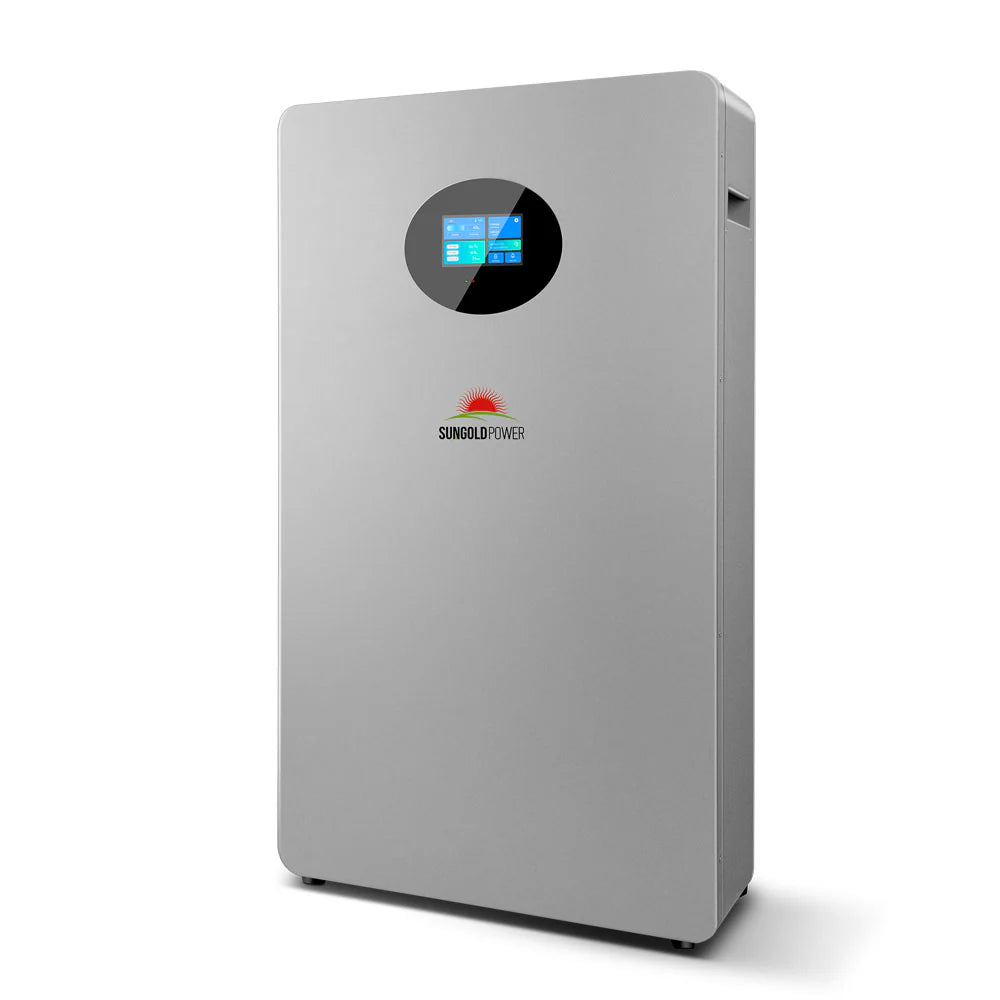
The integrated 200A Battery Management System (BMS) handles overcharge, over-discharge, overcurrent, overtemperature, and short-circuit protection automatically during normal operation. The front panel includes a circular LCD touchscreen displaying state of charge, voltage, and current in real time. An IOT port supports WiFi cloud monitoring one WiFi module covers the entire battery bank when multiple units are connected in parallel.
Communication uses CAN bus, RS485, and RS232 protocols. The battery ships with DIP switch configuration settings and pin-by-pin wiring diagrams for 16 inverter brands in the user manual. Up to 32 units connect in parallel, scaling total storage to 328 kWh. The battery supports floor mounting with included brackets or wall mounting with an optional bracket kit sold separately.
Rated for 8,000 or more deep cycles at 80% depth of discharge, with a 15-year expected service life under daily cycling conditions. Backed by a 10-year manufacturer warranty.
Important: This battery is a DC storage component. It does not include or replace an inverter/charger. Connecting to a home electrical panel for backup or grid-tied use requires a licensed electrician in most jurisdictions. If you do not yet have a compatible inverter, see the FAQ tab for guidance on what to look for.
Features
Battery and Chemistry
-
LiFePO4 lithium iron phosphate chemistry thermally stable, does not produce thermal runaway under normal operating conditions, suitable for indoor and garage installation
-
10.24 kWh nominal / 9.84 kWh usable capacity at 0.5C discharge rate
-
51.2V nominal voltage, operating range 44.8V to 57.6V
-
8,000 or more deep cycles at 80% depth of discharge 15-year rated service life with daily cycling
-
200A continuous discharge current at initial temperature at or below 30°C (86°F)
- 140A maximum charge current
- Peak discharge: 200–240A for 5 minutes / 240–300A for 15 seconds
- LiFePO4 chemistry has a low self-discharge rate typical for lithium iron phosphate cells. The manufacturer recommends recharging within 6 months during storage at 0–30°C to maintain cell health
Battery Management System (BMS)
-
200A integrated BMS with cell equalization function actively balances cells to extend service life
- Automatic protection: overcharge, over-discharge, overcurrent (charge and discharge), overtemperature, undertemperature, short circuit, and reversed polarity
- Most protections recover automatically when the fault condition clears; short circuit and reversed polarity require manual reset via the front-panel button
- BMS enters sleep mode during extended idle periods to reduce self-consumption; connect a charge source or press the reset button to reactivate
Display and Monitoring
-
Circular LCD touchscreen on front panel displays SOC percentage, voltage, current, and system status in real time
- LED indicators: RUN light (operating status), ALM light (alarm active), SOC bar (charge level at a glance)
-
IOT port for WiFi cloud monitoring one WiFi module connects to the Master battery and covers all units in a parallel array
Inverter Compatibility
-
Three communication protocols supported: CAN bus, RS485, RS232
- Pin-by-pin wiring diagrams included in user manual Appendix I for: Victron, Sol-Ark, Growatt, Goodwe, SMA, Schneider, Solis, SAJ, Deye, Megarevo/INVT, Luxpower, Sunsynk, Alpha/Outback, Voltronic, Phocos, MPP Solar
- DIP switch on the battery panel selects the correct protocol group and baud rate per inverter no software configuration required
- Compatible with on-grid, backup, and off-grid system configurations
Scalability and Installation
-
Up to 32 units connectable in parallel maximum combined capacity 328 kWh
-
Dual mounting options: floor mount (brackets included) or wall mount (optional bracket kit sold separately)
- Manufacturer recommended inverter-to-battery ratio: 1 kW of inverter capacity per 2 kWh of battery storage. Example: a 10kW inverter paired with at least 2 units (20 kWh)
- Maximum communication cable length: 15 meters between battery and inverter
- Maximum power cable length: 10 meters between battery and inverter
- Must remain in upright orientation cannot be installed upside down, sideways, or face-down
- Unit weighs approximately 198 lbs (90 kg) — two people and appropriate lifting equipment required for safe installation
Safety Certifications
-
UL1973 batteries for use in stationary and vehicle auxiliary power applications
-
UL9540A evaluating fire characteristics of battery energy storage systems
-
UN38.3 transport safety testing for lithium batteries
- MSDS documentation provided
Tech Specs
| Parameter |
Value |
| Product Model |
SG48200T |
| Battery Chemistry |
LiFePO4 (Lithium Iron Phosphate) |
| Nominal Voltage |
51.2V |
| Operating Voltage Range |
44.8V – 57.6V |
| Charge Voltage |
56.0V |
| Float Charge Voltage |
54.6V |
| Nominal Capacity |
200Ah @ 0.5C |
| Nominal Energy |
10.24 kWh @ 0.5C |
| Usable Energy |
9.84 kWh @ 0.5C |
| Standard Charge Current |
100A or less |
| Max. Charge Current |
140A |
| Standard Discharge Current |
100A or less |
| Max. Discharge Current |
200A (initial temp. at or below 30°C / 86°F) |
| Peak Discharge Current |
200–240A for 5 min / 240–300A for 15 sec |
| Max. Short Circuit Current |
920A / 300 microseconds |
| BMS Rating |
200A with cell equalization function |
| Cycle Life |
8,000 or more cycles at 80% DoD, 0.5C |
| Expected Service Life |
15 years under daily cycling conditions |
| Communication Protocols |
CAN bus / RS485 / RS232 |
| Max. Units in Parallel |
32 units (328 kWh combined maximum) |
| Inverter Setting Absorption Voltage |
56.0V |
| Inverter Setting Float Voltage |
54.6V |
| Inverter Setting Low Voltage Cut-off |
48.0V |
| Inverter Setting Recharge Start Voltage |
50V or above |
| Inverter Setting Restart Voltage |
52V |
| Inverter Setting Low SOC Cut-off (off-grid) |
4% |
| Inverter Setting Low SOC Limit (grid-tied) |
10–20% (varies by inverter brand) |
| Rated Charge Current (N units) |
100A x N (N = number of batteries) |
| Max. Charge Current (N units) |
200A x N (N = number of batteries) |
| Charging Temperature |
0°C to 50°C (32°F to 122°F) |
| Discharge Temperature |
-10°C to 50°C (14°F to 122°F) |
| Storage Temperature (6 months or less) |
0°C to 30°C (32°F to 86°F) |
| Storage Temperature (3 months or less) |
-10°C to 45°C (14°F to 113°F) |
| Recommended Operating Environment |
15°C to 35°C (59°F to 95°F), 5–75% relative humidity |
| Dimensions (H x W x D) |
37.2 x 21.1 x 6.8 inches (944 x 535 x 173 mm) |
| Weight |
Approximately 198.4 lb (90 kg) |
| Mounting Options |
Floor mount (brackets included) / Wall mount (optional kit, sold separately) |
| Front Panel Display |
LCD touchscreen SOC, voltage, current, alarm status |
| Remote Monitoring |
IOT port 1 WiFi module per battery bank (connects to Master unit) |
| Included Power Cable Gauge |
1/0 AWG (red positive, black negative, 1,500mm each) |
| Certifications |
UL1973, UL9540A, UN38.3, MSDS |
| Warranty |
10 years manufacturer warranty |
Specifications sourced from manufacturer datasheet and user manual (SG48200T, Version V-00). Confirm final specifications with us before installation.
What Is Included
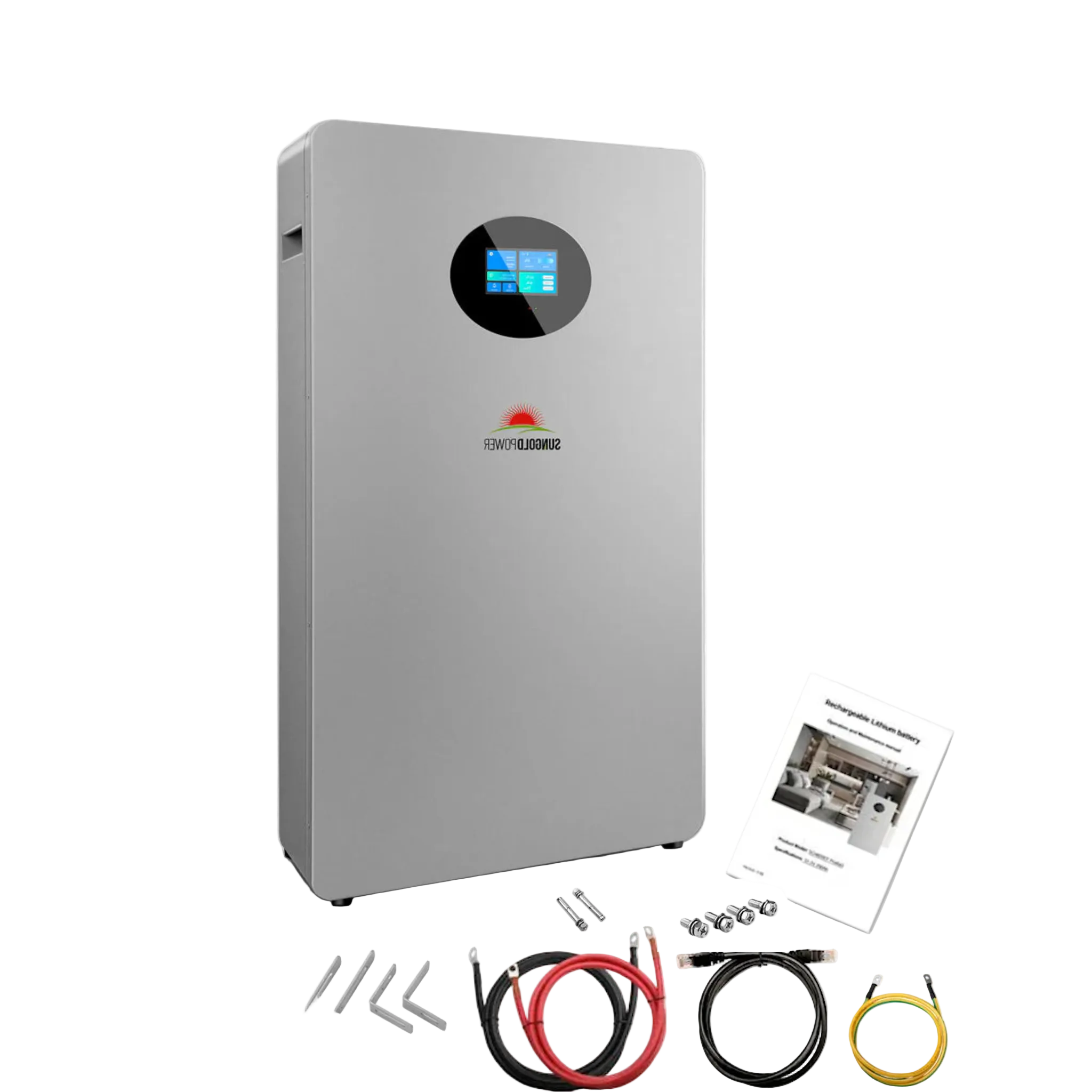
Each SG48200T ships in a wooden freight crate. The following items are included with every unit:
| Item |
Qty |
Notes |
| Battery pack (SG48200T) |
1 |
Ships pre-charged above 51.2V |
| User manual |
1 |
Includes wiring diagrams for 16 inverter brands in Appendix I |
| Power cables (1/0 AWG) |
1 set |
Red positive and black negative, 1,500mm each |
| Grounding cable |
1 |
Yellow/green, 1,000mm |
| Battery communication cable |
1 |
RJ45, 1,000mm for battery-to-battery linking in parallel arrays |
| Floor-to-wall fixed brackets |
2 |
L-shaped steel, for standard floor-mount installation |
| Expansion screws (M6 x 50) |
2 |
For floor bracket anchoring |
| Mounting screws (assorted) |
1 set |
For bracket assembly |
Not included wall mount bracket kit: If you plan to hang the battery on a wall, the optional wall mount kit (sold separately) contains: 1 horizontal wall rail, 2 battery side brackets, 2 limit brackets, 4 M10 x 80 expansion screws, and 12 M6 x 16 screws. Wall mounting requires drilling into concrete or masonry standard drywall alone cannot support the battery weight.
Not included inverter communication cable: The cable connecting the battery to your inverter's CAN or RS485 port is selected based on your inverter brand (Version I, II, or III, or custom). Pinout specifications for each brand are provided in Appendix I of the user manual.
Who Is This For
This battery is a DC energy storage component that works within a larger solar or backup power system. It is not a standalone plug-and-play device. It requires a separately purchased compatible inverter/charger, proper DC wiring, and in most cases a licensed electrician for the final connection to a home electrical panel.
| Home backup power |
Homeowners who want power available during grid outages for essential loads refrigerator, lighting, internet router, sump pump, or medical equipment such as CPAP machines and oxygen concentrators. |
| Solar energy storage |
Households with existing or planned solar panels who want to store excess daytime generation for use at night or during cloudy periods rather than sending unused energy back to the grid. |
| Off-grid systems |
Rural properties, cabins, farms, or workshop buildings where grid connection is unavailable or impractical. Multiple units connect in parallel to scale storage to the system's requirements. |
| Time-of-use management |
Customers on time-of-use utility plans who want to charge the battery during off-peak hours and draw from it during on-peak hours. |
| Commercial and light industrial |
Small businesses, agricultural operations, or commercial facilities needing scalable on-site energy storage. Up to 32 units connect in parallel for 328 kWh combined capacity. |
| DIY solar builders |
Technically capable installers or homeowners building a custom 48V battery bank with a compatible hybrid or off-grid inverter. The user manual includes full wiring diagrams, DIP switch settings, and step-by-step commissioning procedures for each supported inverter brand. |
This battery is not suited for: direct connection to AC loads without an inverter, use in 12V or 24V battery systems, portable power station applications, or any installation where no compatible inverter/charger is present. The unit weighs approximately 198 lbs (90 kg) and requires two people and appropriate lifting equipment for safe handling and installation.
If you are unsure whether this battery is compatible with your system, contact us before purchasing.
FAQ
Is this battery compatible with my inverter?
The SG48200T supports CAN bus, RS485, and RS232 protocols and includes pin-by-pin wiring diagrams for 16 inverter brands: Victron, Sol-Ark, Growatt, Goodwe, SMA, Schneider, Solis, SAJ, Deye, Megarevo/INVT, Luxpower, Sunsynk, Alpha/Outback, Voltronic, Phocos, and MPP Solar. For inverters not on this list, contact us to confirm compatibility before purchasing.
What inverter do I need to use with this battery?
You need a 48V hybrid or off-grid inverter/charger with CAN or RS485 battery communication support. The manufacturer recommends a 1:2 inverter-to-battery ratio for example, a 5kW inverter paired with one battery (10 kWh), or a 10kW inverter paired with at least two batteries (20 kWh). SunGold Power offers compatible inverters in 6kW, 10kW, 12kW, and 18kW split-phase configurations. Other compatible brands include Growatt, Victron, Sol-Ark, Goodwe, and Deye, among others. Confirm your inverter has a CAN or RS485 battery communication port before purchasing.
Does this battery work without solar panels?
Yes. The battery charges from the grid through a compatible inverter/charger, from solar panels through an MPPT charge controller or hybrid inverter, or from a generator. It operates in on-grid, backup, and off-grid modes depending on the inverter configuration.
Do I need an electrician to install this?
Mounting the battery and connecting it to the inverter with the provided DC cables can be done by a knowledgeable installer following the user manual. Connecting the inverter to your home electrical panel required for backup or grid-tied operation must be performed by a licensed electrician in most jurisdictions. The user manual labels certain steps "Qualified Person Only" for this reason.
How long will one battery power my home during an outage?
Runtime depends on the loads connected. One 10.24 kWh unit can power a refrigerator (approximately 150W), LED lighting (approximately 100W), internet router (approximately 20W), and device charging (approximately 50W) for roughly 20 to 30 hours. Running central air conditioning or electric heat significantly reduces that time. For whole-home backup, most customers connect two or more units. The manufacturer recommends pairing a 10kW inverter with at least 2 batteries (20 kWh) based on the 1:2 ratio guideline.
Can I run medical equipment such as a CPAP or oxygen concentrator on this battery?
A CPAP machine typically draws 30 to 60 watts. A home oxygen concentrator draws approximately 150 to 300 watts depending on the model. One SG48200T unit contains enough stored energy to power both devices for several hours during an outage when paired with a compatible inverter. Always verify your specific equipment power requirements and consult your medical provider before relying on any battery backup for critical medical equipment.
Can I add more batteries later?
Yes. Up to 32 units connect in parallel using the daisy-chain RJ45 communication cable and parallel power cables. Each additional battery adds 10.24 kWh of storage, up to 328 kWh combined. The manufacturer recommends maintaining a 30 to 50% charge margin in the existing bank when adding new units to support system stability.
Is it safe to install this battery indoors or in a garage?
LiFePO4 chemistry does not produce thermal runaway under normal operating conditions, making it suitable for enclosed spaces including garages and utility rooms. The battery holds UL1973 and UL9540A certifications, which address fire safety for stationary energy storage systems. Do not install near open flames, heat sources above 80°C, or in areas exposed to direct rain or standing water. Discharge operating range is 14°F to 122°F (-10°C to 50°C).
What inverter settings do I need to program?
Settings from the manufacturer commissioning table: Absorption voltage 56.0V, Float voltage 54.6V, Low voltage cut-off 48.0V, Recharge start voltage 50V or above, Restart voltage 52V, Low SOC cut-off for off-grid 4%, Low SOC limit for grid-tied 10 to 20% depending on inverter brand. Current limits scale with the number of units connected: rated charge and discharge 100A per battery, maximum charge and discharge 200A per battery.
How many solar panels are needed to charge this battery in one day?
To fully charge one 10.24 kWh battery during 5 peak sun hours, approximately 2,000 to 2,500 watts of solar panel capacity is needed roughly 7 to 8 panels at 300W each, accounting for typical system losses. Fewer peak sun hours or shading on the array will reduce the amount charged each day.
Can I wall-mount this battery?
Yes, with the optional wall mount bracket kit sold separately. Wall mounting requires drilling into concrete or masonry with M10 x 80 expansion bolts at a minimum 60mm depth. Standard drywall alone cannot support the battery weight of approximately 198 lbs. The floor mount brackets included with the unit are the simpler option and require no drilling into walls.
How do I connect multiple batteries together?
Set the first battery as Master by turning the M/S switch ON, and set all additional batteries as Slave with the M/S switch OFF. Connect batteries using the RJ45 communication cable daisy-chained from the Link OUT port of each battery to the Link IN port of the next. The Master battery's Link IN port remains empty. Connect DC power cables in parallel between all units. The WiFi module connects to the Master battery's IOT port and covers all units in the bank.
What happens if the battery is over-discharged?
When the battery reaches the low voltage cut-off threshold (48.0V), the BMS stops discharging and enters protection mode. The manufacturer recommends reconnecting a charge source within 24 hours to avoid potential cell damage from extended deep discharge. To reactivate after an over-discharge event, connect a solar, grid, or generator charge source, or press the reset button on the battery panel.
What does the 10-year warranty cover?
The 10-year warranty covers manufacturing defects under normal operating conditions. It does not cover damage from improper installation, operation outside rated parameters, physical damage, water exposure, or unauthorized modifications. A purchase receipt is required to establish the warranty start date. Products purchased through unauthorized resellers may not qualify. For full warranty details, see our Warranty tab or contact us directly.