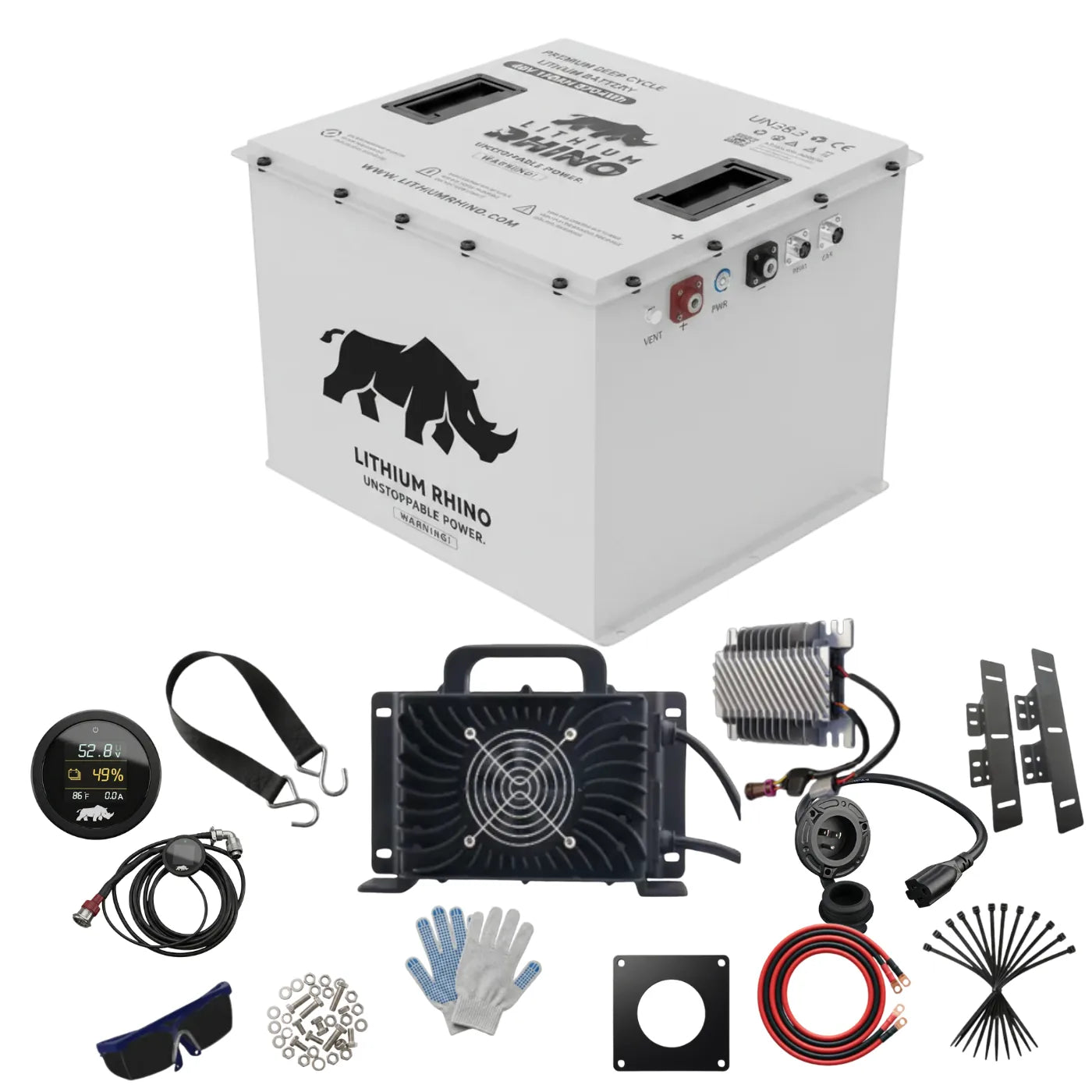
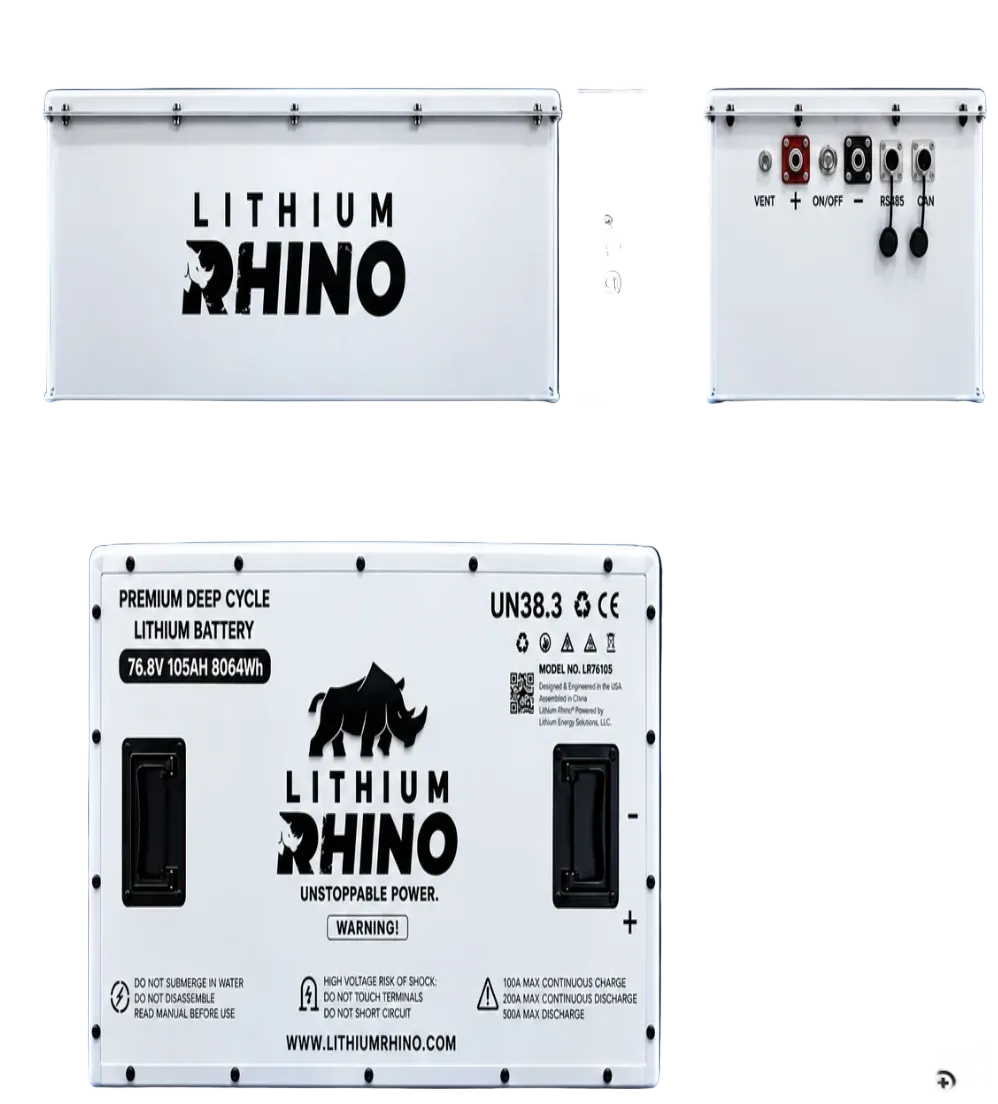
The Lithium Rhino 76V 105Ah Self-Heated Conversion Kit (SKU LR76V105AH) is a 76.8V nominal, 105Ah, 8,064Wh lithium iron phosphate (LiFePO4) golf cart battery made by Lithium Rhino for 72V golf carts, low-speed vehicles, and high-amp AC motor builds. It replaces a 72V lead-acid bank with a single battery and ships as a complete kit with charger, 12V reducer, gauge, cables, and mounting hardware.
This is the battery to build around when your cart runs a high-amp controller. Inside are 24 Grade A EVE LiFePO4 prismatic cells managed by Lithium Rhino's proprietary BMS, rated for 300A continuous, 600A for 30 seconds, and 800A for 1 second, switched through a high-current relay. That headroom supports hard launches and hill climbs on AC conversions such as the Navitas TAC3 850A with a 7.5kW motor, when the controller is programmed to the battery's limits.
Self-heated charging lets the battery warm its cells when temperatures drop below freezing, then begin charging once the cells reach a safe temperature. A built-in Bluetooth module connects to the free Lithium Rhino app for live state of charge, per-cell voltage, temperature, fault alerts, and remote BMS support.
Key features
- 76.8V nominal, 105Ah, 8,064Wh of stored energy; charges to 87.6V
- 300A continuous / 600A (30 s) / 800A (1 s) BMS with high-current relay
- Self-heated charging for cold garages and winter use
- 24 Grade A EVE LiFePO4 cells, rated 6,000+ cycles
- IP65 splash-resistant case; -4°F to 140°F operating range
- Bluetooth app (iOS and Android) plus 3-inch color round gauge with dash power button
- 50A / 600W 12V reducer with trigger wire for lights and accessories
- 8-year manufacturer warranty: 6 years full replacement, years 7–8 at a flat $500
Built for
- 72V golf carts, including Bad Boy Buggies and other factory 72V carts
- 72V GEM low-speed vehicles
- Custom and lifted carts converted to 72V AC drive (Navitas TAC2/TAC3 and similar high-amp controllers)
- Owners replacing six 12V or nine 8V lead-acid batteries with one maintenance-free pack
Specifications
| Specification |
Value |
| Brand / Model |
Lithium Rhino 76V 105Ah Self-Heated Conversion Kit |
| SKU / UPC |
LR76V105AH / 759675116614 |
| Chemistry |
LiFePO4 (lithium iron phosphate), Grade A EVE prismatic cells |
| Configuration |
24 cells in series (24S) |
| Nominal voltage |
76.8V (for 72V systems) |
| Full-charge voltage |
87.6V |
| Capacity |
105Ah |
| Stored energy |
8,064Wh (8.06 kWh) |
| Continuous discharge |
300A |
| Peak discharge |
600A for 30 seconds / 800A for 1 second |
| Max charge current |
50A |
| Cell balance accuracy |
±20mV |
| Cold-weather charging |
Self-heated (warms cells below freezing, then charges) |
| Operating temperature |
-4°F to 140°F |
| Ingress rating |
IP65 (splash resistant; do not pressure wash) |
| Rated cycle life |
6,000+ cycles |
| Monitoring |
Bluetooth app (iOS/Android) + 3" color round gauge |
| Dimensions (L x W x H) |
24.4" x 13.4" x 9.3" (62.0 x 34.0 x 23.6 cm) |
| Battery weight |
153 lb (69.4 kg) |
| Kit shipping weight |
198 lb (89.8 kg), wooden crate, freight delivery |
| Warranty |
8 years (6 years full replacement, years 7–8 flat $500); kit components 2 years |
What's in the Box
- Lithium Rhino 76V 105Ah self-heated LiFePO4 battery with integrated BMS and Bluetooth module
- Lithium Rhino smart lithium charger with mount
- 50A / 600W 12V voltage reducer with trigger wire
- 3-inch two-page color round gauge with dash power button and mount
- Heavy-duty charge port adapter plug and charge port plate
- Charging cable and 15 ft 12AWG lithium extension cord
- 48" (4 ft) 2AWG pure copper main cables
- Universal mounting brackets, mounting hardware, and bracket drill bit
- Lead-acid removal strap
- Safety gloves, safety glasses, and heavy-duty zip ties
- Lithium Rhino license plate
- Free Lithium Rhino mobile app access and remote install support
Kits ship in a metal-reinforced wooden crate by freight. Plan for someone to receive the delivery, and inspect the crate before signing.
Range and Performance
Range on a 72V cart depends far more on speed, tire size, weight, and terrain than on the battery alone. Energy use climbs quickly above 25 mph because wind resistance rises with the square of speed. The table below shows our estimates for this 8.06 kWh battery, assuming roughly 7.3 kWh used per charge with a reserve left in the pack.
| Cart setup |
Typical speed |
Estimated range |
| Stock-height 72V cart, stock motor, 2 passengers, mostly flat |
15–20 mph |
50–65 miles |
| Lifted, 20–22" tires, 4 passengers, mid-range AC kit (440–600A controller, 4–5kW motor) |
20–28 mph |
35–45 miles |
| Navitas TAC3 850A + 7.5kW AC motor, lifted, 22–23" tires |
30–40 mph cruising |
27–35 miles |
| Navitas 850A + 7.5kW driven hard: frequent full-throttle launches, steep hills, or 45+ mph |
40+ mph |
18–25 miles |
Estimates only, not manufacturer ratings. Actual range varies with driving style, payload, tire pressure, terrain, temperature, and accessories.
Using a high-amp controller
AC controllers like the Navitas TAC3 850A can request more current than any golf cart battery should deliver continuously. Navitas controllers let you program the battery current limit and low-voltage cutback, so set them to match this battery: keep sustained draw at or below 300A, and let short bursts use the 600A (30 s) and 800A (1 s) headroom. Lithium Rhino's warranty excludes damage from discharge beyond the battery's rating, so confirm your controller settings with Lithium Rhino tech support before your first drive.
If the BMS shuts the battery off during hard acceleration, the controller is asking for more current than the BMS allows. Lower the battery current limit or acceleration rate in the controller settings.
Need more range?
For 6-seat carts, high-speed builds, or long daily routes, the Lithium Rhino 76V 170Ah "Godzilla" kit stores about 62% more energy with the same 300A BMS class.
Compatibility
Compatible with
- 72V golf carts and LSVs, including Bad Boy Buggies and 72V GEM vehicles
- 72V AC conversions such as Navitas TAC2 and TAC3 (48V/72V) controllers, when programmed within the battery's current limits
- Carts converting from a 72V lead-acid bank (six 12V or nine 8V batteries)
Not a direct fit for
- 48V or 36V carts running their original controller, motor, and solenoid. Moving to 72V requires a 72V-rated controller and solenoid at minimum; 12V accessories run through the included reducer.
- Carts with factory lithium systems that require CAN communication with the OEM controller or charger
Not sure about your cart? Send us your make, model, year, controller, and motor, and we will confirm fit before you order.
FAQ
Will the Lithium Rhino 76V 105Ah fit my cart?
It is built for 72V systems, including Bad Boy Buggies, 72V GEM vehicles, and carts converted to 72V AC drive. The battery measures 24.4" x 13.4" x 9.3" and the kit includes universal mounting brackets. Send us your cart's make, model, year, controller, and motor and we will confirm fit before you order.
Can I put this battery in a 48V golf cart?
Not with the stock 48V controller and solenoid. A 76.8V battery that charges to 87.6V will overload 48V-only components. To run 72V you need a 72V-rated controller and solenoid at minimum, which is why this battery is most often paired with a 48V/72V AC kit such as the Navitas TAC3. The included 12V reducer handles lights and accessories from the 72V pack.
Does it work with a Navitas TAC3 850A controller and 7.5kW AC motor?
Yes. The Navitas TAC3 850A kit is sold for 48V and 72V systems, and this battery's 300A continuous, 600A (30 s), and 800A (1 s) BMS is designed for high-amp builds. Program the controller's battery current limit so sustained draw stays at or below 300A. Confirm your controller's maximum input voltage with your dealer, since this battery reaches 87.6V at full charge.
How should I set my Navitas controller for this battery?
Use the Navitas app or On-The-Fly programmer to set the battery current limit within the BMS rating (300A sustained, short bursts up to 600A for 30 seconds), and set the low-voltage cutback to protect the pack. If the battery shuts off during hard acceleration, lower the current limit or acceleration rate. Lithium Rhino tech support can review your settings, which we recommend before the first drive.
How many miles will I get per charge?
We estimate 50–65 miles on a stock-height 72V cart at 15–20 mph, 35–45 miles on a lifted 4-passenger cart with a mid-range AC kit, and 27–35 miles on a Navitas 850A and 7.5kW build cruising at 30–40 mph. Hard launches, steep hills, and speeds above 40 mph can bring that to 18–25 miles. These are estimates, not manufacturer ratings.
Why does range drop so much at higher speeds?
Wind resistance increases with the square of speed, so a cart at 40 mph pushes roughly four times the air resistance it does at 20 mph. Larger tires, lift kits, extra passengers, and frequent full-throttle starts add to it. Setting a top speed in your controller is the most effective way to extend range.
What does self-heated charging mean?
LiFePO4 cells can be damaged if charged below 32°F. When the battery is plugged in below freezing, it warms its own cells first and starts charging once they reach a safe temperature. That makes it suitable for unheated garages, barns, and winter storage with the charger connected.
How long does it take to charge?
Charge time depends on how depleted the battery is. From fully empty, expect roughly 6.5 hours with the included charger. Most riders top up from partial charge in less time, and lithium does not need to be fully drained before charging.
What is the difference between 76.8V and 72V?
They describe the same system class. 72V is the traditional lead-acid rating; 76.8V is the nominal voltage of a 24-cell LiFePO4 pack (24 x 3.2V). LiFePO4 holds its voltage higher through the discharge, so carts often feel stronger later in the ride than they did on lead-acid.
Can I keep using my old lead-acid charger?
No. Use the included Lithium Rhino charger or a charger that meets Lithium Rhino's published specifications. Lead-acid chargers use the wrong charge profile, and non-compliant charging voids the battery warranty.
Will my lights, radio, and accessories still work?
Yes. The kit includes a 50A / 600W 12V voltage reducer with a trigger wire for headlights, taillights, horns, USB ports, and audio. Very large sound systems or light bars may need a higher-capacity reducer.
How long does installation take?
Lithium Rhino reports that most installs take 2–4 hours. The kit includes pre-sized copper cables, brackets, hardware, and a drill bit, and Lithium Rhino offers a free 30-minute video support call. Some carts need small wire connectors or tray modifications depending on the model.
How much does it weigh compared to lead-acid?
The battery weighs 153 lb. A typical 72V lead-acid bank of six 12V batteries weighs well over 350 lb, so most carts lose about 200 lb or more, which improves acceleration and reduces wear on suspension and tires.
Can I connect a second battery for more range?
Lithium Rhino's warranty allows up to three batteries in parallel. Series connections are not permitted. Confirm any parallel setup with Lithium Rhino tech support before installing.
Can I monitor the battery from my phone?
Yes. The built-in Bluetooth module connects to the free Lithium Rhino app for iOS and Android. It shows state of charge, voltage, and per-cell temperature, logs faults and cycle history, and lets Lithium Rhino run remote BMS diagnostics. There is no subscription.
What does the warranty cover?
Lithium Rhino warrants the battery for 8 years. Years 1–6 include full repair or replacement with shipping covered. In years 7–8 you pay a flat $500 and Lithium Rhino covers the rest, or you can apply $500 as credit toward a new Rhino kit. Kit components such as the charger, reducer, and gauge are covered for 2 years. Register within 120 days of purchase or coverage is limited to 1 year.
Can I use this battery in a fleet or rental cart?
Yes, but commercial use such as fleet, rental, or daily business operation requires written approval from Lithium Rhino for full coverage. Without approval, warranty coverage is limited to 3 years.
Should I choose the 76V 105Ah or the 76V 170Ah?
Choose the 105Ah if your cart carries up to 4 passengers, you ride mostly in a neighborhood or on the course, and you want a lighter, more compact pack. Choose the 170Ah if you run a 6-seat cart, regularly drive above 30 mph, or need longer daily range from a high-amp AC build.
Warranty
Lithium Rhino 8-Year Limited Warranty
- Years 1–6: full repair or replacement, shipping included
- Years 7–8: flat $500 deductible; Lithium Rhino covers shipping and remaining costs, or apply $500 as credit toward a new Rhino kit
- Kit components (charger, reducer, gauge, harnesses): 2 years full replacement, then 50% of MSRP for the life of the model
- Register within 120 days of purchase to activate full coverage
- Commercial use requires written approval for full coverage
Coverage excludes improper installation or wiring, discharge beyond the battery's rating, non-approved chargers, opening the case, pressure washing or water intrusion, storage fully discharged, and use outside the United States. Lithium Battery Supply is an authorized Lithium Rhino dealer.