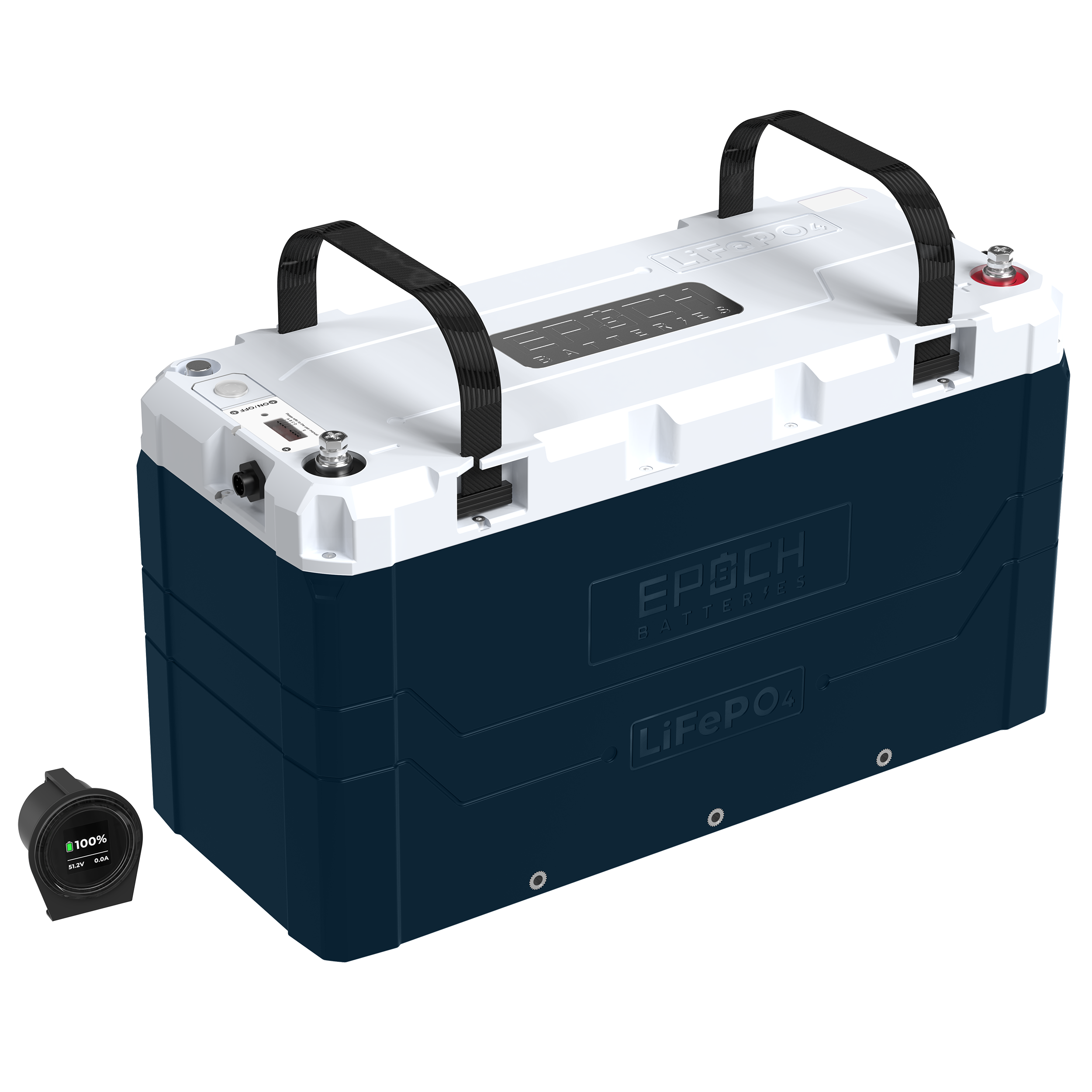
The Epoch 24V 230Ah V2 Elite (model C24230A) is a 24V marine lithium battery: a 25.6V, 230Ah lithium iron phosphate (LiFePO4) deep-cycle battery that stores 5,888Wh (5.89kWh) in a single case. It is made by Epoch Batteries, and Lithium Battery Supply sells it as an authorized Epoch dealer with Epoch's 11-year limited manufacturer warranty.
On the water, it is built for two jobs: running 24V trolling motors and powering 24V house banks on center consoles, bay boats, cruisers, sportfishers and liveaboard yachts. One battery replaces the two 12V batteries a 24V system normally needs, so there is no series jumper to corrode, one battery management system (BMS) to monitor, and fewer connections to inspect in a damp compartment.
For boat owners, three features matter most: native CAN communication with Victron GX devices on Victron-equipped vessels, Bluetooth monitoring through an included gauge you can mount at the helm, and self-heating for charging boats stored or launched in freezing weather. The same battery also suits 24V RV and off-grid systems. It is a deep-cycle battery, not a starting battery.
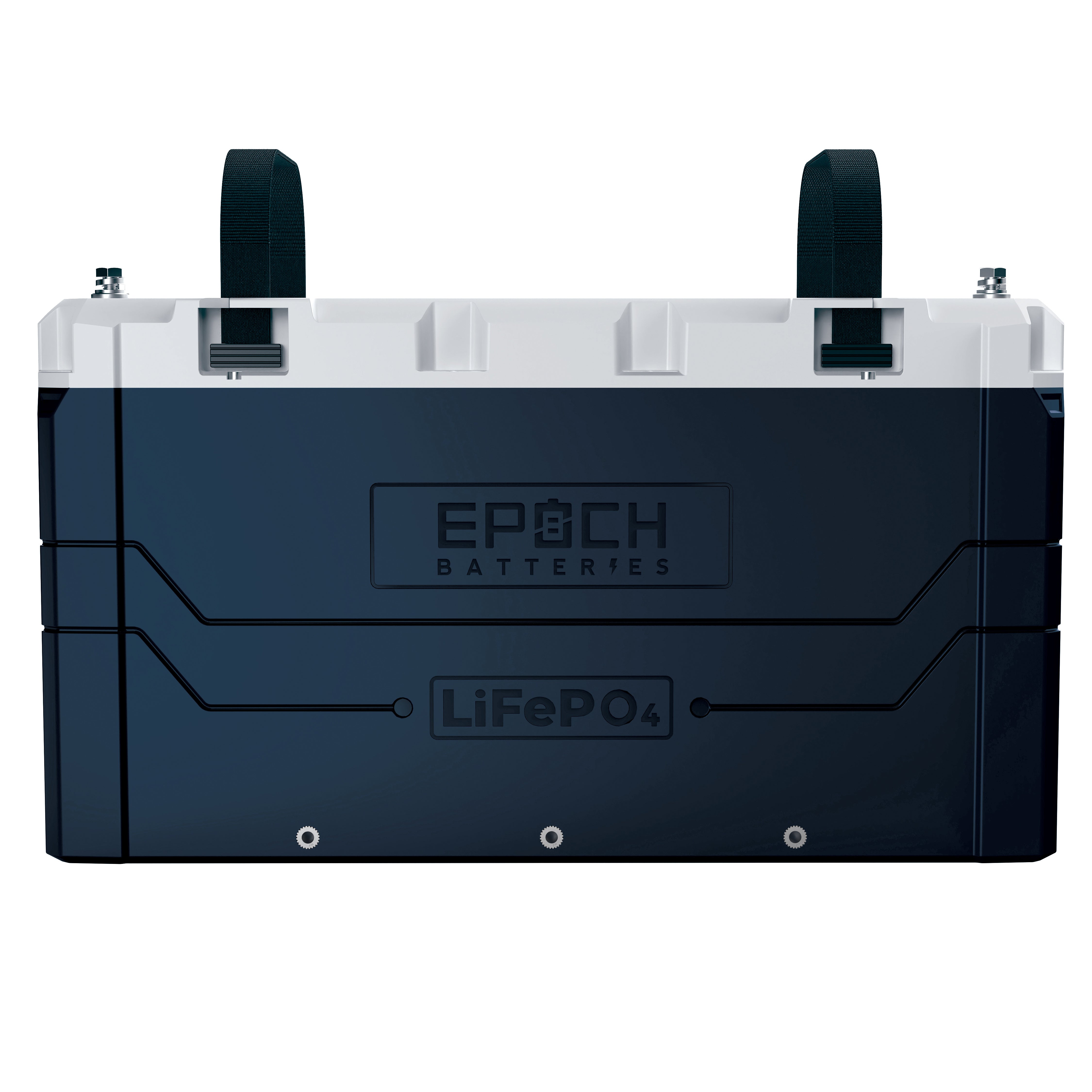
Check fit before ordering: 20.86 in L × 8.65 in W × 12.06 in H (height includes terminal posts), 97 lb. If you are replacing a Group 8D battery, compare these dimensions with your tray, hold-down and lid clearance. It does not fit Group 27 or Group 31 trays. Mounting bracket sold separately; plan for a two-person lift.
Features
5.89kWh in one 24V case
230Ah at 25.6V nominal works out to 5,888Wh of stored energy. On a boat, building the same energy from smaller batteries means more cases, more interconnects and more lugs exposed to salt air. A single C24230A keeps the bank simple, and you can still add batteries in parallel later as your electronics and house loads grow.
Capacity vs. current: what 230Ah and 110A mean
These two numbers describe different things. 230Ah is capacity, how much charge the battery holds. 110A is the maximum continuous current, how fast it can safely deliver or accept that charge. At 25.6V, 110A continuous is about 2,816W DC before inverter losses. The battery can supply up to 300A peak discharge for a short duration and accept up to 200A charge for a short duration; Epoch does not publish a fixed time for the 300A peak, so size your system around the 110A continuous rating.
Self-heating for cold-weather charging
Useful for boats stored, launched or fished in freezing weather: LiFePO4 cells should not be charged below 0°C (32°F). When a charge source is connected and the cells are too cold, the BMS holds off charging and uses power from that charge source to run an internal heater. Charging resumes automatically once the cells reach 5°C (41°F). With self-heating, Epoch rates charging from an ambient temperature of -30°C (-22°F). Discharge is rated from -20°C to 55°C (-4°F to 131°F). The heater works during charging only, so expect a short delay before charge current flows on a cold morning.
Bluetooth monitoring through the included gauge
Bluetooth runs through the external battery gauge that ships with the battery. Pair it with the Epoch Li-Ion app (iOS and Android) to see state of charge, voltage, current, individual cell voltages, temperatures, history and warnings, and to install firmware updates. Mount the gauge at the helm, console or cabin for at-a-glance state of charge without a phone.
Native CAN communication with Victron GX
The battery communicates over CAN bus at 500 kbit/s with compatible Victron GX devices such as the Cerbo GX, Ekrano GX and Cerbo GX Mk2. With DVCC enabled, the battery reports its status and sets the charge voltage and current limits that Victron chargers follow. A Victron GX device is required for this integration; inverters, chargers and solar controllers connect through the GX device, not directly to the battery. See the Victron & Charging tab for setup.
IP67 enclosure
The case is rated IP67: dust-tight and protected against temporary immersion in up to 1 meter of water for 30 minutes. That rating covers accidental exposure. It does not cover pressure washing, water jets or continuous submersion, so on a boat, mount it upright and secured in a compartment that stays dry in normal use, above bilge water and away from spray, with all harness connectors fully seated.
Smart BMS and internal fuse
The BMS protects against over-voltage, under-voltage, over-current, short circuit and out-of-range temperature. A 270A internal fuse (UL 60691) adds a further layer of protection. The internal fuse does not replace system protection: install a DC-rated fuse or breaker near the battery positive, sized for your system.
Scalable banks
Connect up to 16 batteries in parallel for 3,680Ah at 24V, or 2 in series for a 51.2V nominal (48V-class) system. Use matched C24230A batteries of the same age and state of charge.
Long rated life, low upkeep
Epoch rates the C24230A for 3,500+ cycles. There is no watering or equalizing; periodic inspection and terminal torque checks (8–12 N·m) are all the routine care it needs. Self-discharge is rated at 3% per month or less.
Marine Systems
24V trolling motors
A single C24230A replaces the two 12V batteries a 24V trolling motor normally runs on. Connect the motor's positive lead to the battery positive and its negative lead to the battery negative; no series jumper is needed. Check your motor's maximum current draw in its manual and confirm it stays within 110A continuous. At 230Ah, one battery gives a long day on the water with reserve for multi-day trips or electronics on the same bank. Plan for the 8D-class footprint and 97 lb weight compared with Group 27 or Group 31 batteries.
24V house banks
On center consoles, bay boats, cruisers, sportfishers and liveaboard vessels, the C24230A powers house loads such as chartplotters, sonar, radar, livewell and bilge pumps, refrigeration, lighting and inverter circuits. Each battery adds 5.89kWh, and up to 16 can run in parallel. Larger inverter loads, such as galley appliances or air conditioning, may need two or more batteries so each stays within its 110A continuous rating.
Victron-equipped yachts and cruisers
On boats with a Victron GX device (Cerbo GX, Ekrano GX or Cerbo GX Mk2), the battery reports its state of charge and charge limits over CAN bus. With DVCC on, the MultiPlus or Quattro, MPPT solar controllers and other Victron chargers follow the battery's limits, and bank data appears on the GX display. See the Victron & Charging tab for setup.
Charging on board
Shore power chargers, inverter-chargers and solar controllers must be programmed to Epoch's LiFePO4 settings. For engine charging from an outboard or inboard alternator, use a DC-DC charger or an alternator regulator set up for lithium, and follow the engine or alternator manufacturer's guidance.
Marine installation notes
- Mount upright and secure the battery against vibration and wave impact.
- Choose a dry, ventilated compartment above bilge water and away from spray. IP67 covers temporary immersion, not continuous submersion or washdown.
- Follow ABYC E-11 for conductor sizing and place a DC-rated fuse or breaker close to the battery positive.
- Use marine-grade tinned copper cable and keep terminal covers fitted.
Beyond the boat
The same battery also serves 24V RV, overland, off-grid solar and backup systems. See the Applications tab for the full list.
Planning runtime
Epoch's technical data sheet plans runtime on 80% of nominal energy (4,710Wh, or 184Ah), which leaves a reserve for battery life and cold conditions. Estimated runtime for a constant DC load at the battery terminals:
| Constant DC load |
Estimated runtime |
| 100W |
about 47 hours |
| 250W |
about 19 hours |
| 500W |
about 9.4 hours |
| 1,000W |
about 4.7 hours |
| 1,500W |
about 3.1 hours |
| 2,000W |
about 2.4 hours |
| 2,816W (110A continuous) |
about 1.7 hours |
| Constant DC current |
Estimated runtime (184Ah) |
| 5A |
about 36.8 hours |
| 10A |
about 18.4 hours |
| 25A |
about 7.4 hours |
| 50A |
about 3.7 hours |
| 100A |
about 1.8 hours |
| 110A |
about 1.7 hours |
These are planning estimates, not guarantees. Inverter losses, cable losses, temperature and changing loads reduce real-world runtime.
Not intended for
- Engine starting or cranking (this is a deep-cycle battery)
- 12V systems (this is a 24V battery)
- Mixing with other battery brands, models or chemistries in the same bank
Applications
Epoch lists these applications for the 24V 230Ah V2 Elite (C24230A). It is a 24V deep-cycle battery for house power and energy storage, not engine starting.
Marine
Marine house power
24V house banks for electronics, pumps, lighting and inverter circuits.
24V trolling motors
One battery in place of two 12V batteries wired in series.
Marine electronics and fish finders
Chartplotters, sonar, radar and livewells on one 24V bank.
Yachts and cruising boats
Scalable house banks with Victron GX integration.
RV and vehicles
RV house power (24V systems)
5.89kWh per battery for 24V coach house loads.
Motorhomes and Class A or Class C coaches
Parallel banks for larger inverter and appliance loads.
Travel trailers and fifth wheels
24V house power with Bluetooth monitoring.
Camper vans and van life
For 24V van builds with room for an upright 8D-size case.
Overlanding and expedition vehicles
Self-heating supports charging at cold camps.
Off-grid and energy storage
Off-grid solar systems
Pairs with 24V MPPT controllers programmed to Epoch settings.
Solar battery banks and inverter systems
Up to 16 in parallel: 3,680Ah, about 94.21kWh.
Home energy storage and backup power
24V backup with an inverter-charger; local codes may apply.
Cabins and remote power systems
Charging supported from -30°C (-22°F) ambient with self-heating.
Systems and specialty
Victron-based systems with a compatible GX device
CAN at 500 kbit/s; DVCC hands charge control to the battery.
Communications backup
Low self-consumption and ≤3% per month self-discharge for standby use.
Commercial fleet and specialty power systems
24V deep-cycle power within 110A continuous per battery.
Victron & Charging
Charger settings (Epoch V02)
Program every charge source (inverter-charger, shore charger, solar controller and DC-DC charger) to these values, including Victron equipment that will normally run under DVCC. The manual settings take over if CAN communication is lost.
| Specification |
Value |
| Charger type |
Lithium (LiFePO4) compatible |
| Bulk / absorption voltage |
28.4V |
| Absorption time |
At least 15 minutes per battery in the bank (e.g., 60 minutes for four batteries) |
| Float voltage |
27.0V |
| Re-bulk voltage |
26.6V |
| Equalization |
Disabled |
| Temperature compensation |
Disabled (0 mV/°C) |
| Maximum continuous charge current |
110A per battery (total of all charge sources) |
| Maximum charge current, short duration |
200A |
Do not use lead-acid, AGM or gel profiles, equalization, desulfation or repair modes. The battery's operating voltage range is 20.0V to 29.2V; never charge above 29.2V.
Connecting to a Victron GX device
- Set the 8 DIP switches on every battery. A single battery uses the standalone setting (switches 1, 2 and 4 ON); banks use the Master, slave and position settings in Epoch's technical data sheet and user manual.
- Insert the communication harness (the end with the waterproof plug) into the blue port of the battery set as Master.
- For a bank, link batteries with RJ45 cables: Master black port to the next battery's blue port, and so on, up to 16 batteries in parallel. Battery-to-battery RJ45 cables are not listed in the box contents.
- Connect the harness's grey RJ45 plug to the GX device: the BMS-CAN port on a Cerbo GX or Ekrano GX, or VE.Can 1 or VE.Can 2 on a Cerbo GX Mk2. On a VE.Can port, set the port speed to 500 kbit/s under Settings > Services > VE.Can.
- Switch on the batteries.
- On the GX device, turn on DVCC and set both the controlling BMS and the battery monitor to Epoch.
- Confirm the Epoch battery appears in the device list, the modules-online count matches the number of batteries, and the installed capacity equals 230Ah per battery (e.g., 920Ah for four).
- Program the manual fallback settings above into the MultiPlus, Quattro and every other charge source.
While charging, the inverter tile on the GX display shows "External control." That is normal and means the battery is managing the charge limits.
Inverter sizing
DC current from the battery is roughly the AC load divided by (battery voltage × inverter efficiency). For example, assuming 90% efficiency, a 1,500W load draws about 1,500 ÷ (25.6 × 0.90) ≈ 65A, within one battery's rating. A 3,000W load draws about 130A, which exceeds 110A continuous, so it calls for at least two batteries in parallel. Check your inverter's maximum continuous DC input current, and size cables, fusing and disconnects for the full system current.
Bank sizing
| Batteries in parallel (24V) |
Bank capacity |
Nominal energy |
| 1 |
230Ah |
5.89kWh |
| 2 |
460Ah |
11.78kWh |
| 4 |
920Ah |
23.55kWh |
| 8 |
1,840Ah |
47.10kWh |
| 16 (maximum) |
3,680Ah |
94.21kWh |
Wire parallel banks to positive and negative busbars with equal-length battery cables so current shares evenly between batteries.
Two batteries in series form a 51.2V nominal string (58.4V at full charge); every charger, inverter, fuse and conductor must be rated for that voltage. Epoch's published DIP switch settings do not cover series-parallel arrays, so contact Epoch before designing one.
Tech Specs
Sources: Epoch C24230A Specification Sheet and Technical Data Sheet, Revision V02 (October 2026). Ratings at 25°C unless noted.
| Specification |
Value |
| General |
| Model / SKU |
C24230A |
| Series |
Epoch V2 Elite |
| Chemistry |
Lithium iron phosphate (LiFePO4) |
| Battery type |
Deep-cycle, house power and energy storage (not for engine starting) |
| Electrical |
| Nominal voltage |
25.6V (3.2V per cell) |
| Nominal capacity |
230Ah |
| Stored energy |
5,888Wh (5.89kWh) |
| Operating voltage |
20.0–29.2V |
| Maximum charge voltage |
29.2V (3.65V per cell); BMS high-voltage cutoff |
| Minimum voltage |
20.0V (2.5V per cell) |
| Cell type |
Prismatic LiFePO4 |
| Cell configuration |
8S1P (230Ah cells) |
| Cycle life |
3,500+ cycles |
| Self-discharge |
≤3% per month |
| Self-consumption |
20mA powered on; 200µA powered off |
| Maintenance |
Maintenance-free |
| Current |
| Maximum continuous discharge |
110A (about 2,816W DC at 25.6V) |
| Peak discharge |
300A (short duration) |
| Maximum continuous charge |
110A |
| Maximum charge, short duration |
200A |
| Charging |
| Bulk / absorption |
28.4V |
| Absorption time |
At least 15 minutes per battery in the bank |
| Float |
27.0V |
| Re-bulk |
26.6V |
| Equalization |
Disabled |
| Temperature compensation |
Disabled (0 mV/°C) |
| Victron GX |
DVCC on; controlling BMS: Epoch |
| Temperature |
| Charge (cell temperature) |
0 to 55°C (32 to 131°F) |
| Charge with self-heating (ambient) |
-30 to 55°C (-22 to 131°F) |
| Discharge |
-20 to 55°C (-4 to 131°F) |
| Storage, up to 1 month |
-20 to 45°C (-4 to 113°F) |
| Storage, up to 1 year |
0 to 35°C (32 to 95°F) |
| Best performance |
15 to 25°C (59 to 77°F) |
| Mechanical |
| Dimensions (L × W × H) |
20.86 × 8.65 × 12.06 in (529.8 × 219.8 × 306.3 mm) |
| Weight |
97 lb (approx. 44 kg) |
| Terminals |
M8 threaded; torque 8–12 N·m (71–106 lbf·in) |
| Terminal polarity (top view) |
Negative left, positive (red) right |
| Mounting |
Upright; threaded inserts for optional Epoch V2 & V2-T bracket (sold separately) |
| Case |
ABS + PC, UL94 V-0 |
| Enclosure |
IP67 |
| Communication and BMS |
| Bluetooth |
Via included battery gauge; Epoch Li-Ion app |
| CAN bus |
500 kbit/s; Victron GX |
| Series / parallel |
Up to 2 in series; up to 16 in parallel |
| BMS protection |
Over/under-voltage, over-current, short circuit, temperature |
| Internal fuse |
270A rated; 1,200A transient overload for 3 s; UL 60691 (TEX150-R1N-XBZ) |
| BMS protection thresholds |
| Overcharge |
29.2V (3.65V/cell); release 27.6V |
| Over-discharge |
21.6V (2.70V/cell); release 24.0V |
| Charge over-current |
200A after 5 s; release 125A |
| Discharge over-current |
280A after 5 s |
| Short circuit |
1,200A |
| Charge temperature |
Low 0°C (release 5°C); high 55°C (release 50°C) |
| Discharge temperature |
Low -20°C (release -17°C); high 55°C (release 50°C) |
| Compliance |
| Battery pack |
UL 1973 |
| Cells |
UL 1642; UL 9540A; IEC 62619:2022 |
| Other |
CE, RoHS |
| Transport classification |
UN 3480, Class 9 |
| Warranty |
| Manufacturer warranty |
11-year limited (see Warranty tab for terms) |
Compatibility
Will it fit?
The battery measures 20.86 in L × 8.65 in W × 12.06 in H (529.8 × 219.8 × 306.3 mm) and weighs 97 lb. If you are replacing a Group 8D battery, compare these dimensions with your tray, hold-down and lid clearance, and allow extra space above the lid for cable lugs, bend radius and service access (the 12.06 in height includes the terminal posts). Viewed from the top, the negative terminal is on the left and the positive (red) on the right. It will not fit Group 27 or Group 31 trays. Install it upright. The optional Epoch V2 & V2-T Mounting Hardware (8D battery bracket) is sold separately and fastens to threaded inserts on the case. Plan for a two-person lift.
What's in the box
- C24230A battery
- Communication harness (for Victron GX connection)
- Battery gauge with Bluetooth (mountable)
- Mountable ON/OFF switch
Per Epoch's V02 technical data sheet. The battery also has its own power button. Not included: mounting bracket (optional Epoch V2 & V2-T Mounting Hardware, sold separately), battery cables, battery-to-battery RJ45 cables for banks, fuses and chargers. Epoch notes that supplied hardware may vary by production revision.
Chargers and solar controllers
Any 24V charger, inverter-charger, solar charge controller or DC-DC charger works if it can be programmed to Epoch's values: 28.4V bulk/absorption, 27.0V float, 26.6V re-bulk, equalization off, temperature compensation off, and no more than 110A continuous per battery from all sources combined. If your current charger only offers lead-acid, AGM or gel profiles, it will need to be replaced.
Victron equipment
CAN integration requires a compatible Victron GX device (Cerbo GX, Ekrano GX or Cerbo GX Mk2). Victron inverter-chargers, MPPT controllers and other chargers follow the battery's limits through the GX device under DVCC. Without a GX device, the battery still works with Victron chargers programmed manually to the settings above.
Trolling motors
Compatible with 24V trolling motors whose maximum current draw stays within 110A continuous. Not for 12V or 36V motors without a separate voltage solution.
Installation and safety
- Install a DC-rated fuse or breaker as close to the battery positive as practical, sized for your system's maximum current; on boats, follow ABYC E-11 for conductor sizing and overcurrent protection.
- Size cables, busbars and disconnects for the full system current: up to 110A continuous per battery, more in parallel banks.
- Torque the M8 terminals to 8–12 N·m (71–106 lbf·in), keep terminal covers fitted, and recheck periodically.
- In parallel banks, use busbars and equal-length battery cables.
- Design the system so the BMS does not trip in normal use; protection thresholds are safety limits, not operating targets.
- Secure the battery against movement and vibration, upright, in a dry location away from standing water and spray.
- Use marine-grade tinned copper cable in saltwater environments.
- Secure the battery against wave impact as well as vibration on boats.
- For fire, Epoch specifies a Class D extinguisher, sand or dry powder.
- Read Epoch's user manual and safety data sheet before installation, or have a qualified installer complete the work.
FAQ