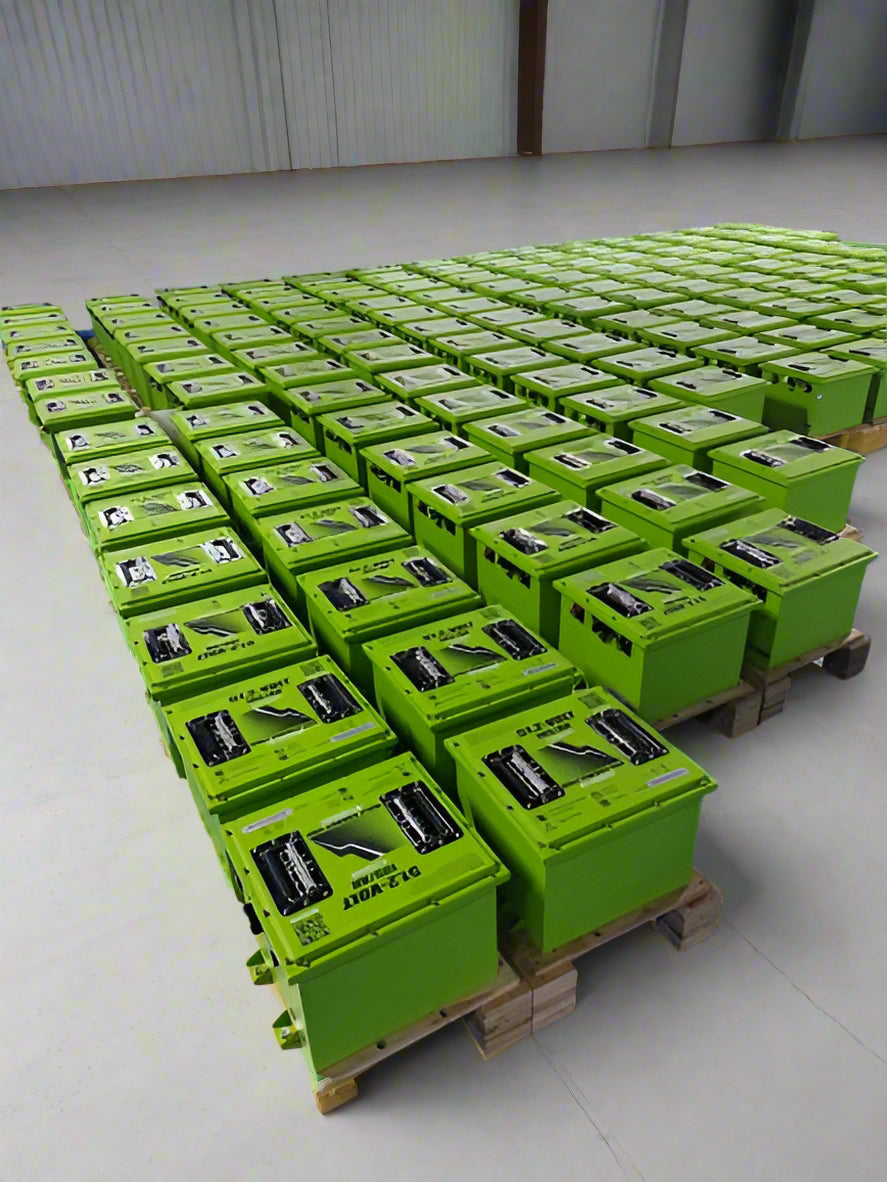
The Bolt Energy 48V 105Ah Thin is a complete lithium iron phosphate (LiFePO4) conversion kit for the Yamaha G19 (1996–2002) and Yamaha G22 / G-MAX (2003–2007). One battery replaces all six of your lead-acid batteries, includes everything needed to complete the swap, and is backed by a 12-year manufacturer warranty. The Thin is built specifically for the long, narrow battery tray found in the G19 and G22 the correct form factor for these models.
Here is what actually changes the day after you install it:
Six heavy, corroded batteries come out one sealed unit goes in their place
Your cart loses roughly 100 lbs of dead weight you feel it the first time you press the pedal
Hills that used to slow you down, you now climb without losing speed
The cart runs at the same power level from the first mile to the last no fade as the charge drops
You plug in one cable at the end of the day and walk away no watering schedule, no terminal cleaning, no equalization charges ever again
Your phone shows you exactly how much charge is left no more guessing from a dash gauge that barely moves
You stop budgeting for a replacement battery set every 3–5 years
That is the real outcome of switching to lithium. Everything below explains how it works and whether it is right for your G19 or G22.
Who is this battery best for?
G19 or G22 owners whose lead-acid batteries are aging, failing, or due for replacement
Owners who want more range, better hill performance, or a lighter, more responsive cart
Anyone tired of the maintenance routine watering, cleaning terminals, watching water levels
Owners in cold climates who need a battery that can charge in a freezing garage or outdoors (heated option)
Anyone planning to keep their G19 or G22 running for years and wants one battery purchase that outlasts multiple lead-acid sets
Two kit tiers. One heated upgrade option. The Standard Kit includes the battery, charger, SOC meter, and hardware. The Professional Kit adds a 400A solenoid, 2-gauge cables, and a 30A DC-to-DC reducer for 12V accessories recommended for most G19 and G22 conversions. The heated version is available on either kit tier for cold-climate charging.
Why Switch to Lithium?
Your G19 or G22 originally came with six 8V lead-acid batteries. They work but they require maintenance, lose performance over time, and need replacing every few years. Here is an honest comparison:
Lead-Acid (6×8V)
Bolt Energy 105Ah Lithium
Number of Batteries
6 individual batteries
1 battery
Total Weight
200+ lbs
100.8 lbs
Usable Range
18–25 miles (degrades over time)
30–50 miles (stable over lifespan)
Power Consistency
Fades as charge drops
Flat voltage, full power until nearly empty
Maintenance
Monthly watering, terminal cleaning, equalization
None fully sealed for life
Lifespan
3–5 years
8–12 years (~3,000 cycles)
SOC Monitoring
Voltage gauge (inaccurate on lithium)
Smart SOC meter + Bluetooth app
Cold Weather Charging
Reduced performance
Self-heating option available
Safety
Produces hydrogen gas, acid corrosion risk
No venting, no acid, thermally stable
Warranty
1–2 years typical
12 years (Bolt Energy)
The honest math: A replacement set of six 8V lead-acid batteries for a G19 or G22 runs $600–$900 and lasts 3–5 years before performance drops enough to replace them again. Over 12 years the length of Bolt's warranty you would replace that lead-acid set 2–4 times. One lithium kit, installed once, covers the same period with better performance the entire time.
Key Benefits
One Battery Replaces Six Your G19 and G22 originally ran on six 8V lead-acid batteries wired in series to make 48V. The Thin replaces all six with a single sealed pack. One installation, one charger, one connection. Simpler and cleaner than anything lead-acid requires.
About 100 lbs Lighter Six 8V lead-acid batteries combined weigh well over 200 lbs. The Thin weighs 100.8 lbs. That weight comes out of the rear of the cart and the difference shows up immediately quicker acceleration, better handling, less frame stress, and noticeably better hill climbing.
Flat Voltage = Consistent Power Start to Finish Lead-acid voltage drops steadily as the pack drains your cart loses torque and slows down as the charge falls, especially on hills. LiFePO4 voltage stays nearly flat from roughly 90% down to about 20% charge. Your cart performs the same throughout the ride, not just when the batteries are fresh.
30–50 Miles Per Charge Range depends on load, terrain, speed, and tire pressure. Most G19 and G22 owners coming from aging lead-acid see a meaningful jump in usable range. Use Bolt Energy's Distance Calculator at boltenergyusa.com for an estimate based on your setup.
Zero Maintenance for the Life of the Battery No water to add. No terminals to clean. No equalization cycles. No acid to manage. The battery is completely sealed and requires nothing between charges for its entire service life.
12-Year Warranty | 6 Years Full Replacement Years 1–6: full replacement at no cost on verified defects. Years 7–12: prorated. Register at boltenergyusa.com within 30 days of purchase to activate.
Bluetooth Monitoring + OTA Updates The free Bolt app connects to the built-in Bluetooth receiver and shows state of charge, cell voltages, temperature, and fault codes in real time. BMS firmware updates over the air no hardware swaps needed.
IP66 Powder Coated Steel Enclosure Built to IP66 standard handles rain, wash-down, and outdoor exposure without damage to the case or internal components.
What's in the Kit
Both kit tiers include the same Thin battery. The Professional Kit adds the components most G19 and G22 conversions require.
Item
Standard Kit
Professional Kit
51.2V 105Ah Thin Battery
✓
✓
Bluetooth Receiver
✓
✓
Smart SOC State-of-Charge Meter
✓
✓
Waterproof High-Speed Lithium Charger
✓
✓
Mounting Bracket
✓
✓
3/8" Battery Ring Terminal Connectors
✓
✓
10" Tie Straps
✓
✓
400A Heavy-Duty Solenoid
—
✓
2× 40" 2AWG Premium Installation Cables
—
✓
30A DC-to-DC Voltage Reducer (12V accessories)
—
✓
AC Hardwire Port
—
✓
15ft 12-AWG Lighted Extension Cord
—
✓
DECO Cover Plate
—
✓
Lead Battery Removal Strap
—
✓
Which kit is right for your G19 or G22? For most conversions: Professional Kit. The solenoid should be replaced on any lithium conversion. The 2-gauge cables handle lithium's discharge better than factory wiring. The 30A DC-to-DC reducer is required if your cart has lights, a horn, USB ports, or any 12V accessories. The Standard Kit works only if your solenoid is recently replaced and your cart has zero 12V accessories.
Compatibility
The Thin is the correct form factor for Yamaha G19 and G22 carts, which use a long, narrow battery tray designed for six 8V batteries in a row.
Why the Thin and not the Square? The G19 and G22 use a long, narrow battery tray originally designed for six 8V batteries arranged in a single row. The Thin (20″ × 8.43″ × 10.65″) matches this tray. The Square (12.8″ × 12.01″ × 10.42″) is built for the grouped tray in the G29/Drive and Drive2. Identical specs and performance only the shape differs. Ordering the wrong shape means a fitment problem. Not sure which tray your cart has? Contact us before ordering.
Important, confirm your voltage before ordering: Some early G19 and G22 models came in a 36V configuration. This kit is for 48V systems only. G1 through G16 Yamaha models are 36V and require the 38.4V Classic battery not this product. Check your cart's spec label or contact us if you are unsure of your voltage before ordering.
Controller compatibility: The G19 and G22 use a GE SepEx 48V DC controller (300A stock). This controller is compatible with the Thin's 51.2V nominal voltage no reprogramming needed for stock setups. If your cart has an aftermarket controller, confirm lithium voltage compatibility with that manufacturer before ordering.
Installation
Most stock G19 and G22 conversions take 1–3 hours with basic hand tools. No welding, cutting, or controller reprogramming required for stock carts.
What the install involves:
Remove all six 8V lead-acid batteries (the lead removal strap in the Pro Kit makes this easier)
Mount the Thin using the included bracket it fits the long narrow tray in the G19/G22
Connect the main cables and terminal connectors
Install the SOC meter and Bluetooth receiver
Address the charger interlock wiring reconnect the small red and black wires from the old charge port to battery positive and negative so the control system gets the signal it needs to run (covered in the installation instructions)
Replace the solenoid (Pro Kit includes a 400A unit)
Install the DC-to-DC reducer if your cart has 12V accessories (included in Pro Kit)
After the swap, always cycle the Tow/Run switch flip to Tow, wait 30 seconds, flip back to Run before the first test drive
If you are not comfortable with the wiring steps, a local golf cart dealer or technician can complete the installation. We are available by phone or chat if you have questions during the process.
Performance
Here is what G19 and G22 owners typically notice after switching to the Bolt Energy Thin:
Faster off the line. Removing 100+ lbs of dead battery weight reduces the total load the motor moves. Most owners feel the difference on the first drive.
Stronger hill climbing. LiFePO4 delivers consistent amperage under load. Lead-acid voltage sags when the motor pulls hard on hills this means slowing down. Lithium does not sag the same way.
No slowdown as the charge drops. Lead-acid performance degrades in the bottom third of the charge. LiFePO4 stays flat the cart performs the same at 30% charge as at 90%.
More usable range. The flat discharge curve means more of the rated 105Ah is actually usable in normal driving conditions.
Will it make my cart faster? Top speed is set by your controller. Lithium improves how you get to that speed and how consistently you maintain it under load. For higher top speed, a controller or motor upgrade is a separate modification.
Cold Weather
The standard Thin cannot charge below 34°F (1°C). The BMS blocks charging to protect the cells. You can still drive the cart in cold weather only charging is restricted.
If your G19 or G22 charges in an unheated space that drops below freezing, choose the heated version. Here is exactly how it works:
Plug in the charger as normal
If the battery is below the charging temperature threshold, the internal heater activates automatically and warms the cells from the inside
Once the battery reaches approximately 34°F, the heater shuts off and normal charging begins no switches, no manual steps
The heater only runs while the charger is plugged in zero power draw while driving or unplugged
Plug in at night in a cold garage it warms itself, charges fully, and is ready in the morning
Both versions have identical charge and discharge specifications. The only difference is the self-heating capability. If you are in a mild climate or store your cart in a heated space, the standard version is the right choice.
Bluetooth & Monitoring
Every Thin includes a built-in Bluetooth receiver and a Smart SOC meter. Here is what you get:
Bolt Mobile App (iOS + Android free): Real-time state of charge, individual cell voltages, pack temperature, and fault codes.
Over-the-Air BMS Updates: Bolt pushes firmware improvements directly to your battery through the app no hardware changes, no shipping anything.
Remote Diagnostics: Bolt technicians can read the app data to diagnose most issues without a shop visit.
CAN Port: Secondary communication port for dealer and technician-level diagnostics.
Smart SOC Meter: Replaces the stock dash gauge, which reads lead-acid voltage curves and is not useful on lithium. The SOC meter is calibrated for LiFePO4 and shows actual remaining charge.
FAQ
Yes, the Thin is the correct form factor for the G19 (1996–2002) and G22 / G-MAX (2003–2007). These carts use a long, narrow battery tray designed for six 8V lead-acid batteries arranged in a single row. The Thin (20″ × 8.43″ × 10.65″) is built specifically for this tray geometry. The included mounting bracket secures the battery without any permanent modifications to the cart. If your cart has been lifted or modified, contact us to confirm tray clearance before ordering.
The Thin and the Square are the same battery, same cells, same specs, same performance in two different shapes for two different tray styles. The Thin (20″ × 8.43″ × 10.65″) is long and narrow, built for the G19 and G22 tray. The Square (12.8″ × 12.01″ × 10.42″) is compact and nearly cube-shaped, built for the grouped tray found in the G29/Drive and Drive2. For Yamaha G19 and G22 → Thin. For Yamaha G29/Drive and Drive2 → Square. Ordering the wrong shape will result in a fitment problem, contact us if you are unsure which tray your cart has.
All six. Your G19 or G22 originally ran on six 8V lead-acid batteries wired in series to produce 48V. The Thin replaces the entire pack with a single sealed unit six batteries out, one in. One charger connection, one monitoring app, one installation. Simpler and cleaner than anything lead-acid requires.
No. The original Yamaha lead-acid charger uses a charge profile that is not compatible with LiFePO4. Using it risks overcharging the lithium pack. A compatible lithium charger is included in both the Standard and Professional Kits. Do not use the original lead-acid charger at any point after converting.
Yes, a simple but important step. The G19 and G22 have a charger interlock: a physical switch inside the charging receptacle that cuts power to the cart when a charger is plugged in. When you switch to the Bolt lithium charger, the small red and black control wires from the old charge port need to be reconnected to battery positive and negative so the control system receives the signal it needs to allow the cart to run. This step is covered in the installation instructions. After any battery swap on these models, always cycle the Tow/Run switch flip to Tow, wait 30 seconds, flip back to Run before testing the cart.
Yes, if your cart has any 12V accessories lights, horn, USB charger, fan, or radio. The battery operates at 51.2V nominal and cannot directly power 12V devices. The Professional Kit includes a 30A DC-to-DC reducer. If you order the Standard Kit and your cart has any 12V accessories, add a reducer separately before completing the installation.
Yes, replacing the solenoid is standard practice for any lithium conversion. The stock G19/G22 solenoid is sized for lead-acid and may fail under lithium's faster discharge characteristics. The Professional Kit includes a 400A heavy-duty solenoid. If ordering the Standard Kit, plan to add a solenoid separately before installation.
Not accurately. The stock G19/G22 dash gauge reads lead-acid voltage curves. LiFePO4 voltage stays nearly flat from about 90% down to 20% charge, so the stock gauge will appear stuck or inaccurate throughout most of the discharge. Both kits include a Smart SOC meter calibrated for lithium that gives you a reliable, real-time read on remaining charge.
Not in terms of top speed your controller sets that limit. What lithium changes is how the cart gets to that speed and how consistently it performs under load. Quicker off the line, stronger hill climbing, and no slowdown as the charge drops the cart performs the same at 30% charge as it does at 90%. For higher top speed, a controller or motor upgrade is a separate modification.
Most customers see 30–50 miles per charge under normal conditions. Actual range depends on total passenger and cargo weight, terrain and hill grades, driving speed, tire inflation, and accessory draw. Flat ground, steady speeds, and properly inflated tires maximize range. Bolt Energy offers a Distance Calculator at boltenergyusa.com where you can estimate range based on your specific setup.
Yes, most G19 and G22 conversions take 1–3 hours with basic hand tools. No cutting, welding, or controller reprogramming required for stock carts. You are removing six individual 8V batteries and installing one the physical swap is straightforward. The charger interlock wiring and solenoid swap are the main additional steps, both covered in the included instructions. Always cycle the Tow/Run switch after the swap before your first test drive. If you are not comfortable with the wiring, a local golf cart dealer or technician can complete the install. We are available by phone or chat if you have questions during the process.
For most G19 and G22 conversions, the Professional Kit is the right choice. It includes the 400A solenoid (should be replaced on any lithium conversion), 2-gauge installation cables (recommended for lithium discharge levels), and a 30A DC-to-DC voltage reducer (required if your cart has any 12V accessories). The Standard Kit is sufficient only if your solenoid was recently replaced and your cart has absolutely no 12V accessories.
The standard battery cannot charge below 34°F the BMS blocks charging to protect the cells. You can still drive the cart in cold weather. If your cart charges in a space that drops below freezing, choose the heated version. It warms the cells automatically when you plug in the charger, shuts off once the battery reaches approximately 34°F, then begins charging normally no manual steps needed. Both versions have identical charge and discharge specs.
The standard battery cannot charge below 34°F. The BMS blocks charging until the cells are warm enough but you can still drive the cart in cold weather. If your G19 or G22 lives in a heated garage or you are in a mild climate, the standard version is fine.
The heated version adds an internal self-warming system. Here is exactly how it works:
You plug in the charger as normal.
If the battery temperature is below the charging threshold, the heater activates automatically and begins warming the cells from the inside.
Once the battery reaches approximately 34°F, the heater shuts off on its own and normal charging begins — no switches, no manual steps.
The heating system only runs while the charger is plugged in. It draws no power while you are driving or when the cart is unplugged.
Plug it in before bed in a cold garage it warms itself, charges fully, and is ready to go in the morning.
Both versions have identical charge and discharge specs. The only difference is the self-heating capability.
The same complete kit battery, charger, SOC meter, mounting bracket, and all included accessories with the heated Thin in place of the standard one. No additional hardware, no special wiring, no extra installation steps. The heating system is fully internal and activates automatically through the charger connection.
Yes, the included lithium charger stops automatically at full charge. Do not use the original Yamaha lead-acid charger at any point after converting to lithium.
No. Yamaha G1 through G16 models are 36V carts and require the Bolt Energy 38.4V Classic battery not this 51.2V kit. Installing a 48V lithium kit on a 36V cart will damage your controller. This page is for 48V systems only. If you are unsure of your cart's voltage, check the spec label on the frame or contact us before ordering.
Most G19 and G22 models are 48V, but some very early units came in a 36V configuration. The easiest way to confirm: check the spec label on the frame (usually under the seat or near the motor), count your existing batteries six 8V batteries = 48V, six 6V batteries = 36V or check with your local Yamaha golf cart dealer. If your cart is 36V, it requires the 38.4V Classic battery, not this kit. Contact us if you need help confirming before ordering.
No, G29/Drive and Drive2 carts use a grouped battery tray that requires the Square form factor, not the Thin. The specs and performance are identical, but the Square will not fit your G19/G22 tray and the Thin will not fit your G29/Drive2 tray. See the Yamaha G29/Drive/Drive2 Square battery page here.
Specifications
Specification
Value
Cell Type
Prismatic LiFePO4
Cell Configuration
1P16S
Nominal Voltage
51.2V
Working Voltage Range
43.2V – 58.4V
Recommended Voltage Range
48.0V – 57.0V
Nominal Capacity
105Ah
Energy
5,376Wh (5.376kWh)
Capacity @ 25A
252 minutes
Efficiency
0.99
Self Discharge
<3% per month
Max Continuous Discharge
250A
Peak Discharge
520A ± 15.6A (30 seconds)
BMS Discharge Current Cut-Off
260A ± 7.8A (50s) / 520A ± 15.6A (30s)
BMS Discharge Voltage Cut-Off
40V
Recommended Low Voltage Disconnect
48.0V
BMS Reconnect Voltage
41.6V
Discharge Temp Range
-4°F to 149°F (-20°C to 65°C)
Recommended Charge Current
5A – 52A
Maximum Input Current
350A
BMS Charge Voltage Cut-Off
58.5V
Charging Temp Range
34°F to 140°F (0°C to 60°C)
Dimensions (L × W × H)
20″ × 8.43″ × 10.65″
Weight
100.8 lbs (45.7 kg)
Terminal Type
M8*1.5*25mm
Case Material
Powder Coated Steel
Enclosure Protection
Designed to IP66 Standard
Bluetooth
Yes, Bolt mobile app (iOS & Android)
OTA Updates
Yes, BMS firmware via app
CAN Port
Yes
Self-Heating Option
Available upgrade
Approximate Cycle Life
~3,000 cycles
Estimated Service Life
8–12 years
Battery Warranty
12 years (6 full + 6 prorated)
Accessories Warranty
1 year
Manufacturer
Bolt Energy USA - Largo, FL (Nivel family of brands)
Why go lithium?
More power - More range - Zero maintenance
Lead-acid
Heavy
Shorter runtime
Slow charging
Needs maintenance
vs
Bolt LiFePO4
Lighter weight
Longer runtime
Faster charging
Zero maintenance
See compatibility section above for supported models and year ranges.
Voltage
48V
Capacity
105Ah
Energy
5.38 kWh
Form factor
Thin
Standard Kit
$2,495.00 - 10 items
Professional Kit
$2,675.00 - 14 items
Heated upgrade
+$75.00
30A DC converter
+$77.00
50A DC converter
+$99.00
SKU
33-114
Why go lithium?
More power - More range - Zero maintenance
Lead-acid
Heavy
Shorter runtime
Slow charging
Needs maintenance
3-4 yr lifespan
vs
Bolt LiFePO4
Lighter weight
Longer runtime
Faster charge
Zero maintenance
10+ yr lifespan
Safety notice
Read the user manual before installation. Install should be done by a qualified person.
Free shipping. Orders ship within 24 hours.
Manufacturer warranty included. Register after installation to activate full coverage.
Choose Bolt Energy Lithium Batteries for premium power solutions, proudly manufactured in Florida, USA, tailored for all golf cart brands. Experience reliable, high-output performance with the IP66 waterproof, powder-coated steel casing, upgraded 2AWG premium internal wiring, and all-stainless-steel hardware featuring an improved waterproof lid edge design. Rigorously tested with 3 consecutive 5 foot drop tests, 3 hour horizontal and vertical vibration tests, BMS peak input/output current and AMP overload testing, plus over 1,000 hours of real-life road testing, our batteries ensure durability and safety. Backed by a 10 year warranty, Bolt Energy offers exceptional quality and unmatched customer service check each product page for detailed warranty terms and product details. Discover Bolt Energy lithium golf cart batteries through our store.
View all Bolt Energy Batteries
With so many options available, selecting a lithium battery can be overwhelming. Our battery experts are here to help you make the choice for your specific needs.
1
Tell Us Your Application
Golf cart, RV, marine, solar storage, or something else?
2
Share Your Current Setup
What batteries are you currently using? How much space do you have?
3
Get Expert Recommendations
Receive personalized recommendations with installation guidance
Gary Carter at lithium battery supply helped me choose my Rhino battery for my 2020 Polaris Ranger EV. Gary was very helpful and responsive throughout the process of ordering, shipping, and installation of my battery. I would highly recommend Gary and lithium battery supply to anyone considering switching from lead acid to lithium.
Let's be honest, you can buy this battery kit from multiple places online. However, you likely are not going to get the same level of customer service as you will here. The level of communication is second to none. I got several shipping updates via text. I reached out after the sale for some support and received replies well past 8:00 pm. If they sell it and you're buying, buy from Gary
Had it running constantly for 4 weeks now and it awesome. The charger runs for about 2 hours a day and a constant load. The staff was the best part above the heat quality of the battery. Thanks Epoch
Gary Carter is a throwback to what customer service used to be
Gary Carter is a throwback to what customer service used to be. He followed the sales process all the way through to installation. He even asked for post install pictures. Unfortunately most sales now end when your check clears. Not Gary. He showed genuine interest all the way. Keep on redeeming the sales profession. Thanks for everything.