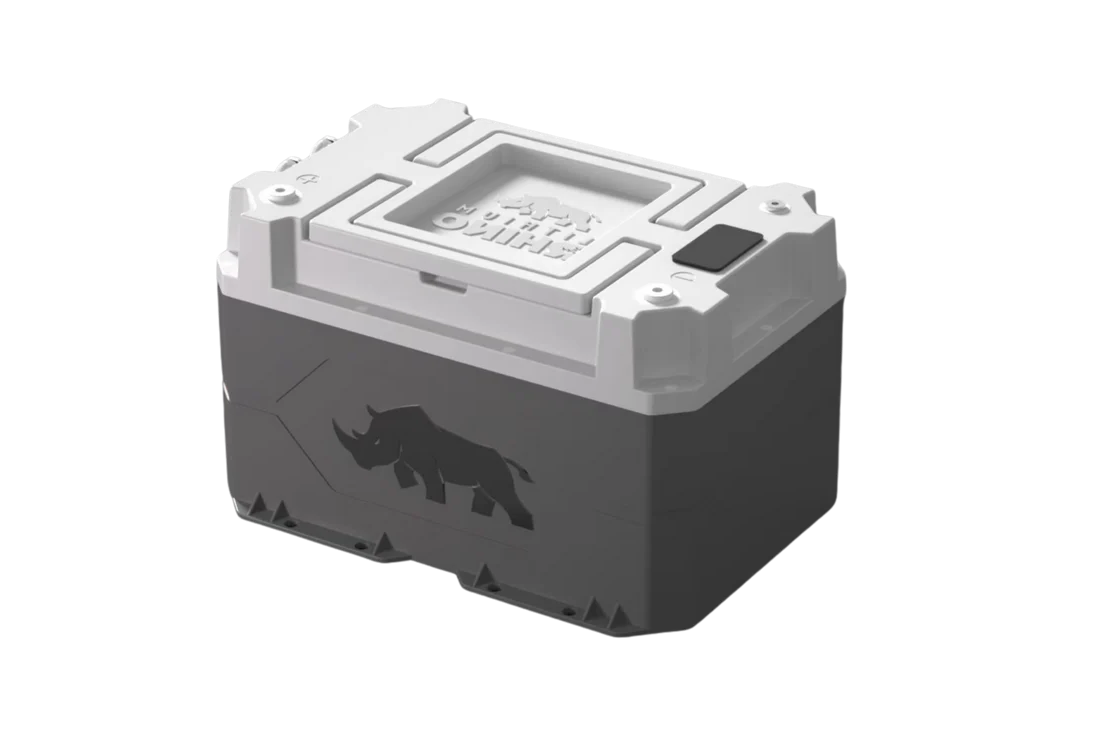
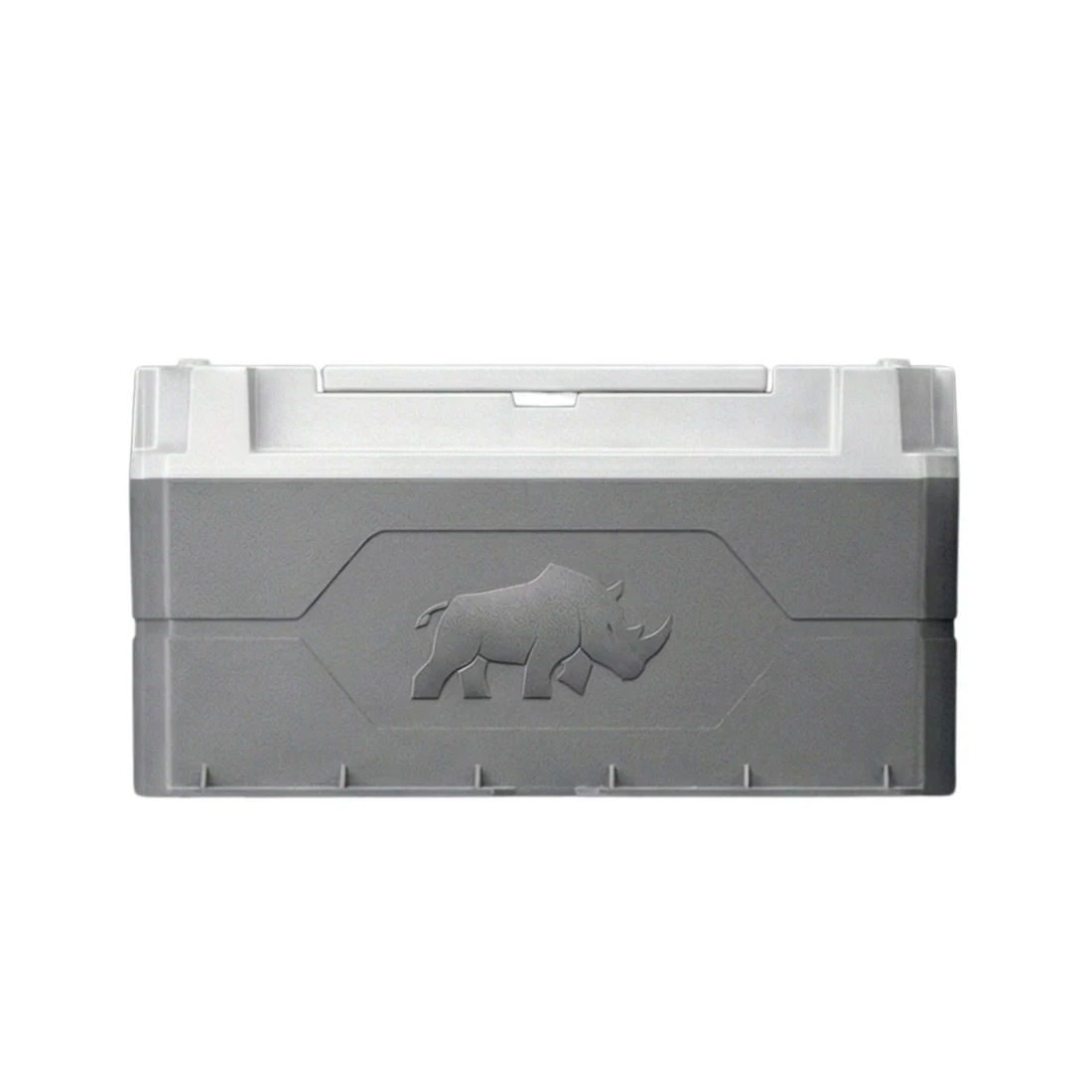
One 24V battery in place of two. The Lithium Rhino 24V 100Ah Marine Battery Kit replaces a heavy pair of 12V lead-acid or AGM batteries with a single 25.6V LiFePO4 pack, so you get all-day trolling power at roughly a third of the weight and none of the maintenance.
The Lithium Rhino 24V 100Ah Marine LiFePO4 Battery Kit is a 25.6V lithium iron phosphate battery built for 24V trolling motors, made by Lithium Rhino and available from Lithium Battery Supply, an authorized Lithium Rhino dealer. Every kit includes the battery, a 15A waterproof charger, a console gauge, an external power button, an on-battery color display, mounting hardware and the free Rhino app, and it is backed by an 8-year full-replacement warranty.
A traditional 24V trolling setup ties two 12V batteries together with a series jumper. That is well over 100 pounds sitting on your bow, four terminals to corrode, and a jumper cable to fail. This kit does the same job with one sealed 45.4 lb battery, one clean set of terminals, and no jumper. Less weight on the bow means better trim and easier access, and it frees up space for tackle and electronics.
Inside is lithium iron phosphate chemistry, the same reason your motor keeps its speed all day. LiFePO4 holds a steady voltage through almost the entire discharge, so your trolling motor pulls hard from the first cast to the last instead of slowly fading the way lead-acid does. You get 100Ah and 2,560Wh of energy, a 150A smart BMS watching every cell, and IP67 sealing built for spray, rain, dust and the pounding of rough water.
Who it's for
Anglers and boaters running a 24V trolling motor usually 55 to 80 lb thrust, who want to trade a heavy two-battery lead-acid setup for one lighter battery, hold steady power through a full day, and be done with acid, watering and corroded terminals. It suits bass boats, aluminum and multi-species boats, bay boats, skiffs and pontoons rigged with a 24V bow-mount motor.
What changes on the water
You take roughly 60 or more pounds off the bow, which helps the boat sit and run better. Your trolling motor keeps its speed from the first spot to the last instead of slowing down in the afternoon, so spot-lock and shoreline fishing stay strong late in the day. And you stop planning trips around a fading battery charge it overnight on the included charger and it's ready the next morning.
What makes it a strong upgrade
One-battery 24V design, no series jumper, fewer terminals, simpler install than two 12V batteries.
2,560Wh of usable lithium power, full-day runtime for most anglers who mix cruising, spot-lock and shoreline fishing.
150A continuous BMS, plenty of headroom for common 24V motors, with built-in over-current, short-circuit, temperature and voltage protection.
IP67 marine sealing, protected against dust and temporary water immersion.
Complete kit, 15A waterproof charger, console gauge, external power button, on-battery color display and the free Rhino app, all included.
8-year warranty and US-based support, full-replacement coverage on the cells, BMS and electronics.
Before you order: confirm your trolling motor is a true 24V model, and measure your battery compartment against the dimensions in the Specifications tab. This is a purpose-built 24V pack, not a drop-in Group 27 or 31 replacement, and it is not series-connectable, so it cannot be combined into a 36V or 48V bank.
Why Lithium Rhino
There are cheaper 24V lithium batteries and there are bare batteries sold without a charger. Lithium Rhino sits in a different spot: a complete, marine-focused kit with the discharge headroom, sealing and support that hold up to real fishing use. Here's what stands behind it.
Discharge headroom that fits high-thrust motors
The 150A continuous BMS, with a 500A peak, gives more current headroom than many competing 24V 100Ah batteries that top out around 100A. That matters during spot-lock bursts and when a bigger 24V motor loads up against wind and current.
Built and sealed for the marine environment
An IP67 rating protects against dust and temporary water immersion — a step above the IP65 rating found on many competitors. The dual-layer ABS shell is made to take spray, vibration and the pounding of rough water.
A complete kit, not just a battery
The 15A waterproof charger, console gauge, external power button, on-battery color display and free Rhino app are all in the box. You can read state of charge three ways on the battery, at the helm, or on your phone which matters with lithium because voltage stays flat and a simple gauge can't tell you much on its own.
8-year warranty and US-based support
The battery is rated for 6,000+ cycles and a 10+ year life expectancy, and it's backed by an 8-year full-replacement warranty on the cells, BMS and electronics. As an authorized Lithium Rhino dealer, Lithium Battery Supply can help you with sizing, setup and any warranty claim directly.
Compatibility
This battery suits trolling motors built for a nominal 24V system, which generally means motors in the 55–80 lb thrust range on boats up to about 20 feet. Compatibility comes down to voltage and current draw, not the brand on the cowling, so always check the label on your exact motor before ordering.
Common 24V trolling motors
Minn Kota: 24V versions of Edge 70, PowerDrive 70, Terrova 55/80, Riptide Terrova, Riptide PowerDrive and Ultrex.
MotorGuide: 24V versions of X3-70, Xi5 80 and Tour / Tour Pro.
Garmin Force, Lowrance Ghost and Ghost X, Rhodan HD: these are offered in both 24V and 36V. This battery fits only the 24V configuration and cannot be paired for 36V.
Newport Vessels and Haswing: 24V models such as the Newport NV Series and Haswing Cayman and Protruar. Confirm your model's voltage and amp draw before connecting.
Voltage matters most. Many motor families ship in 12V, 24V and 36V versions that look identical. Read the voltage on the motor label or in the owner's manual, and follow the motor maker's wire-gauge and circuit-breaker chart for your model.
Boat types it fits
Bass boats, aluminum and multi-species boats, walleye boats, jon boats, flats boats and skiffs, bay boats and pontoons, anything running a 24V bow-mount trolling motor with room to mount the battery securely. Physical fit depends on your compartment dimensions, so measure before buying.
Boats commonly running 24V trolling motors
If you fish a Ranger, Skeeter, Nitro, Tracker, Bass Cat, Phoenix, Caymas, Triton, Vexus, Lund, Crestliner, Alumacraft, G3, Xpress, SeaArk, Lowe, War Eagle, Blazer, Falcon, Sea Hunt, Sportsman, Pathfinder, Hewes, Maverick or Carolina Skiff, among many others, there's a good chance it's set up for a 24V bow-mount motor that this battery can run. The battery isn't tied to any one boat brand; what matters is that your motor is 24V and the battery fits your compartment.
Boat and motor brand names describe compatible applications only. Lithium Rhino is not affiliated with, or endorsed by, these manufacturers, and compatibility should be verified for your specific boat, motor, wiring and charger.
Runtime
Runtime depends on how hard you push the motor. The rule is simple: divide capacity by your average current draw. The battery is rated for 240 minutes of reserve at a steady 25A draw, and the table below extends that to other loads. These are continuous-draw estimates under ideal conditions wind, current, boat weight, weeds and heavy spot-lock use will shorten them.
Average draw
Estimated runtime
Typical use
5A
~20 hours
Low-speed positioning in calm water
10A
~10 hours
Easy cruising, light corrections
15A
~6.5 hours
Moderate mixed use
25A
4 hours
Steady moderate load (rated reserve)
40A
~2.5 hours
Higher speed or active spot-lock
50A
~2 hours
Near-full load on many 24V motors
Will it last all day? For most anglers, yes. When the motor is used the normal way positioning, drift correction, shoreline fishing and spot-lock rather than wide-open running, a full day on the water is realistic. If you routinely run near full throttle in wind or current, estimate from your motor's maximum amp draw and consider whether a higher-capacity 24V battery fits your style better. Leaving roughly 20% in the tank rather than draining to empty also helps the battery reach its full cycle life.
Lithium vs AGM
The usual 24V trolling setup is two 12V AGM or lead-acid batteries wired in series. Here's how one Lithium Rhino compares to that traditional pair.
Feature
Lithium Rhino 24V 100Ah LiFePO4
Two 12V 100Ah AGM in series
System design
One integrated 24V battery
Two batteries plus a series jumper
Weight
~45.4 lbs
Often 120–150+ lbs combined
Usable capacity
Deep, regular discharge without harm
Typically limited to about 50% to protect life
Voltage under load
Stays flat, so speed holds all day
Sags as it drains, so the motor slows
Cycle life
6,000+ cycles
Usually a few hundred deep cycles
Charge time
~400 min at 15A
Often much longer, and slows near full
Maintenance
None; no watering or acid
Sealed, but heavier and prone to sulfation if left discharged
Connections
One positive, one negative
Four terminals plus a jumper cable
Monitoring
On-battery display, console gauge and app
Usually needs a separate meter
The short version: one lighter battery, more usable energy, steadier speed and far more cycles, with three built-in ways to see exactly where your charge stands.
Specifications
Specification
Value
Nominal voltage
25.6V
Working voltage
21.6V – 29.2V
Nominal capacity
100Ah
Energy
2,560Wh
Recommended depth of discharge
80%
Reserve at 25A
240 minutes (4 hours)
Cell chemistry
Lithium iron phosphate (LiFePO4)
Cell type / configuration
Prismatic, 1P8S (8 cells)
Max continuous discharge
150A
Peak discharge
500A
Recommended charge current
15A
Max charge current
50A
Charge time (15A charger)
~400 minutes from near empty
Discharge temperature range
-4°F to 131°F (-20°C to 55°C)
IP rating
IP67
Dimensions (L x W x H)
14.65 x 10.51 x 8.70 in
Weight
~45.4 lbs
Terminal type
M8 female
Shell
ABS plastic
Series connectable
No
Bluetooth / app monitoring
Yes (iOS & Android)
On-unit display & console gauge
Yes
BMS protections
Over-voltage, under-voltage, cell over-temp, BMS over-temp, over-current, short circuit, cell balancing
Certification
UN38.3
Shipping classification
UN3480
Warranty
8 years, full replacement (with registration)
What's in the kit
Lithium Rhino 24V 100Ah IP67 marine LiFePO4 battery
15A waterproof 24V LiFePO4 charger
Full-color round console state-of-charge gauge
External console power button
Full-color display built into the battery
Mounting hardware
Free Rhino app access over Bluetooth (iOS and Android)
Installation & Charging
Installing the battery
Confirm the motor is 24V. Read the voltage on the motor label never assume it from thrust or model name, since many families come in more than one voltage.
Measure your compartment. Allow for the 14.65 x 10.51 x 8.70 in body plus room for terminals, cable bends and access to the display.
Remove the old bank. Kill shore power and all loads first, and photograph the wiring before you disconnect. The old series jumper between two 12V batteries is not used here.
Mount it securely. Use the included hardware or a marine tray that stops the battery from sliding or tipping in rough water.
Add circuit protection. Fit the breaker or fuse your motor maker specifies, as close to the positive terminal as practical. The internal BMS is not a substitute for a main breaker.
Use the right cable. Tinned marine cable sized for your motor's current and run length, with correctly sized M8 lugs torqued to spec.
Wire the gauge and button, then test. Route the low-voltage display wiring away from heat and sharp edges, then check polarity, torque, breaker and charger behavior before launch. Compare the app reading to the console gauge.
Get a pro to install it if your boat wiring is undocumented, corroded or undersized, if you're replacing an onboard charger, or if the compartment needs modifying.
Charging
Use the included 15A waterproof LiFePO4 charger, it's matched to the battery and is the simplest correct option. If you use a different charger, it must be a 24V LiFePO4 profile that stays within the 29.2V limit.
Do not use a 12V charger, it cannot charge a 24V battery.
A two-bank 12V lead-acid onboard charger is generally not right for a single 24V battery unless its maker specifically supports that setup.
Turn off any equalization or desulfation modes, which are for lead-acid and can apply the wrong voltage.
Don't wire the battery straight to an outboard alternator, use a proper DC-to-DC charger designed for LiFePO4.
Care and storage
Charge only with the included or another approved LiFePO4 charger.
Don't store it fully drained; leave a partial charge and switch off loads.
Keep it out of standing bilge water even though it's IP67 sealed.
Check terminal tightness, cables and mounting periodically.
Store in a dry, temperature-controlled spot for the off-season.
Don't charge in freezing conditions unless the manual permits it the published temperature range covers discharge, so confirm the cold-charge limit before winter use.
FAQ
Is this a true 24V battery?
Yes. It's a native 25.6V LiFePO4 battery built from eight cells in series, so it supplies a complete 24V system from one enclosure, no pairing required.
Can it replace two 12V batteries wired in series?
Yes, in most 24V trolling-motor installs. The motor has to be a 24V model, and your wiring, breaker, charger and compartment need to be compatible. You'll remove the old series jumper, since this is already a complete 24V battery.
What size trolling motor is it for?
It's built for 24V trolling motors, which are usually in the 55–80 lb thrust range on boats up to about 20 feet. Confirm your motor's voltage on its label before ordering.
Will it work with my Minn Kota, MotorGuide, Garmin or Lowrance motor?
Yes, when that motor is set up as a 24V system for example a 24V Minn Kota Terrova, Ultrex or PowerDrive, a 24V MotorGuide Xi5, or a Garmin Force or Lowrance Ghost in 24V configuration. Check the label and follow the motor maker's breaker and wire-size guidance.
Will it power a 36V trolling motor?
No. This is a 24V battery and it isn't series-connectable, so it can't build a 36V system. Choose a dedicated 36V battery for a 36V motor.
Can I connect two in series for 36V or 48V?
No. The manufacturer specification states this battery is not series-connectable.
Can I connect two in parallel for more capacity?
The spec sheet confirms series connection is not allowed and does not list parallel operation. Don't parallel these unless Lithium Rhino approves your exact setup, so reach out to us first if that's your plan.
How long will it run my trolling motor?
It depends on your average draw. The battery is rated for 4 hours at a steady 25A. A motor averaging 10A can run around 10 hours, while a continuous 50A load runs closer to 2 hours. Normal mixed fishing use lasts far longer than steady full throttle.
How much does it weigh?
About 45.4 lbs roughly a third of a comparable two-battery lead-acid 24V bank.
What are the dimensions, and will it fit a Group 27 or 31 box?
It measures 14.65 x 10.51 x 8.70 in. It's a purpose-built 24V pack, so measure your compartment rather than assuming it drops into a standard lead-acid group tray.
Is it waterproof?
It's rated IP67, meaning it's sealed against dust and temporary water immersion. Still mount it above standing bilge water and don't leave it submerged.
Does it come with a charger?
Yes, a 15A waterproof LiFePO4 charger is included, so you don't need to buy one separately.
Can I use my existing onboard charger?
Only if it offers a true 24V LiFePO4 profile. Many two-bank 12V lead-acid onboard chargers are not suitable for a single 24V battery, so check with the charger maker before using one.
Can I charge it while underway or from my outboard?
Not with the included charger, which runs on AC shore power, and never wired straight to the outboard. To charge underway you add a step-up 12V-to-24V DC-to-DC charger between your engine's charging system and the battery. That's needed because the battery is 24V while most outboards charge at 12V, and because connecting lithium directly to an alternator can damage it. Keep the charge rate within the battery's limits and confirm the setup with your outboard maker and with Lithium Rhino, since onboard charging isn't documented for this battery.
How long does charging take?
About 400 minutes from near empty with the included 15A charger. Partial recharges take proportionally less time.
Does it have Bluetooth and an app?
Yes. Built-in Bluetooth connects to the free Rhino app for iOS and Android, showing live state of charge, per-cell voltage and temperature, fault alerts and cycle history. No subscription.
What's the maximum continuous discharge?
150A continuous, with a 500A peak. That's ample headroom for common 24V trolling motors.
What size breaker or fuse do I need?
Use the size your trolling-motor maker specifies for your exact model and cable run. Don't size the breaker from the battery's 150A BMS rating alone.
Can it power my fish finder and electronics?
Most fish finders run on 12V, not 24V, so you'd need a properly rated 24V-to-12V converter to run them from this battery. Many anglers keep a separate 12V battery for electronics, especially power-hungry live sonar.
Can it start an outboard engine?
No, this is a deep-cycle trolling-motor battery, not a cranking battery. Don't use it to start an engine.
Can I charge it below freezing?
The published range covers discharge (-4°F to 131°F) but not charging. As with most LiFePO4 batteries, avoid charging below freezing unless the manual specifically allows it.
Can I use it in saltwater?
Yes, it's built for marine use including saltwater. Use tinned marine cable, protect the terminals from corrosion, and rinse salt off surrounding gear without spraying the connections directly.
What warranty does it have?
An 8-year full-replacement warranty covering the cells, BMS and built-in electronics, plus US-based support. Register your kit after install to lock in coverage. Read our Warranty Tab
How many years or charge cycles will it last?
It's rated for 6,000+ charge cycles and a 10+ year life expectancy, well over a decade of typical seasonal fishing use, compared with the two to three seasons common for lead-acid.
Does it ship charged and ready to use?
Lithium batteries ship at a partial state of charge for safe transport. Top it off with the included charger before your first trip so you start with a full battery.
Do I need to buy a battery box or tray?
You need a way to secure it against movement. Mounting hardware is included, but many anglers also use a marine tray or strap sized to the battery's 14.65 x 10.51 x 8.70 in body. It doesn't require a vented box the way lead-acid does, since it doesn't off-gas.
Which way can I mount it?
Mount it upright and secured. Confirm any alternate orientation in the manufacturer manual before installing it on its side, and keep the terminals accessible and protected either way.
Does it need any maintenance?
No watering and no acid to check. Just inspect the terminals, cables, breaker and mounting from time to time, keep it charged over the off-season, and use the app to keep an eye on cell health.